
Uncategorized
Retatrutide Research Peptide: Clinical Evidence, Online Reports and Laboratory Context

Oct
A trial result and a biohacker’s account are not equivalent evidence. The Retatrutide research peptide is attracting attention in clinical literature and online forums, but these sources answer different questions. In the Phase 3 TRIUMPH-1 study, participants without diabetes receiving the 12 mg trial dose recorded mean weight reduction of 28.3% at 80 weeks. This finding describes a monitored clinical study, not a basis for personal use.
Interest in reported experiences is understandable, particularly where posts describe perceived effects or adverse experiences. Yet accounts in online biohacker discussions are anecdotal and cannot establish safety, efficacy or product identity. Retatrutide remains investigational, and online reports must not be confused with an approved medicine or used to guide personal use.
This article distinguishes human-trial findings from online reports, then outlines the compound’s triple-receptor research context and the limits of laboratory-only material. NH Peptides supplies Retatrutide for laboratory research only, not for human use, consumption, diagnosis or treatment. Assess each type of evidence on its own terms.
Key Takeaways
- Assess clinical findings by checking the study population, design and measured outcomes before drawing conclusions.
- The Retatrutide research peptide is studied for activity at GLP-1, GIP and glucagon receptors. Its mechanism differs from single- and dual-receptor approaches.
- Biohacker posts can show what people are discussing, but personal accounts cannot establish efficacy, safety or the identity of a substance.
- Separate peer-reviewed research from press coverage, commercial claims and online commentary when weighing evidence.
- NH Peptides supplies Retatrutide for laboratory research only. It is not for human use, consumption, diagnosis or treatment.
What is Retatrutide, and why is it being studied?
Retatrutide is an investigational peptide studied in human clinical research for its effects on metabolic processes. Also identified by the development code LY3437943, it is described as a triple-receptor agonist: it activates three receptor systems involved in regulating metabolism, rather than acting on one or two alone.
How is Retatrutide described in research?
The three targets are the glucagon-like peptide-1 (GLP-1), glucose-dependent insulinotropic polypeptide (GIP) and glucagon receptors. An agonist binds to a receptor and activates it. In research descriptions, Retatrutide’s activity at GLP-1 and GIP receptors is associated with pathways involved in satiety, digestion and insulin secretion. Glucagon-receptor activity is being investigated for its role in energy expenditure and fat metabolism. These are proposed mechanisms, not guarantees of individual effects.
“Triple agonist” identifies the receptor targets; it does not describe clinical benefit or establish how a compound will perform in a particular population. Researchers assess those questions through defined protocols and measured endpoints. The Retatrutide Wikipedia article offers a broad overview of the compound and its development, but study findings are best interpreted through the underlying clinical publications.
Why distinguish clinical studies from research-peptide supply?
Clinical trials involve human participants enrolled under a research protocol. Researchers specify the population, intervention, comparison groups, monitoring and outcome measures. Findings apply to the compound as studied under those conditions. They do not establish that a separately supplied laboratory product has the same identity, composition or evidence base.
A Retatrutide research peptide supplied for laboratory studies belongs to a different context. It is research material, not a treatment or clinical-use product. Clinical trial results cannot be used to infer that laboratory material is suitable for human use, nor do they make a research product an approved medicine.
NH Peptides supplies Retatrutide for laboratory research. Its products are not for human use, consumption, medical diagnosis or therapeutic treatment. This distinction is fundamental: human research concerns participants in controlled studies, while laboratory supply is intended for scientific research outside that clinical setting.
Retatrutide is being studied because its three receptor targets raise a specific research question: how does combined activity across GLP-1, GIP and glucagon pathways affect measured metabolic outcomes? The answer depends on evidence from clinical studies and other defined research, not on the compound’s name or receptor profile alone. Keep the investigational compound, clinical evidence and laboratory material distinct so each can be assessed on its own terms.
What have human clinical studies investigated?
Human studies have examined Retatrutide in adults with obesity, including people with type 2 diabetes. Key questions include how body weight changes during treatment, whether results differ between studied populations, and what adverse events are recorded. These are research questions, not treatment recommendations.
Which research questions and outcomes are relevant?
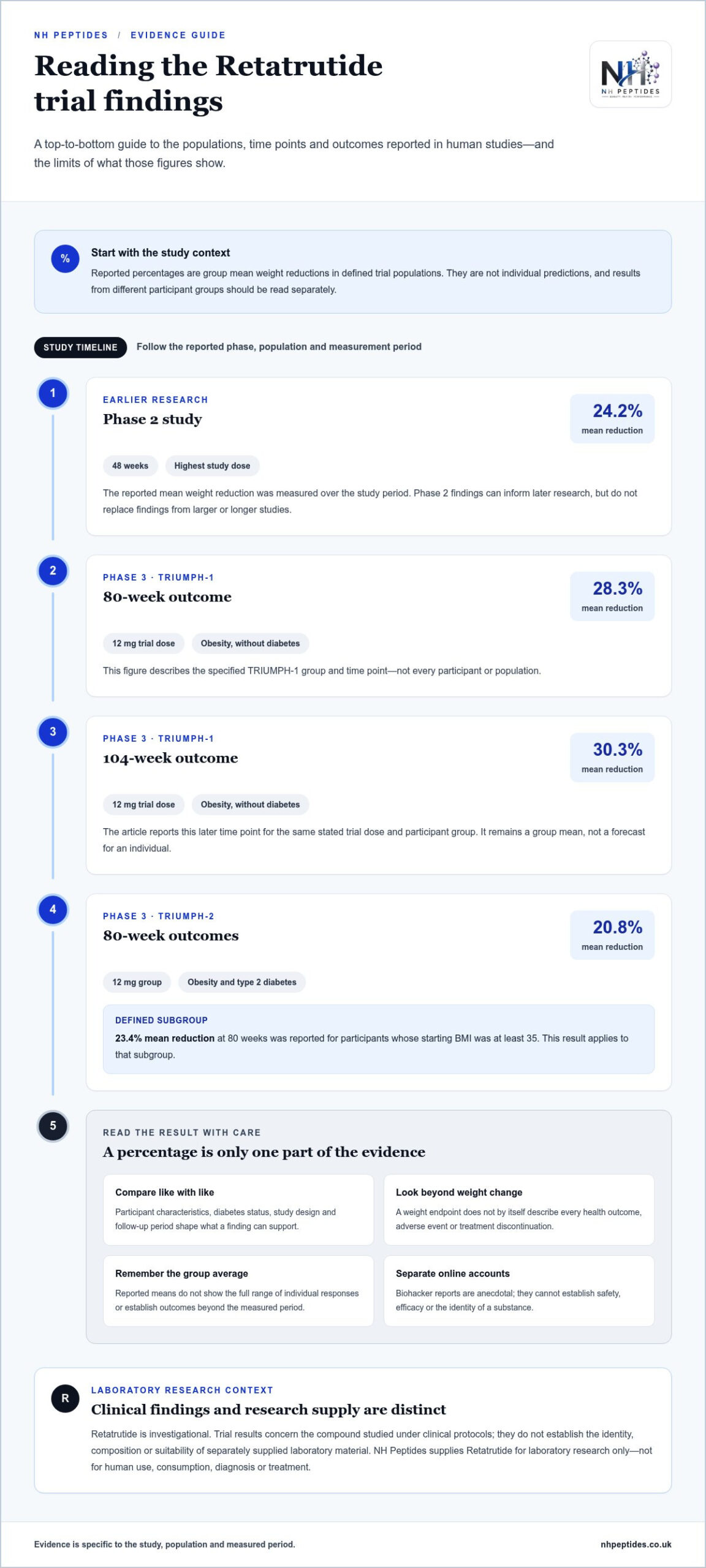
Phase 3 trials TRIUMPH-1 and TRIUMPH-2 assessed weight change over defined study periods in different participant groups. In TRIUMPH-1, participants with obesity and without diabetes receiving the trial’s 12 mg dose had mean weight reduction of 28.3% at 80 weeks and 30.3% at 104 weeks. In TRIUMPH-2, which studied participants with obesity and type 2 diabetes, mean weight reduction in the 12 mg group was 20.8% at 80 weeks. These figures refer to trial populations and specified time points.
Weight change is an endpoint, a measurement selected to assess a study question. It does not, on its own, describe every health outcome or predict an individual result. TRIUMPH-2 also reported a 23.4% mean reduction at 80 weeks in participants whose starting BMI was at least 35. This subgroup result applies to that defined group, not to all participants or populations.
How should readers interpret trial findings?
Study design and population matter. TRIUMPH-1 and TRIUMPH-2 were controlled clinical trials, but their participant groups differed, including by diabetes status. Read their results separately rather than treating them as directly interchangeable. The reported percentages are group averages. They do not show the range of individual responses or establish outcomes beyond the measured study periods.
An earlier Phase 2 study reported mean weight reduction of 24.2% over 48 weeks in participants receiving the highest study dose. Phase 2 findings can inform later research, but they are not a substitute for results from larger or longer studies. Across these reports, the endpoint, follow-up period, participant characteristics and trial design define what a result can support.
Separate reported findings from conclusions. A change in body weight is not, by itself, proof of broader benefit, long-term safety or suitability for people outside the enrolled population. Adverse events and treatment discontinuations form part of the evidence and should be considered alongside efficacy endpoints. Press coverage may simplify these details, so the publication and its methods remain central to interpretation.
These clinical findings concern Retatrutide studied under trial protocols. They do not establish the composition or suitability of a separately supplied Retatrutide research peptide. NH Peptides supplies research material for laboratory studies only, not for human use, consumption, diagnosis or treatment. For the laboratory-only product context, view NH Peptides research peptides.
How do biohacker reports compare with clinical evidence?
Online biohacker commentary and clinical research answer different questions. Clinical trials use defined eligibility criteria, protocols and outcome measures. Forum posts are personal accounts, usually without standardised measurement or independent verification. Laboratory research adds another evidence type: it can examine a compound or biological process under specified experimental conditions, but it cannot establish what happens in people.
What can individual reports tell readers?
Public discussions show what people claim to have experienced and which concerns are being raised. For example, Reddit discussions mentioning Retatrutide are anecdotal commentary, not clinical evidence. Posts may describe perceived changes or adverse experiences, but readers generally cannot verify the substance, its identity, the circumstances or other factors that might have influenced the account.
Selection and reporting biases matter too. People who post may not represent everyone with an experience, and accounts can omit relevant context. These limitations do not prove that every post is inaccurate. They mean an individual report cannot establish causation, safety, efficacy or product quality. It should not be treated as a direction or recommendation for use.
What does a fair evidence comparison look like?
Compare each source by its method and purpose, not by how certain its wording sounds. Peer review can assess a study’s methods and reporting, but it does not remove every limitation. Commercial statements and personal commentary are not substitutes for a published trial. The table summarises what each evidence type can contribute and what it cannot establish.
| Evidence type | What it can show | Limitations |
|---|---|---|
| Human clinical study | Measured outcomes in a defined participant group under a specified protocol. | Findings are bounded by the population, design, endpoints and follow-up period. |
| Laboratory research | Experimental observations under controlled laboratory conditions. | Laboratory results alone do not establish human outcomes or clinical suitability. |
| Biohacker commentary | What individuals publicly report or discuss in online forums. | Reports are not standardised or independently verified and cannot establish cause or effect. |
Keep source categories distinct. A claim in a forum is not a trial result, and a laboratory observation is not a report of human efficacy. Even when an online account appears consistent with a published finding, that resemblance does not verify the person’s experience or the material involved. Read Retatrutide research peptide discussions as commentary, separate from clinical publications and laboratory data.
NH Peptides’ Retatrutide is supplied for laboratory research only. It is not for human use, consumption, medical diagnosis or therapeutic treatment. Online anecdotes do not change that product boundary or establish the identity or quality of any research material.
How should Retatrutide research evidence be assessed?
A structured appraisal helps separate what a study measured from what a summary or commentary claims it means. Apply the same checks to clinical publications, press coverage, commercial statements and online discussion. Their formats and purposes differ, so they should not be treated as equivalent evidence.
Which details matter when reading a study?
Start with the publication and research question. Identify the study design, participant population, measured endpoints and follow-up period. Then read the stated limitations. These details define the scope of the result. A finding in a specific group over a stated timeframe cannot establish an individual response or support conclusions beyond the outcomes actually measured.
- Source: Locate the original paper or registered study record. Identify whether a statement comes from peer-reviewed research, a press release, a commercial page or personal commentary.
- Design: Check how the study was structured, including whether there was a comparison group and how outcomes were measured.
- Population: Note who was included and any eligibility criteria that limit how broadly findings can be applied.
- Endpoints: Distinguish the outcomes specified for measurement from broader claims about benefit or risk.
- Limitations: Review the authors’ discussion of uncertainty, study duration and other constraints before drawing conclusions.
An experimental result describes what was observed under defined research conditions; it is not clinical guidance for an individual.
How can readers separate evidence from interpretation?
Compare a paper’s reported methods and results with the wording used in summaries. A summary may be useful, but watch for claims that extend beyond the measured endpoint, population or timeframe. Statements about expected personal effects, safety or suitability require evidence that the original study may not have assessed.
Keep peer-reviewed publications distinct from press coverage and commercial statements. Peer review provides scrutiny of a manuscript, not proof that every conclusion is definitive. Commercial descriptions may serve a different purpose, while personal commentary records individual claims rather than controlled observations. Biohacker posts should remain clearly labelled as anecdotal, even when they refer to clinical findings.
Documentation has a separate role. Research records can describe a study or a laboratory material, but a document about a supplied Retatrutide research peptide does not make clinical findings transferable to that material. When reviewing documentation, identify what it covers, which material or study it refers to, and what conclusions it can support. Do not treat a laboratory document as clinical evidence.
NH Peptides supplies Retatrutide for laboratory research only. It is not for human use, consumption, medical diagnosis or therapeutic treatment. For information on the laboratory research peptide offering, view NH Peptides Retatrutide research material. For a structured way to assess lot-specific records, see the research peptide quality documentation guide.
What is the laboratory context for a Retatrutide research peptide?
NH Peptides supplies Retatrutide as a research peptide for laboratory studies. This supply context is separate from human clinical research, where an investigational compound is examined in participants under defined study protocols. Published clinical findings concern the compound studied in those trials. They do not establish the identity, composition or suitability of separately supplied laboratory material.
What does laboratory-only supply mean?
Laboratory-only supply means the material is intended for scientific studies, not for use as a medicine or personal experimentation. NH Peptides products are not for human use, consumption, medical diagnosis or therapeutic treatment. No clinical finding changes this boundary. Human-study results cannot be taken as evidence that a laboratory product is suitable for people, nor do they provide instructions for handling it in a clinical setting.
The distinction matters when reading product descriptions alongside trial reports. A clinical publication describes a study’s methods, participants and measured outcomes. A laboratory product listing identifies research material supplied for scientific study. These are different types of information with different purposes. Neither should imply that supplied material is the same as a trial intervention or that trial results apply to it.
Laboratory studies may examine defined research questions under specified experimental conditions. Their findings remain bounded by those conditions. They do not, by themselves, establish human safety, efficacy or treatment value. Likewise, an online report about personal experience cannot verify the identity or quality of laboratory material. Keep these evidence categories separate to avoid extending claims beyond what the relevant source establishes.
Where can readers find related research information?
For broader category context, readers can review NH Peptides’ Research Peptides range. Documentation has a separate role: records may describe particular attributes or analytical results, but the category name alone does not describe the contents of a specific document. Consider what a record identifies, the material or study it covers, and the limits of its results. This context does not replace evaluation of published clinical research.
When assessing a statement, identify whether it concerns a human trial, a laboratory experiment, product documentation or personal commentary. Then keep its conclusion within that source’s scope. A reported clinical outcome is not a product specification; a laboratory result is not clinical guidance; and a product listing is not evidence of human suitability.
NH Peptides’ Retatrutide is supplied for laboratory research only. Researchers seeking category-level context can review the Research Peptides range and assess related information according to its stated purpose.
Apply the evidence boundary to your next research step
Use the distinction between clinical evidence and laboratory supply as a practical filter when evaluating Retatrutide material. The Retatrutide research peptide belongs in a defined scientific research context; online discussion or published human findings cannot establish the characteristics of a separate laboratory product. Tie your assessment to the source, its purpose and the question your research is designed to address.
NH Peptides is a UK-based supplier of research peptides, including Retatrutide, for laboratory studies. Products are not for human use, consumption, diagnosis or treatment. Researchers seeking category context can view NH Peptides’ research peptide range.
Careful distinctions support clearer interpretation and more disciplined research planning. Continue with evidence relevant to your specific scientific question.
Frequently Asked Questions
Is Retatrutide approved for medical use in the UK?
Retatrutide is investigational; the research information summarised here does not establish UK marketing authorisation. Clinical-trial activity is distinct from authorisation by the Medicines and Healthcare products Regulatory Agency (MHRA). As regulatory status can change, consult current MHRA information before relying on a status claim. NH Peptides’ research peptide is supplied for laboratory studies, not as an approved treatment or a product suitable for patients.
What does Retatrutide target?
Scientific research describes Retatrutide as activating GLP-1, GIP and glucagon receptors. These are cellular targets associated with signalling by three different hormones. The term “agonist” means a substance activates a receptor. This mechanism describes a research focus, not a predicted response in any person. Receptor activity also cannot establish that a particular laboratory material is appropriate for human use.
Is Retatrutide the same as a GLP-1 medicine?
No. Retatrutide is investigated for activity at three receptor targets, including GLP-1, while the phrase “GLP-1 medicine” may refer to compounds with different target profiles. Shared activity at one receptor does not make substances interchangeable or establish the same evidence, status or effects. Compare the exact compound and its primary research sources. Do not infer suitability or make treatment decisions from a broad category label.
Can a research peptide be used by humans?
No. NH Peptides’ products are strictly not for human use, consumption, medical diagnosis or therapeutic treatment. Laboratory research supply is distinct from a human clinical study, which involves participants enrolled under a defined research protocol. The Retatrutide research peptide supplied by NH Peptides is not a clinical-use product. Clinical findings about an investigational compound do not change the intended context of supplied laboratory material.
Are biohacker reports reliable evidence about Retatrutide?
Biohacker reports are personal accounts, not controlled evidence. They cannot establish that Retatrutide caused a reported change or verify safety, efficacy or the identity of a substance. Public discussions, such as Reddit posts mentioning Retatrutide, are anecdotal commentary only. Treat each account as an unverified report, not a recommendation or evidence about NH Peptides products.
What is the difference between Retatrutide clinical research and laboratory research?
Clinical research studies human participants under a protocol with defined eligibility criteria, measurements and oversight. Laboratory research examines questions using scientific methods outside that human-participant setting. The findings and materials from these contexts are not interchangeable. NH Peptides supplies Retatrutide for laboratory studies only. Its products are not for human use, consumption, diagnosis or treatment, regardless of findings reported in clinical studies.
How can I check whether a Retatrutide research claim is credible?
Trace the claim to its original source, then check the study design, research question, participant group, endpoints and limitations. Compare a news or commercial summary with the paper’s methods and reported results. A claim about an outcome should match an endpoint measured in the stated population and timeframe. Personal posts are commentary, not primary research, and no single result establishes clinical suitability for laboratory material. For laboratory research product information, view NH Peptides’ research peptide range.

Pingback: UK Research Peptide Supplier Comparison | NH Peptides
Pingback: Retatrutide Laboratory Studies: How to Interpret the Evidence