
Uncategorized
Retatrutide Certificate of Analysis: A Research Checklist

Oct
A Retatrutide certificate of analysis can document test results for a stated lot, but it cannot establish that the material is safe or effective in people. For researchers, the key checks are whether the document matches the lot under review and whether its methods and results support the claims it makes about identity and purity.
Published human research and laboratory documentation answer different questions. Clinical-trial reports, including findings from TRIUMPH-1 and TRANSCEND-T2D-1, describe results under defined study conditions; they do not verify a separate research lot. Online biohacker feedback about Retatrutide consists of anecdotal accounts, not clinical evidence or product testing. Such feedback does not indicate that research compounds are for human use.
This checklist covers how to match a COA to a lot, interpret identity and purity results, and record what the document leaves unproven. It also distinguishes analytical records from published human research and personal reports, so each source is read within its proper evidential limits.
Key Takeaways
- Use the Retatrutide certificate of analysis to record the stated analytical results for an identified material and lot.
- Match the compound name and lot identifier before assessing the test entries.
- Read identity and purity as separate analytical findings, and note the methods reported.
- Keep COA records separate from published clinical findings and anecdotal online feedback.
- Use the checklist to define what a COA supports. It is not evidence of human safety, efficacy or individual outcomes.
What a Retatrutide certificate of analysis establishes
A certificate of analysis (COA) records specified analytical testing for a material or identified lot. It presents the tests and results stated in the document. Its value depends on whether it can be linked to the material being reviewed and whether the methods and results are clear enough to interpret.
Three elements serve different purposes in research records: the compound name identifies what the material is claimed to be; the lot identifier links the document to a particular batch; and the results state what was measured using the described tests. A Retatrutide certificate of analysis can support review of those documented attributes. It should not be treated as evidence that every lot has the same results.
A product description may name a compound or explain its research context. A general quality statement is a claim, not test results for a specific lot. A published human research paper reports findings from a defined study, with its own participants, procedures and limitations. These documents answer different questions and cannot replace one another.
COA, lot record and product description: distinct documents
A lot-specific record should identify both the material and the lot to which its results apply. The compound name alone is not enough to establish a match: a document labelled “Retatrutide” does not demonstrate that it corresponds to a particular lot. Compare its lot identifier with the one attached to the material, then retain the matching reference in the research record. General product information may not include this lot-level detail.
What a Retatrutide COA cannot establish
Analytical attributes and biological or clinical outcomes are different types of evidence. A test may report an identity-related or purity-related measurement, but that does not establish biological activity in a study or predict a clinical response. The Retatrutide Wikipedia article outlines the compound’s experimental status and pharmacological context; it is not a lot-specific test record.
Published human clinical research reports outcomes under study-specific conditions. Online biohacker feedback about Retatrutide comprises personal accounts, not controlled clinical evidence or verification of a tested lot. Such accounts may describe perceived experiences, but cannot confirm material identity, establish causation or demonstrate outcomes for others. Research compounds are not for human use, consumption, diagnosis or treatment.
A COA supports review only of the stated analytical results for the material and lot it identifies. It does not establish human safety, efficacy, dosage or therapeutic suitability. It does not authorise human use or medical treatment. Interpret each result within the scope of its stated method and keep it separate from clinical findings and anecdotal reports.
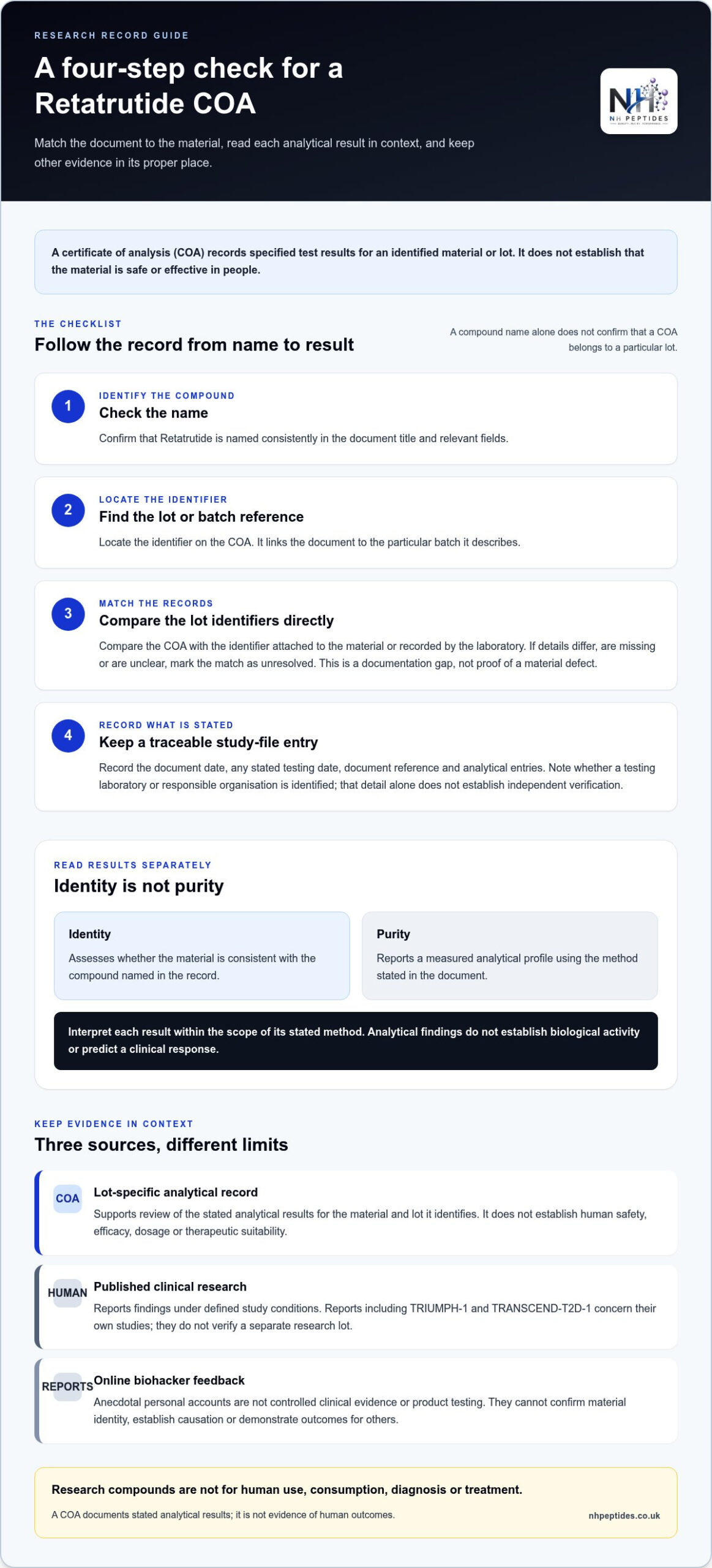
Retatrutide COA checklist: identify the compound and match the lot
When assessing Retatrutide as a laboratory research compound, match the material record to the document before relying on its test entries. NH Peptides supplies Retatrutide for research. Use this sequence to document the material selected for a study:
- Check that Retatrutide is named consistently in the document title and relevant fields.
- Locate the lot or batch identifier on the COA.
- Compare it with the identifier on the corresponding material or laboratory record.
- Record the document date, reference and stated analytical entries in the study file.
This check links the information under review to the specific Retatrutide material. A product name alone does not establish that a document applies to a particular lot. If identifiers differ in spelling, punctuation or suffix, record the discrepancy rather than assuming they refer to the same material.
Confirm compound identity and lot correspondence
Check that the document names Retatrutide consistently, then locate its lot or batch reference. Compare the reference directly with the identifier accompanying the material or recorded by the laboratory. If the identifier is missing, inconsistent or difficult to read, mark the match as unresolved. That is a documentation gap, not proof of a material defect.
Keep the comparison tied to the research material record. A product description can provide general information about a compound, but it cannot replace a lot-level match. Do not infer correspondence from a similar-looking code or the compound name alone.
Check dates, document control and traceability
Record the issue date, any stated testing date and document reference. Note whether a testing laboratory or responsible organisation is identified. These details help distinguish the document from other records, but their presence does not by itself establish independent verification.
In laboratory documentation, retain the COA reference alongside the Retatrutide lot identifier and the record used for comparison. Mark missing or unclear details rather than filling them in by assumption. Matching the lot connects the analytical record to the specific research material and supports traceability in the study file.
NH Peptides supplies Retatrutide for laboratory studies. Researchers can review the Retatrutide research compound in that context. Research compounds are not for human use, consumption, diagnosis or treatment.
How to interpret Retatrutide identity and purity results
Read identity and purity entries as separate findings. Identity testing assesses whether the material is consistent with the compound named in the record; purity testing reports a measured analytical profile using the stated method. Neither tells a reader what human research participants experienced. Clinical findings, including those reported in TRIUMPH-1 and TRANSCEND-T2D-1, describe outcomes within defined study conditions. They are not interpretations of a supplier’s analytical results.
Read human-study results in context, including the population, outcome and study period. For example, TRIUMPH-1 reported an average weight reduction at a specified study time point, whilst TRANSCEND-T2D-1 reported changes in HbA1c and weight in adults with type 2 diabetes. Those findings concern trial data, not the identity or purity of a separate research lot. They do not establish individual outcomes or provide a basis for human use of research compounds.
Identity results and analytical methods
Check the COA’s stated purpose and reported result. Where LC-MS is named, its mass-related data may contribute evidence relevant to identity, but the method name alone is not a conclusion. Where HPLC appears, interpret it according to the record’s description and output. Neither method label establishes what a human study found or predicts a participant’s response.
Keep the evidence streams distinct in your notes: a clinical paper supports discussion of the human-study outcomes it reports, while a COA supports review of its stated analytical entry. Do not use a reported clinical effect to infer that a lot produced the same result.
Purity percentages and their limitations
Interpret a reported purity value alongside its method, units, stated specification and reporting basis, where supplied. A percentage based on one analytical measure should not be treated as another kind of quantity. If the basis is absent, record that limitation instead of assuming results are comparable. Do not apply a universal pass threshold unless an applicable criterion is stated in the record.
Published human research reports outcomes under specific protocols; it does not turn an analytical percentage into a clinical measure. A trial outcome, in turn, does not explain a COA’s purity result. Online biohacker accounts are anecdotal and separate from both clinical findings and analytical testing. They cannot resolve gaps in either source.
A purity result describes the stated analytical measurement; it does not establish human safety, efficacy or an individual outcome. Record the method and result as presented, and assess human findings from the relevant study report rather than extrapolating from the COA.
Apply the Retatrutide COA checklist to research records and evidence
A COA is most useful in a study file when its details can be traced to the material record and kept separate from evidence about Retatrutide’s effects in people. Record what the document states, not what its results might imply beyond their analytical scope. This maintains a clear distinction between material documentation, study findings and informal online accounts.
Record COA findings within a laboratory study
Follow the laboratory’s established materials documentation and study protocol. A concise entry can include the COA title or reference, compound name, lot identifier, issue date and any stated testing date. Add the analytical method, result, units and stated specification where provided. If a detail is absent or unclear, mark it as such rather than filling the gap by inference.
Keep a copy of, or a clear reference to, the source document according to the laboratory’s recordkeeping practice. Link the entry to the relevant materials record and study documentation so a reviewer can identify which COA was consulted. Record mismatches and unresolved fields separately. This supports traceability without turning document review into a claim about experimental performance.
The Retatrutide certificate of analysis records stated analytical findings for an identified material. A research protocol and its results address different questions. Neither fills gaps in the other: a COA does not report a clinical outcome, and a study result does not verify the identity of a supplied lot.
Separate analytical records from human research and online reports
Published human research reports findings from defined clinical studies and under the conditions described by their authors. Those results apply to the study context. They do not establish that a separate research material lot was tested or replace its analytical documentation. Keep citations to clinical papers in the evidence or background record, separate from the COA reference in the materials record.
Biohacker feedback found online is a different evidence category. Online Retatrutide discussion and personal reports are anecdotal accounts, not controlled clinical findings or analytical test results. They cannot establish a lot’s identity, purity, safety or suitability. Their mention here is for evidence classification only; research compounds are not for human use, consumption, diagnosis or treatment.
Read published clinical findings and online reports as separate sources, and assess each according to its methods and limitations. Personal accounts are not corroboration of a COA or evidence that a research compound is appropriate for human use.
NH Peptides supplies research peptides, including Retatrutide, for laboratory studies. Explore Retatrutide for laboratory research, and assess analytical records against the material and study documentation.
Retatrutide COA limitations and NH Peptides research context
A COA has a defined evidential scope. It can support review of the analytical results stated for the material and lot identified in the record. Its significance depends on the information presented: the test, method, result, units and any stated criterion. Keep missing fields visible in your interpretation. Do not replace them with assumptions about what was tested or what a result means.
Supplier documentation, published human research and online reports address different questions. A COA does not report clinical outcomes. A human study reports findings under its own conditions, but does not verify the identity or analytical profile of a separate supplied lot. Personal accounts in biohacker discussions are anecdotal, not controlled clinical evidence or analytical testing. None can substitute for the others.
Interpret supplier documentation within its stated scope
Review only the tests, values, dates and lot details shown in the relevant document. Record whether each item is stated, absent or unclear. A supplier-issued record may document the analysis it reports, but its source does not establish independent verification beyond those contents. Keep your interpretation proportionate to the methods and results presented.
Published human research can inform understanding of Retatrutide in clinical-study settings. It cannot establish human safety, treatment suitability or outcomes for a different material, nor does it expand the scope of a COA. Biohacker feedback has a narrower role: it reflects individual online accounts, which cannot demonstrate causation, verify a lot or predict another person’s experience. These reports do not indicate that research compounds are for human use.
Next step for Retatrutide research information
NH Peptides is a UK-based supplier of research peptides, including Retatrutide for laboratory studies. Read product information and analytical documentation according to what each record actually states. Neither a supplier description nor a COA is a clinical claim or evidence of suitability for human use.
For further supplier information, review NH Peptides research peptide information. Retatrutide and other research compounds are strictly not for human use, consumption, medical diagnosis or therapeutic treatment. Their scope is research in laboratory studies, not personal use or medical decision-making.
In practice, keep the Retatrutide certificate of analysis in the material’s analytical record, clinical papers in the human research evidence record, and biohacker feedback in a clearly labelled anecdotal category. Keeping the records separate prevents one source from being treated as proof of a different claim. It also helps researchers distinguish what is documented, what human studies report and what remains anecdotal without overstating the evidence.
Keep evidence traceable in future research
Use a consistent evidence-recording approach in future work. Keep each Retatrutide certificate of analysis connected to the relevant study file, and distinguish documented analytical findings from published human research and anecdotal online reports.
For research peptide information, review NH Peptides research peptide information. Research compounds are strictly not for human use, consumption, diagnosis or treatment.
Clear evidence boundaries make research records more precise. Keep each source linked to the claim it can support.
Frequently Asked Questions
What should a Retatrutide certificate of analysis include?
A useful record identifies the compound and relevant lot, and presents the tests performed with their methods and reported results. It may also state dates, a document reference, laboratory or responsible organisation, units and acceptance criteria. These fields support interpretation and traceability, though formats differ. Treat absent details as unstated rather than assuming a test was performed or a particular testing standard applied.
How can I check whether a Retatrutide COA matches a lot?
Compare the lot or batch identifier printed on the COA with the identifier on the relevant material record, character by character. Check prefixes, suffixes and punctuation, not just the central sequence. For example, a shared code with a different suffix may indicate a different reference. Record the discrepancy rather than treating it as a match, and keep the source document linked to the material record.
Does a Retatrutide COA prove the compound is safe or effective?
No. A COA reports specified analytical findings; it does not establish human safety, clinical efficacy, appropriate dosage or suitability for treatment. A result cannot predict an individual’s response. Published human research has its own study design and findings, which should be assessed independently. Retatrutide research compounds are not for human use, consumption, diagnosis or treatment, and a COA does not change that restriction.
What does an LC-MS result on a peptide COA show?
An LC-MS entry reports findings from liquid chromatography-mass spectrometry where the record identifies that method. The mass-related data may contribute evidence relevant to identity, but the conclusion depends on the reported result and the document’s interpretation. A method label alone does not confirm identity or provide a complete quality assessment. Record the result as written, including any stated units or qualifications.
Does a purity percentage confirm Retatrutide identity?
No. A purity percentage and an identity result address separate analytical questions. A percentage may describe a result obtained using a particular method and reporting basis, such as a chromatographic measurement. Without that context, it may not be directly comparable with another result. Do not assume two percentages use the same basis merely because their units look alike.
Are online biohacker reports the same as a Retatrutide COA?
No. Online biohacker discussions and personal reports are anecdotal accounts, not lot-specific laboratory records or controlled clinical findings. They cannot verify a material’s identity, establish its purity or show that it caused a reported outcome. Read them as unverified personal commentary, not evidence of product suitability. Research compounds are not for human use, and online accounts are not use guidance.
Can a Retatrutide certificate of analysis establish what happened in a human study?
No. A COA cannot establish a participant’s response, a study outcome or the cause of an event. Those questions are addressed through the study’s published methods and results, which apply to the research described by its authors. A COA concerns the analytical information stated for its identified material. Keep the document and clinical paper as separate records, and do not use either to make claims beyond its scope.
