
Uncategorized
Research Peptide Quality Documentation: A Laboratory Reference

Oct
A purity percentage is not a complete quality record. For a focused explanation of what the number can and cannot show, see our guide to interpreting peptide purity test results. Research peptide quality documentation is a connected evidence trail: a result has limited value unless its method, sample identity and relationship to the batch are clear. A Certificate of Analysis, chromatographic data and identity testing can each support different conclusions, but none should be read without context. For an overview of the supplier’s stated testing process, see NH Peptides quality and testing.
Document abbreviations can be easy to confuse, and a high reported purity may look more conclusive than the evidence warrants. The assessment also depends on whether the record relates to the specific material under review. This guide explains what common laboratory records can establish, where their limits lie, and how to check whether they are consistent and relevant to a research question.
Laboratory records are not human research literature, and neither is anecdotal feedback. Published human studies report findings under specific conditions. Online discussions, including biohacker feedback on Reddit, are personal reports, not batch verification. Neither source should be treated as evidence that a research product is suitable for human use. NH Peptides supplies products for research purposes only, not for human use, consumption, medical diagnosis or therapeutic treatment.
Key Takeaways
- Research peptide quality documentation combines records with different roles. A Certificate of Analysis, chromatogram and safety data sheet do not establish the same attributes.
- Use HPLC results to review chromatographic purity data and mass spectrometry results to assess identity evidence. Treat purity, identity and batch traceability as separate questions.
- Compare product identifiers, batch references and document dates across records. Note inconsistencies rather than assuming that documents refer to the same material.
- Published human research and biohacker feedback offer different kinds of context, but neither verifies a supplied product batch or establishes suitability for human use.
- NH Peptides supplies research products, including Retatrutide, for laboratory studies. Assess documentation by its stated methods, identifiers and scope.
Research peptide quality documentation: what the record set is for
Research peptide quality documentation brings together records that can support material identification, analytical results, traceability and handling. Its value depends on how clearly each record relates to the material under review. A certificate or test result is not a blanket certification of every quality attribute.
Batch context gives a record its scope. A useful working definition is: “Peptide quality documentation is evidence linked to an identified material and batch, showing what was examined, how results were produced and what those results can support.” Without that link, an analytical result may describe a sample, but its relevance to a particular research material is uncertain.
Records can help organise laboratory work, but they are not a substitute for scientific literature. Published human studies report findings within the conditions and populations studied; they do not verify the identity or analytical profile of a separate supplied batch. Online discussion, including biohacker feedback on Reddit, may show what individuals report or question. It remains anecdotal, not a controlled study or product-specific laboratory result.
What questions should quality records answer?
Review each record against a defined question. Check what material is named, which batch or lot the record concerns, and what procedure produced each reported result. Record any gaps rather than filling them with assumptions.
- Material: Does the stated name or identifier match the material being reviewed?
- Batch: Is a batch or lot reference present, and does it match across relevant records?
- Method: Is the analytical procedure identified clearly enough to understand what the result represents?
- Receipt and retention: Can the laboratory connect the material it received to its retained records, including relevant dates and handling information?
These checks matter because peptide production involves chemical processes and subsequent analytical control. The overview of peptide synthesis, including chemical methods and quality control provides background on synthesis approaches and analytical techniques. That general context does not establish the history or quality of a particular batch.
What documentation cannot establish by itself
A purity result alone does not describe every quality attribute. Interpret it within the method and sample context stated in the record. Nor does a result automatically establish that the material matches every identifier, was handled under particular conditions, or is appropriate for a specific research question.
Keep evidence types separate. Laboratory records concern the sample and tests documented. Human-study literature reports findings about a compound under specific study conditions. Biohacker comments and forum discussions are personal accounts, not evidence of clinical efficacy, safety, identity or batch quality. None should be used to infer that a research product is suitable for human use, consumption, diagnosis or treatment.
COA, HPLC and LC-MS records: what each document contributes
Analytical records describe particular laboratory findings. Human research papers and public discussion serve different purposes: they help readers understand how a compound is discussed and investigated, not what a separate supplied sample contains. A study citation or a repeated online claim cannot replace product-specific analytical data, and an analytical record cannot establish a human research outcome.
COA: A summary of stated analytical findings. Its value depends on the details it reports, not simply the certificate title.
Chromatogram: A visual output from chromatographic separation. It provides context for a reported analytical result, not a human research finding.
Mass-spectrometry result: Mass-related analytical information that can contribute to laboratory assessment. It does not report participant outcomes or establish clinical conclusions.
SDS: A safety data sheet containing safety and handling information. It is distinct from analytical records and human study literature.
An analytical result reports what a stated procedure found; human research reports findings from a study. Neither, on its own, supports conclusions beyond its own evidence. Keep this distinction in mind when reading research peptide quality documentation alongside literature or public commentary.
Reading analytical method labels without overinterpreting them
HPLC, or high-performance liquid chromatography, is a method associated with chromatographic separation and reported purity analysis. LC-MS combines liquid chromatography with mass spectrometry, producing information relevant to molecular mass and identity assessment. These labels describe analytical approaches, but do not establish the full scope of a report or answer questions raised by a human study.
Read human research on its own terms. A paper’s conclusions depend on the question researchers examined and the evidence they report. Do not turn a finding from a publication into a claim about a commercial research material. Literature may inform scientific discussion, while a laboratory report remains specific to its stated method and data.
Where supporting records fit
A chromatogram allows closer review of the recorded separation behind an analytical result. An SDS serves a separate safety and handling function. Neither replaces published human research, which is the appropriate source for understanding what a study reports about its research question.
Biohacker discussion adds another layer of public commentary. Posts in Reddit’s r/Biohackers community can show which claims or study interpretations are circulating, but they are personal discussion, not peer-reviewed findings. Read them as commentary, not as confirmation of a study result or laboratory report. NH Peptides products are not for human use, consumption, diagnosis or treatment.
For research peptides intended for laboratory studies, view the NH Peptides research range.
Purity, identity and human evidence: avoid false equivalence
NH Peptides products are not for human use, consumption, diagnosis or treatment. Published human research and online biohacker discussion must not be used to suggest otherwise or endorse a research product. These sources answer different questions from laboratory records, and none verifies the contents of a particular supplied batch.
Purity and identity are not interchangeable
Purity findings are method-dependent analytical results. They describe what was measured under the stated procedure, not a complete assessment of every property. Identity evidence addresses whether the material is consistent with the stated compound. Batch traceability addresses whether the evidence can be connected to the material under review. These are separate questions, and a result for one does not automatically answer the others.
For example, a reported peptide purity test result does not, by itself, establish identity or prove that a document belongs to the batch being assessed. Likewise, an identity result does not necessarily describe the proportion of target material relative to detected impurities. Interpret each result within the stated method and record context.
Human research and biohacker feedback have different evidential roles
Peer-reviewed human research reports findings from a defined study, including its participants, procedures and measured outcomes. It provides scientific context about the compound studied under those conditions. It does not authenticate another supplier’s material or establish that a research product corresponds to the compound used in a study. The published STEP 1 trial, for example, is a human study of semaglutide; its findings are specific to that research and do not verify any separate product batch.
Biohacker feedback is a different kind of source. Posts on Reddit’s r/Biohackers community can show what individuals discuss, question or report about peptides. Such comments are anecdotal, may not provide independently assessed details, and cannot be treated as controlled research or analytical evidence. A personal report does not confirm identity, purity, traceability or clinical effect.
Keep these evidence categories distinct in notes and decisions:
- Laboratory records document stated analyses and sample-related information.
- Human studies report research findings within defined study conditions.
- Biohacker comments represent personal accounts, not verified batch results.
Research peptide quality documentation is most useful when conclusions stay within the evidence’s scope. Human literature may inform scientific context, and public feedback may illustrate community discussion, but neither should replace product-specific analytical evidence or be interpreted as a recommendation for human use.
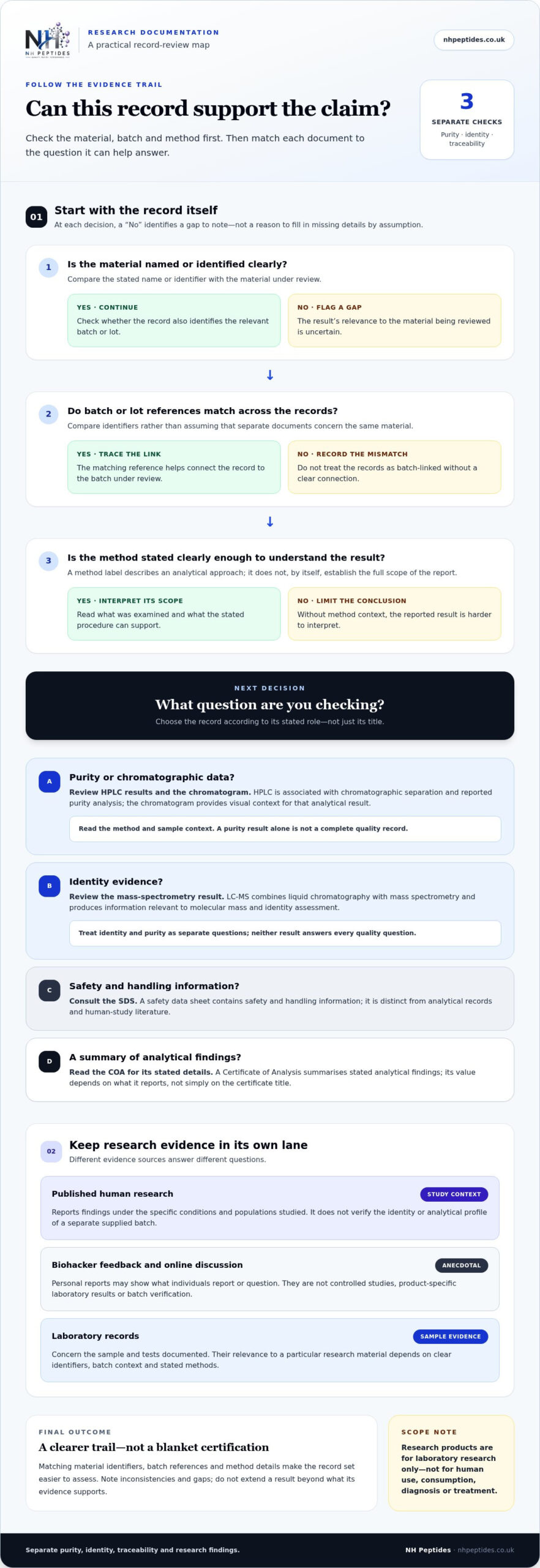
A practical sequence for reviewing peptide quality records
A consistent review sequence makes gaps easier to identify before records are filed with laboratory materials. Assess what each document actually states, then compare those details across the record set. The aim is to establish which conclusions are supported, not to infer missing information.
Check identifiers, scope and document provenance
Start with the material name and batch or lot identifier. Transcribe them as shown rather than relying on shortened labels. Compare document dates, stated methods and reporting scope, and note the source of each record. A laboratory name or method label alone does not establish independent testing; that status should be stated in the documentation.
- Identify the material. Record the product name or identifier used in the laboratory’s receipt and procurement records. Note differences in spelling, format or description across documents.
- Match the batch reference. Compare the batch or lot identifier on each relevant record. A report without a matching identifier may not be attributable to the material being reviewed.
- Check document dates. Note issue, analysis and receipt dates where stated. Record apparent discrepancies for review rather than assuming different dates refer to the same sample.
- Read the stated analytical scope. Identify the method, reported result and sample reference. Keep interpretation within the claims the report actually makes.
- Record source and limitations. Note who issued each document and whether it describes the source or status of the analysis. Do not infer third-party or independent testing unless the record supports that description.
Minimum cross-document check: the material identifier, batch reference, relevant dates, stated method and reported scope should be internally consistent. Record any discrepancies.
Record limitations and preserve an audit trail
If a document omits a batch reference, uses a different product name or leaves the analytical scope unclear, describe the gap precisely. For example, write “batch identifier absent from report” rather than concluding that the result is invalid. This distinguishes an observed documentation gap from a judgement requiring further laboratory review.
Retain source files with the associated procurement and study records, following the laboratory’s established record-retention procedures. Preserve original files where possible and link them to the relevant receipt or study entry using the identifiers available. Internal summaries should distinguish reported findings from interpretation and should not extend a result beyond its stated method or scope.
This sequence assesses documentation, not research outcomes. Published human studies and public biohacker feedback may inform separate discussions about compounds, but they cannot resolve mismatched batch references or gaps in analytical records. Keep those sources separate in laboratory files and do not treat personal accounts as evidence about a specific material.
For research-only peptide products, view the NH Peptides research peptide range. Products are not for human use, consumption, diagnosis or treatment.
Research peptide documentation at NH Peptides: product context and next steps
NH Peptides is a UK-based supplier of research peptides for laboratory studies, serving independent researchers and laboratory facilities across the United Kingdom. Its research product selection includes Retatrutide, Tesamorlin, BPC-157 and TB-500, alongside other compounds. Review the product information for the compound relevant to your research, and assess it within its stated research context.
Keep product information within its research context
These compounds are supplied solely for laboratory research. Product names and descriptions identify items in the research range; they are not claims about clinical use or evidence of human safety or efficacy. NH Peptides products are not for human use, consumption, diagnosis or treatment.
Online biohacker discussions, including posts in Reddit’s r/Biohackers community, may mention compounds also found in research discussions. Such commentary is anecdotal and does not describe or validate NH Peptides products. It is not a product endorsement, a substitute for human research or evidence supporting human use.
Continue to the relevant research peptide information
Use the product range to identify research materials relevant to your laboratory work, then assess each item using its published information. Keep conclusions grounded in the information presented and the intended research-only context.
Explore the research peptide range to review NH Peptides’ listed compounds, including Retatrutide and other research products. All are not for human use, consumption, diagnosis or treatment.
Make documentation review part of the research workflow
Make record review a routine part of laboratory documentation, rather than a separate judgement made only when a question arises. Apply the same review criteria to incoming research materials, record discrepancies clearly, and retain source documents alongside the relevant procurement and study records. This creates a consistent basis for interpreting results and revisiting decisions later.
Keep conclusions proportional to the evidence. Research peptide quality documentation can support defined assessments when identifiers, methods and reporting scope are clear. It cannot replace study-specific scientific judgement, and human research or personal feedback cannot verify a supplied material. Distinguishing these evidence types helps keep reviews precise.
NH Peptides supplies research products for laboratory studies, including Retatrutide and other listed compounds. Products are not for human use, consumption, diagnosis or treatment. Review research peptides for laboratory studies and consider how the available product information fits your research requirements.
Consistent records support clearer, more reproducible research decisions. Apply the same standard at each review.
Frequently Asked Questions
Does a certificate of analysis apply to every peptide batch?
Not necessarily. A certificate applies only to the sample or batch it identifies, and its relevance depends on the identifiers and scope shown. A certificate naming a different lot, or lacking a lot reference, cannot automatically be applied to the material received. Record the discrepancy and do not treat a general or illustrative certificate as evidence for a specific batch.
Can a certificate of analysis establish peptide stability during storage?
Not by itself. A COA reports the results and conditions it documents, but a single analysis does not show how a material changes over time or under different storage conditions. Stability conclusions require relevant time-point data and documented storage conditions. If the certificate gives no stability information, do not infer a storage period or handling limit from its analytical results alone.
Are third-party test results inherently more reliable than supplier results?
No. The testing source is one factor, not a complete measure of reliability. Review whether the report identifies the sample, method, date, results and issuing laboratory, and whether its scope matches the question being assessed. An external report may provide useful separation from supplier interests, but the label “third-party” alone does not establish method suitability, traceability or sound interpretation.
What is the difference between peptide purity and peptide content?
Purity generally describes the proportion of detected material represented by the target relative to other detected components under a stated analytical method. Content concerns the amount of peptide in a defined quantity of material. These measures are not interchangeable: a high reported purity does not, by itself, state how much peptide is present in a sample. Check the report’s definitions, units and method before comparing figures.
Can peptide quality documents prove human safety or efficacy?
No. Laboratory documents do not establish clinical safety or efficacy. Published human research addresses a defined study and cannot verify a separate supplied product. Online comments, including anecdotal biohacker feedback, are personal accounts, not controlled evidence or analytical testing. Neither source demonstrates suitability for human use of NH Peptides products, which are not for human use, consumption, diagnosis or treatment.
How should a laboratory retain peptide quality records?
Retain original documents with the associated procurement and study records, following the laboratory’s record-management procedures. Use a consistent file name or index entry to connect each record to its material identifier and receipt documentation. Preserve revisions or later correspondence where relevant, and note who added internal interpretations. This helps another authorised team member retrieve the source record and distinguish it from laboratory commentary.

Pingback: Peptide Solubility Troubleshooting Guide | NH Peptides
Pingback: UK Research Peptide Supplier Comparison | NH Peptides
Pingback: Retatrutide Research Compound: A Laboratory Review Checklist