
Uncategorized
Retatrutide Laboratory Studies: How to Interpret the Evidence

Oct
In the TRIUMPH-1 trial, the highest retatrutide dose was associated with an average 28.3% reduction in body weight at 80 weeks, according to results published in the New England Journal of Medicine in September 2026. That finding is important, but it is not the only kind of evidence discussed online. Retatrutide laboratory studies, controlled human trials and biohacker accounts answer different questions and have different limitations.
Preclinical findings can appear beside clinical results, while anecdotal reports may circulate without clear context. This article distinguishes those evidence types and explains what study design, duration and peer-reviewed reporting can establish. It also considers online biohacker feedback as anecdotal material, not controlled evidence or an endorsement of human use.
The discussion focuses primarily on human clinical research, with laboratory models placed in context. It also distinguishes research findings from laboratory-only product use: NH Peptides supplies Retatrutide for laboratory research, not for human use, consumption, diagnosis or treatment.
Key Takeaways
- Retatrutide laboratory studies and controlled human trials address different research questions. Identify the model before interpreting a finding.
- Assess clinical findings by study phase, participant group, measured endpoint and follow-up period.
- Separate peer-reviewed papers and trial records from secondary summaries and anecdotal biohacker feedback.
- Online personal accounts may describe subjective experiences, but they are not controlled evidence or guidance for human use.
- NH Peptides supplies Retatrutide for laboratory research only, not for human use, consumption, diagnosis or treatment.
Retatrutide laboratory studies: what the research is examining
Retatrutide is an investigational compound studied in preclinical models and controlled human research. Scientific interest centres on its activity at three receptor types: glucagon-like peptide-1 (GLP-1), glucose-dependent insulinotropic polypeptide (GIP) and glucagon receptors. Retatrutide laboratory studies can examine how this combined activity behaves in defined experimental systems. Human clinical studies address different questions, including how the compound behaves in participants under specified trial conditions.
A proposed biological mechanism is not proof of a clinical outcome. Receptor activity alone cannot establish effectiveness, safety over time or suitability for any individual. Those conclusions require appropriately designed human research, interpreted in light of the participants and duration studied. Online accounts cannot fill gaps in that evidence.
The triple-receptor concept in research
GLP-1 and GIP are hormones involved in metabolic signalling; glucagon is another hormone with its own receptor pathway. Retatrutide has been studied for activity across all three targets. Researchers can examine how this profile relates to biological processes and measured outcomes, but a multi-receptor mechanism does not guarantee a particular response. For a general overview of the compound and its research status, see the Retatrutide Wikipedia article. Check detailed claims against primary studies.
Read mechanism descriptions as explanations of what researchers are investigating, not as instructions or predictions. A finding in cells or an animal model may support further investigation, but cannot establish that the same effect will occur in people. Human trial findings, in turn, apply to the study conditions and participants reported, not automatically to other settings or individuals.
Why study type matters
Laboratory research examines biological processes in experimental systems; human clinical research evaluates outcomes in participants under a defined study design. Preclinical models can help investigate receptor activity and generate hypotheses. Controlled human trials can assess outcomes and adverse events within a specified population, protocol and follow-up period. Informal reports describe individual experiences but lack the controls needed to determine cause or frequency.
Keep these categories separate. A laboratory result may explain why a question is being studied, while a clinical trial tests selected questions in people. Neither a mechanism paper nor a trial result validates personal-use claims. Retatrutide products supplied by NH Peptides are strictly for laboratory research only. They are not for human use, consumption, medical diagnosis or therapeutic treatment.
When evaluating a claim, identify its source before considering the headline. A preclinical experiment, a peer-reviewed human trial and an online personal account each carry different evidential weight. The methods and limitations determine what can reasonably be concluded.
How preclinical and human retatrutide studies differ
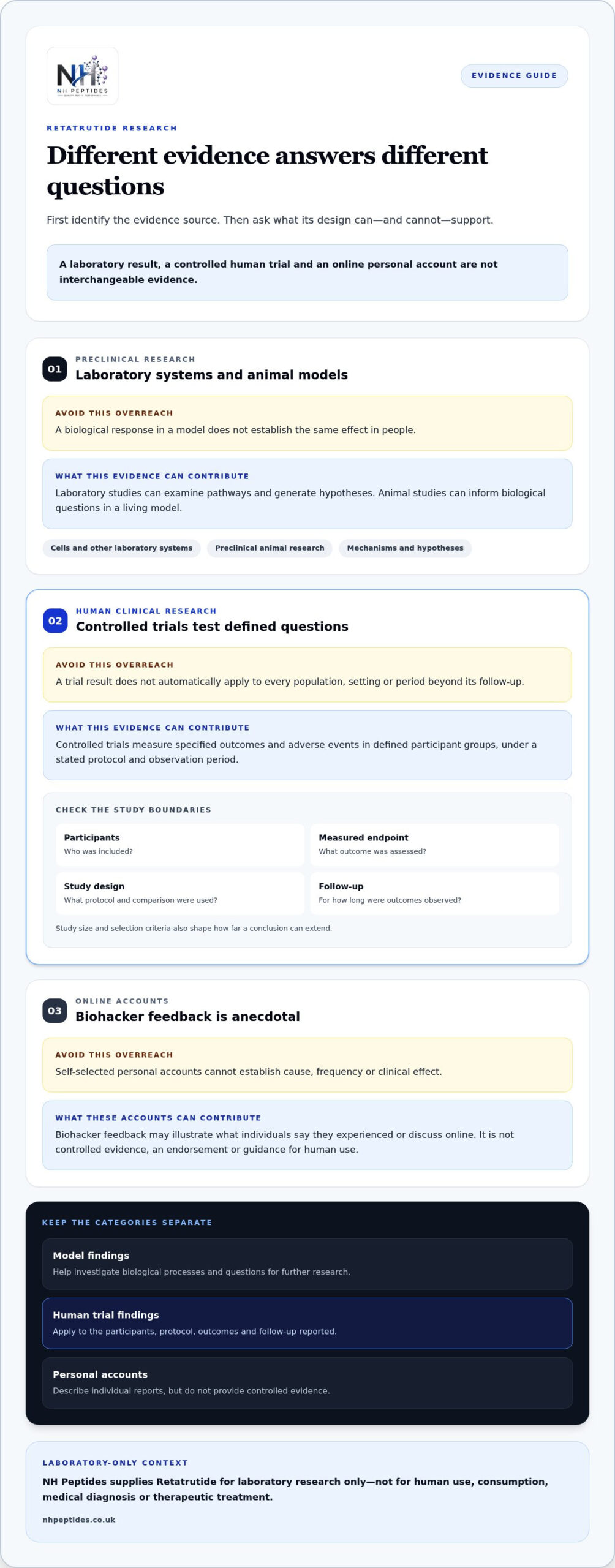
Study type sets the boundary for what a result can support. Preclinical work examines biological processes in laboratory systems or animal models. Human clinical research measures specified outcomes in participants under a defined protocol. Informal online accounts describe individual reports, but do not have the controls needed to establish cause and effect.
| Evidence type | Research question | Model or participants | Evidence contribution | Main limitation |
|---|---|---|---|---|
| Laboratory studies | How does a biological pathway respond? | Cells or other laboratory systems | Can examine mechanisms and generate hypotheses | Does not establish effects in humans |
| Animal studies | How does a process operate in a living model? | Animals used in preclinical research | Can inform biological questions before human testing | Findings may not translate to people |
| Controlled human trials | What outcomes and adverse events occur under the study conditions? | Defined participant groups | Provides evidence tied to a population, protocol and observation period | Does not prove broad applicability or effects beyond follow-up |
| Informal reports | What does an individual say they experienced? | Self-selected online accounts | May illustrate topics people discuss | Cannot reliably establish frequency, cause or clinical effect |
What preclinical models can contribute
Retatrutide laboratory studies can examine receptor-related pathways and biological responses within a controlled experimental model. Animal models can add information about processes in a whole organism. These approaches help define questions for later research, but differences between models and people limit interpretation. Neither laboratory nor animal findings demonstrate human outcomes or establish clinical benefit.
What human clinical studies can contribute
Controlled trials assess outcomes in defined participant groups, using specified measures and observation periods. Their results show what was observed under those conditions. They cannot, on their own, establish that the same findings apply to every population, setting or longer period. Study size, selection criteria, comparison groups and follow-up all shape how far a conclusion can extend.
For study status and design details, the Retatrutide clinical trials on ClinicalTrials.gov database can be read alongside published papers. A trial-register entry describes a study record; it is not equivalent to a peer-reviewed report of results. The broader Retatrutide clinical evidence and laboratory context overview also places human research alongside laboratory findings and online reports.
Keep the evidence categories separate when interpreting claims. A mechanism observed in a model is not a clinical outcome, and a clinical trial result is specific to its protocol and participants. Personal accounts add context about what people report online, but remain anecdotal rather than controlled evidence. NH Peptides supplies Retatrutide for laboratory research only. View Retatrutide research materials in that laboratory-only context.
What published human retatrutide research can, and cannot, show
Human trial findings are meaningful only when read alongside the population, endpoints and observation period that produced them. Phase 3 publications from September 2026 report TRIUMPH-1 results in the New England Journal of Medicine and TRIUMPH-2 results in The Lancet. These reports provide controlled human evidence, but their findings remain specific to the trials rather than forecasts for individuals.
Reading trial findings in their study context
In TRIUMPH-2, a Phase 3 study involving people with obesity and type 2 diabetes, the highest-dose group had an average body-weight reduction of 20.8% at 80 weeks; 52% of that group recorded a reduction of at least 20%. The report also described A1C reductions of up to 1.6 percentage points from a baseline of 7.7%. These are group-level results tied to the trial’s population, measures and follow-up.
A separate Phase 3 trial, TRANSCEND-T2D-1, reported A1C reductions of up to 2.0 percentage points from a baseline of 7.9%. Interpret that result within its own study design and participant group rather than combining it casually with figures from another trial. A reported maximum, an average and the proportion of participants crossing a threshold describe different outcomes.
Safety findings also need trial context. In TRIUMPH-1, treatment discontinuation due to side effects ranged from 4.1% to 18.2%, depending on dose and participant population. This is a trial-specific observation, not a complete assessment of safety or a measure that can be transferred directly to other settings. Consider the paper’s methods, adverse-event reporting and follow-up together.
What a reported result does not establish
A trial result does not establish an individual outcome, and it is not a treatment recommendation or a guide to use. A defined follow-up period does not establish effects beyond that period. Retatrutide laboratory studies and clinical research have distinct roles; neither converts group-level trial data into personal predictions.
Trial results cannot be generalised automatically beyond the studied population, because participant eligibility, health characteristics, study protocol, measured endpoints and follow-up duration limit what the findings can establish. This matters when a headline number is repeated without context. Check whether a figure is an average, a threshold proportion or a maximum, and note which participants and time point it describes.
For an extended discussion of study findings and evidence boundaries, consult the Retatrutide research peptide overview. Published human research is discussed here as scientific literature, not as guidance for product use.
How to assess retatrutide claims, limitations and biohacker feedback
Retatrutide claims appear in different formats: peer-reviewed papers, trial-register entries, summaries and first-person online posts. They do not carry the same evidential weight. A consistent appraisal method helps identify what a statement is based on, what was measured and where interpretation begins. Apply it to online biohacker feedback as carefully as to claims about human research.
A practical sequence for evaluating a claim
- Trace the source. Locate the primary paper or original record behind the claim. If a summary does not identify its source, treat it cautiously.
- Classify the evidence. A peer-reviewed paper reports research; a trial-register entry records study information and may not include published results. A secondary summary interprets other sources, while a personal account is anecdotal.
- Identify the population. Check who was studied and whether the claim refers to that same group. Findings from a defined group should not be assumed to apply to others.
- Check the endpoint. Distinguish a measured outcome from an author’s interpretation or a later commentator’s conclusion.
- Read the limitations. Note the study design, follow-up and uncertainty. Look for independent corroboration before treating a claim as established.
This sequence applies to claims drawn from Retatrutide laboratory studies as well as human trials. The evidence category determines what the source can support. Repetition across websites does not turn an unverified interpretation into a measured finding.
Where biohacker feedback fits
Online biohacker discussions are self-reported accounts, not controlled research. Reddit posts may describe subjective themes such as changes in cravings or energy, or experiences such as nausea or emotional flatness. These reports show what some posters say they experienced, but cannot establish cause, frequency or whether the same account would apply to another person.
Reddit search results for retatrutide experience discussions provide access to user-generated material. Treat these discussions as anecdotal, not independently validated outcomes: posts are not verified clinical records, and search results are not a controlled dataset. Do not use them as evidence of safety, efficacy or suitability for human use. They also do not indicate that NH Peptides products are intended for human use; its products are for laboratory research only.
Keep personal accounts separate from peer-reviewed findings, even when a reported experience resembles an outcome discussed in a study. For laboratory research materials, visit NH Peptides.
Retatrutide research materials and laboratory-only context
Published human studies provide evidence about outcomes recorded in defined research settings. They do not provide instructions for using a research product. Keep those evidence sources separate: a clinical paper describes its study and findings, while supplier information concerns materials supplied for laboratory research. Neither should be read as a recommendation for personal use.
Maintaining the laboratory-only boundary
NH Peptides is a UK supplier of Retatrutide for laboratory studies only. Its products are not for human use or consumption, medical diagnosis or therapeutic treatment. The clinical literature discussed in this article is scientific context, not product-use guidance. No administration instructions or personal-use recommendations are provided.
This distinction matters when published findings and product descriptions appear in the same online discussion. A trial result concerns the compound as studied under its protocol. It does not establish the characteristics or intended use of a supplier’s research material, and a supplier’s listing does not confirm a clinical outcome. Keep product information separate from conclusions drawn from human trials.
Where to continue the research review
Documentation has a different role from efficacy evidence. A document can describe a material or its stated quality information, but its presence alone does not establish clinical effectiveness, safety or suitability for human use. Interpret documentation according to what it records, and distinguish material information from evidence about clinical outcomes.
The research peptide quality documentation reference provides further context on documentation in laboratory research. Read it as a documentation resource, not as a substitute for peer-reviewed clinical evidence or as support for personal-use claims.
For researchers reviewing Retatrutide within a laboratory-only context, NH Peptides supplies the compound for laboratory studies. Keep that supply context distinct from the human research literature summarised in this article.
Keep the evidence record current
Evidence review is a continuing task. As new papers and trial updates appear, keep a dated record of the sources informing a research assessment. This helps distinguish findings available at one point from later results and prevents older summaries from standing in for current publications.
For each source, record its publication or update date, study type and stated limitations. Retatrutide laboratory studies sit within a developing body of research, so conclusions should remain proportionate to the evidence available and the question being examined. A clear reference trail makes later comparisons easier without turning research observations into personal-use guidance.
Researchers and laboratory facilities can consult NH Peptides’ research materials as a separate supplier resource. View Retatrutide research material for laboratory research. Keep the literature review and material assessment distinct, and build conclusions from traceable evidence.
Frequently Asked Questions
What is retatrutide being investigated for in published research?
Published research examines retatrutide’s activity at GLP-1, GIP and glucagon receptors, alongside measured outcomes in human trials. These are separate kinds of evidence: receptor activity describes a research mechanism, while trial results report observations in enrolled participants. For a specific claim, check the original paper’s population and endpoints, then distinguish its results from the authors’ interpretation. Trial-register records, such as those on ClinicalTrials.gov, are not themselves published outcome papers.
How do preclinical retatrutide studies differ from human clinical studies?
Preclinical studies use laboratory systems or animal models; clinical studies enrol people under a defined protocol. A result about receptor activity in an experimental model, for example, cannot establish a weight or metabolic outcome in people. A human trial can report outcomes for its participants, but its inclusion criteria and follow-up still limit interpretation. Identify the model in Retatrutide laboratory studies before comparing their findings with clinical reports.
What does a Phase 2 retatrutide study mean?
A Phase 2 label identifies a stage of clinical development, not a conclusion about effectiveness, safety or approval. To understand a particular study, check its trial record or paper for the participant group, comparison design, endpoints and follow-up. A study measuring a metabolic marker, for instance, answers a different question from one focused on body-weight change. The phase alone cannot show whether results apply outside the population and conditions studied.
Can a review article replace the original retatrutide studies?
No. A review synthesises earlier research and may help locate relevant papers, but it is not the original source for a specific result. Follow its citations to the underlying study and compare the review’s wording with the methods, participant criteria and endpoints reported there. Check its publication date and whether it separates animal evidence from human findings. This is useful when a short summary omits limitations or treats distinct outcomes as equivalent.
Are online biohacker reports evidence of retatrutide efficacy or safety?
No. Biohacker posts are anecdotal, self-reported accounts and cannot establish efficacy or safety. They may describe subjective experiences, but do not provide controlled comparisons or verified clinical measurements. Reddit retatrutide experience discussions are user-generated material, not clinical evidence or an endorsement of human use. Do not treat individual posts as instructions or as evidence that research products are suitable for people.
Does a published human study mean a research peptide is suitable for human use?
No. Publication of a clinical study does not change the intended use of a supplier’s product. NH Peptides supplies Retatrutide for laboratory studies; its products are not for human use or consumption, diagnosis or therapeutic treatment. Human research can be discussed as scientific literature, but it does not provide product-use guidance or an individual recommendation. Keep conclusions about trial participants separate from claims about research materials.
