
Uncategorized
Peptide Purity Test Results: How to Interpret the Data

Oct
A high peptide purity percentage is not a complete quality verdict. Peptide purity test results describe an analytical measurement made using a particular method. On their own, they do not establish identity, total peptide content or suitability for a research application.
The percentage is useful evidence, but its meaning depends on how the sample was analysed and what the result measures. This guide explains how to interpret the reported figure, distinguish purity from identity and quantity, and compare results without overstating what they show.
It also separates laboratory data from published human research and anecdotal biohacker feedback. Neither human-study findings nor personal accounts verify the identity or purity of a separate sample. Biohacker feedback is anecdotal, and research peptides are not for human use. The focus here is what an analytical result can support, what it leaves unanswered, and how to assess documentation in a research context.
Key Takeaways
- Read peptide purity test results as method-specific estimates, not automatic measures of peptide mass or total content.
- Compare the analytical method, sample identifier, test date and reported metric before drawing conclusions across reports.
- Keep purity, identity confirmation and human-study findings distinct: each supports a different type of conclusion.
- Use a consistent review sequence: identify the sample, note the method, interpret the metric and record its limitations.
- Treat biohacker feedback as anecdotal, not as evidence of peptide identity, efficacy or suitability for human use.
What peptide purity test results measure
A reported peptide purity percentage is the proportion of the detected chromatographic signal assigned to the target peptide, relative to the integrated signals included in the analysis. It is an estimate for the sample tested, not a universal property that can be interpreted independently of the method.
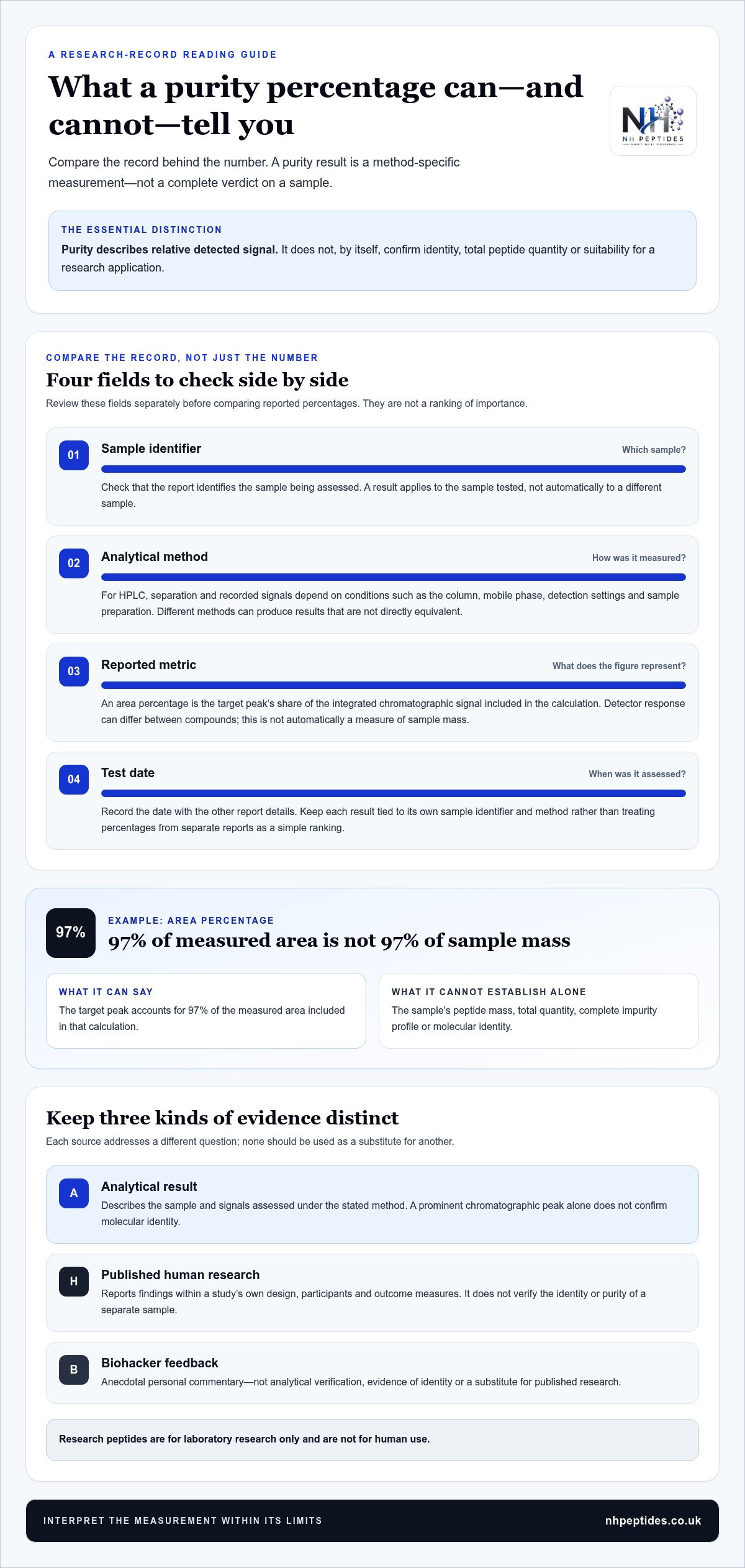
In a chromatogram, separated components appear as peaks. The area under each integrated peak represents its detected signal under the specified conditions. A laboratory may report the target peak’s area as a proportion of the total included peak area. For example, a result of 97% area means the target peak accounts for 97% of the measured area included in that calculation. It does not automatically mean that 97% of the sample’s mass is the target peptide.
Detector response can vary between compounds. Components may also be unresolved, excluded during integration or undetected by the method. The reported value therefore describes the signal the method captured and the laboratory counted, not necessarily every substance in the sample. For background on peptide production and purification, see Peptide Synthesis and Purification.
What a reported purity percentage represents
Area percentage depends on the chromatographic separation, detection settings and peak-integration choices used for the analysis. Changes to the column, mobile phase, gradient, detector or integration parameters can affect which components separate and how their signals are measured.
For that reason, peptide purity test results from different methods are not directly equivalent just because both are expressed as percentages. A percentage also does not establish that every impurity has been detected or identified. It summarises the measured peaks under the stated analytical conditions.
Purity is not identity or research suitability
Purity reporting describes relative signal. Identity assessment asks whether the material corresponds to the intended molecule. That requires relevant supporting evidence, such as a method that assesses molecular mass or structure. A prominent chromatographic peak alone does not confirm its molecular identity.
A purity percentage does not establish concentration or total quantity either. Those questions require measurements suited to the specific purpose. A relative peak-area result cannot, by itself, state how much peptide is present in a sample. This distinction is relevant when assessing research compounds such as Retatrutide, which NH Peptides supplies for laboratory studies.
Finally, analytical purity does not establish suitability for a particular experiment. That judgement depends on the study’s requirements and other sample attributes that a purity figure does not report. Treat the percentage as one defined analytical observation, not a complete assessment of identity, amount or experimental fitness.
How methods such as HPLC produce peptide purity results
High-performance liquid chromatography (HPLC) is one method for analysing a research sample. It separates components so their detector signals can be recorded and assessed. For researchers evaluating a compound such as Retatrutide, HPLC forms part of the analytical record. It does not provide evidence of an outcome in people. NH Peptides supplies research peptides, including Retatrutide, for laboratory studies only.
Reading a chromatogram at a high level
A chromatogram displays detector signals as peaks. Those peaks show components detected under the method conditions, but a peak does not identify itself. The report’s assignments and supporting evidence matter. In a laboratory assessment, a chromatogram can inform conclusions about the analysed sample. Published human research addresses different questions through its own study design, participants and outcome measures.
Do not substitute one type of evidence for another. A paper reporting human-study findings does not verify a supplier sample, and an analytical result does not establish a human outcome. Biohacker commentary is anecdotal too. It may describe individual perspectives, but it is neither analytical verification nor a substitute for published research. Research peptides are not for human use.
Why analytical methods are not interchangeable
HPLC results depend on the column, mobile phase, detection settings and sample preparation. These conditions affect the separation and the signals recorded. Two reports can therefore show different chromatograms even when their headline metrics appear similar. For a meaningful review, keep each result with its method details and sample identifier rather than treating percentages from separate methods as a simple ranking.
Human research findings also need context. Study results relate to the material, protocol and participants described by the authors; they cannot automatically be applied to a separate research compound or sample. The FDA guidance library concerns drug guidance and should be read within its stated scope, not as validation of a particular supplier’s research material.
NH Peptides is a UK-based supplier serving researchers and laboratory facilities nationally. Its research peptide selection includes Retatrutide for scientific investigation. Read product information separately from analytical documentation and human-study literature, and use each source only for the question it can address. View research peptides for laboratory studies.
How to compare peptide purity results without overinterpreting them
Compare records field by field before comparing percentages. A higher figure is not automatically evidence of a more suitable sample if the methods, sample identifiers or reported metrics differ. Record the method, sample identifier, test date and metric separately. This makes gaps visible and helps prevent results from unrelated samples or batches being treated as directly comparable.
- Method: record the analytical technique and relevant conditions stated in the report.
- Sample identifier: match the result to the specific sample or batch being assessed.
- Test date: note when the analysis was performed.
- Reported metric: distinguish area percentage from other forms of measurement.
Interpret a numerical difference only after establishing that the reports measure the same thing under sufficiently comparable conditions. Even then, the figure describes the analytical sample, not clinical performance, safety or human-use status.
Purity percentage versus identity confirmation
Purity describes the relative signals detected under stated analytical conditions. Identity is a separate question: appropriate evidence must support that the detected material is the intended molecule. A result answering one question does not automatically answer the other. For a related record-review framework, see our research peptide quality documentation guide.
| Evidence type | What it can establish | What it cannot establish alone |
|---|---|---|
| Purity analysis | Relative detected components under the stated method | Molecular identity, study suitability or human outcomes |
| Identity analysis | Evidence relevant to whether the material matches the intended molecule | Relative purity, total quantity or clinical performance |
| Published human research | Findings within the study population, protocol and conditions reported | Identity or quality of a separate supplier sample |
Analytical data versus human research and biohacker feedback
A supplier’s analytical result concerns a tested research compound. Published human research reports outcomes under a specific study design; it is not a test report for a separate sample. Biohacker discussions about peptides are anecdotal, not laboratory verification or clinical evidence. They cannot verify a sample’s identity or purity, and must not be used to infer that research peptides are for human use.
The American Peptide Association provides industry resources. Its American Peptide Association Standards are not a substitute for reviewing the actual analytical record. Apply the same discipline to every source: identify what was assessed, in which sample and under what conditions. No single purity figure establishes clinical performance, safety or human-use status.
A practical framework for reviewing a peptide purity result
Use the same sequence each time: identify the sample, note the method, read the reported metric, then record the limitations. This creates a traceable summary of what the document supports without turning one figure into a broader quality or suitability claim. The framework applies to peptide purity test results and other analytical records used in laboratory research.
- Identify the sample. Record the sample or lot identifier shown on the report and compare it with the identifier on the material or its accompanying documentation. A general product description, or a report for a different sample, does not establish results for the lot under review.
- Note the method. Write down the stated analytical technique and any relevant conditions included in the record. Keep the method attached to the result so the value is not mistaken for a method-independent measurement.
- Read the metric. Copy the value, units and stated basis exactly. Distinguish a chromatographic area percentage from a concentration, mass measurement or quantity. Do not infer a different measurement from the percentage alone.
- Record limitations. State what the result supports and what it leaves unanswered, such as identity, total content or suitability for a specific experiment. Keep those unanswered points visible in the research record.
Check the sample and reported method
Begin with traceability. A result is relevant to a sample only when its identifier corresponds to the material being assessed. A product description or an analysis of an unrelated batch cannot substitute for lot-level documentation. Record the test date too: it identifies when that sample was analysed, not the status of another sample.
Next, note the method and the reported units or basis. If a detail is absent, record that as a limit on interpretation. Do not fill gaps by assuming an unfamiliar percentage means the same thing as a familiar one.
Record the result and its limits
Use a brief note with two parts: “The report supports…” and “The report does not establish…”. For example, it may support a stated analytical observation for the identified sample whilst leaving identity or experiment-specific suitability unresolved. Keep conclusions no broader than the evidence.
Published human research and informal biohacker feedback belong in separate records. A study reports findings within its own design and conditions; anecdotal online discussion is not sample analysis or clinical evidence. Neither can verify the identity or purity of a separate research compound, and neither implies that research peptides are for human use.
For broader document review, apply this framework alongside How to Read a Peptide Certificate of Analysis. NH Peptides supplies research peptides for laboratory studies. Explore research peptides for laboratory studies, review the quality and testing information, and consult the certificate of analysis library for batch-specific documentation.
Research peptide documentation at NH Peptides
NH Peptides is a UK-based supplier of research peptides for laboratory studies. Retatrutide is among the research compounds offered for scientific investigation. Product information, analytical evidence and experimental findings serve different purposes, so read each within its own scope. For an overview of the supplier’s analytical process and lot-level documentation, see NH Peptides quality and testing.
For laboratory record-keeping, link any analytical result to the sample it describes. Keep the result, the material’s product description and the study protocol as separate records. A description identifies the research compound; an analytical document reports observations about a tested sample; a protocol defines the requirements of a particular investigation. One record cannot substitute for another.
Keep analytical results within their stated scope
A purity figure reports an analytical finding under the conditions described in the record. It does not predict human-use outcomes or establish that a compound is appropriate for a particular experiment. Identity evidence addresses a different question, while study suitability depends on the requirements and controls of the individual research design.
These distinctions also apply to external information. Published human research describes findings from its own study conditions, not the contents or identity of a separate supplier sample. Informal biohacker discussions are anecdotal and cannot verify a laboratory result, establish efficacy or support conclusions about a product. They are not a substitute for analytical records or evidence for human use.
NH Peptides’ research compounds are solely for laboratory research. They are not for human use or consumption, and are not intended for medical diagnosis or therapeutic treatment. A reported analytical value does not alter those limits. Use it only to inform the research question that the documented method and sample can support.
Find research peptide information
Laboratory readers can use product information to identify the research compound under consideration, then assess any analytical record separately and in relation to its stated sample. Do not transfer a result from one sample to another or infer undocumented specifications. If a result does not answer the study’s question, record that limitation rather than extending the conclusion.
For product information relevant to laboratory investigation, view NH Peptides research information.
Make documentation review part of your research workflow
Before reviewing a new sample, make a short record of the evidence needed for each research decision. This helps show which questions the available documentation answers and which require separate evidence. Apply the same discipline to future peptide purity test results, retaining the method, sample identifier and limitations alongside your research notes.
When a record leaves a question unresolved, keep that uncertainty explicit rather than relying on unrelated reports or informal commentary. A consistent review process supports clearer comparisons and more transparent research decisions.
For product information intended for laboratory research, view NH Peptides research information. Continue your evaluation by distinguishing documented findings from unanswered questions.
Frequently Asked Questions
What does a peptide purity percentage mean?
It usually reports the target peptide’s share of the detected analytical signal included in a particular calculation. For example, a report might express the target peak’s area as a proportion of the integrated chromatogram area. This is not necessarily the peptide’s share by mass. Check the report’s stated metric and calculation basis before recording the value or comparing samples.
Does a high peptide purity result confirm the peptide’s identity?
No. A high result indicates that a large proportion of the measured signal was assigned to the target peak under that method. On its own, it does not show that the peak is the intended molecule. If identity matters to a research decision, review separate identity evidence and ensure it refers to the same sample. A product name on a label is not analytical confirmation.
Can peptide purity results from different methods be compared?
Only with care. First check that both records identify the relevant samples and report the same type of metric. Then compare method details, such as chromatographic conditions and detection settings, where available. If these differ, a difference in percentage may reflect the methods as well as the samples. Record the figures separately rather than ranking them as though they came from one standardised analysis.
Is HPLC purity the same as peptide purity?
HPLC purity is a method-specific way of reporting peptide-related analytical data, not a separate universal definition of purity. The reported value depends on what the method separates, detects and includes in its calculation. The same sample assessed under different chromatographic conditions may produce different peak patterns. Keep the method name and reported basis attached to the result in research notes.
What does a peptide purity test not tell you?
A purity result alone does not establish the sample’s total peptide quantity, concentration, identity or suitability for a particular experiment. It also cannot predict a biological outcome or establish clinical performance or safety. Consider the question being asked: a relative analytical figure cannot substitute for a measurement of amount or for study data. Record unanswered questions separately rather than inferring answers from the purity percentage.
Can biohacker feedback verify peptide purity?
No. Online biohacker discussions about peptides are anecdotal, not analytical measurements of a sample. Comments on social platforms cannot establish identity, purity or composition, even when they describe personal experiences. Such discussion is not clinical research and should not be used to support human use of research peptides.
Does a purity result prove that a research peptide is suitable for laboratory use?
No. Suitability depends on the requirements of the specific study and the evidence relevant to those requirements. A purity result may inform an assessment, but it cannot establish every attribute a protocol may require. NH Peptides supplies research peptides, including Retatrutide, for laboratory studies only. Its compounds are not for human use or consumption, medical diagnosis or therapeutic treatment.

Pingback: Peptide Quality Documentation Guide | NH Peptides