
Scientific Research
Peptide Compounds for Research

Oct
Can a familiar compound name tell you what a study has actually established? Not by itself. Information about peptide compounds for research often combines molecular names, laboratory descriptions and online commentary, even though these sources answer different questions. To interpret them accurately, separate what a source calls a compound from what it says was studied and what it reports finding.
A compound’s identity is not evidence that it shares the properties, effects or research status of another peptide with a similar name. This guide explains the main terms used to describe peptide compounds, shows how research context and evidence type affect interpretation, and sets out a practical way to record claims without treating laboratory information as a clinical conclusion.
Examples such as Retatrutide, BPC-157 and GHK-Cu are used as compound names, not as evidence of particular outcomes. Online biohacker discussions, including commentary in r/Biohackers, are anecdotal and should be distinguished from published research. They do not establish suitability for human use. NH Peptides is a UK-based supplier of compounds intended solely for laboratory experimentation and scientific studies, not for human consumption, diagnosis or treatment.
Key Takeaways
- Classify peptide compounds for research by molecular identity, study question and model or system, rather than by name alone.
- Separate a research context from a finding. The context identifies what is being investigated, not what has been established.
- Assess peer-reviewed findings, supplier descriptions and anecdotal online commentary as distinct evidence types, each with different limits.
- Use a consistent review process: identify the compound, locate its research context, classify the source and record its limitations.
- Keep laboratory information separate from clinical claims. A catalogue entry does not establish efficacy or suitability for human use.
What “peptide compound” means in research
A peptide compound is a molecule identified and considered within a defined scientific or laboratory research context. The term describes the material under discussion; it does not, by itself, specify what the molecule does, why it is being studied or what evidence supports a claim about it.
When reviewing peptide compounds for research, keep three elements distinct: molecular identity, the question being investigated and the evidence reported. A catalogue name may help identify a compound, but it cannot establish a research purpose or outcome. For that, look for a study description and its reported methods and findings. If those details are absent, record the gap rather than filling it with assumptions based on the name.
Peptides and proteins are related categories of molecules built from amino acids. They are often distinguished by chain length, but there is no single boundary used consistently across every field. The terms can overlap in scientific usage. For this article, the distinction is sufficient: “peptide” identifies a type of amino-acid chain, whilst “protein” commonly refers to a larger or more complex molecule. A label alone may not settle how a source classifies a particular molecule.
Peptide terminology: sequence, identity and naming
A sequence describes the order of amino-acid units in a peptide. Identity concerns which molecule a name refers to, ideally supported by reliable structural information. A common name is a convenient label, not necessarily a complete structural description. If sources use different names or levels of detail, compare the identity information they provide instead of assuming the terms are interchangeable.
Retatrutide, Tesamorlin and GHK-Cu are examples of catalogue terminology used by NH Peptides. Their inclusion as names identifies catalogue entries; it does not assign a particular structure, purpose or finding here. For a basic account of peptide structure and general terminology, consult What are peptides?.
Research context is not a clinical claim
Research-use language indicates a laboratory context. It does not mean that a compound is intended for diagnosis or treatment, nor does it establish a clinical effect. A study context identifies the question and system being examined; any conclusion must be assessed from the evidence itself.
NH Peptides products are intended solely for laboratory experimentation and scientific studies. They are not for human use or consumption, medical diagnosis or therapeutic treatment. This boundary applies regardless of how a compound is discussed elsewhere. Foundational terminology about peptides for scientific research can help distinguish laboratory descriptions from claims about clinical use.
When you encounter a compound reference, record the name as given and note whether a sequence or other structural identifier is supplied. Keep those identity details separate from the stated research question and reported findings. This makes it easier to see whether a source establishes the identity, context and result, or leaves one of those points unspecified.
How peptide compounds are described in laboratory research
A useful research description connects three elements: the compound’s identity, the question being investigated and the model or system reported. The name identifies what the source says it studied. The question sets the scope. The model or system indicates where observations were made, such as a cell-based system or another specified experimental model. Missing details limit what can be concluded.
A research description does not, by itself, demonstrate an outcome. It records a context, not proof of a mechanism, biological effect or broader claim. To evaluate a stated result, check the methods, observations and limitations in the relevant source. A compound name alone cannot fill gaps in that evidence.
When reviewing peptide compounds for research, separate the description into these fields:
- Identity: the name and any structural identifiers supplied.
- Study question: the specific issue the work set out to investigate.
- Model or system: the experimental setting described by the source.
- Reported result: the observation, kept distinct from its interpretation.
From compound name to study context
Read a compound name alongside the study question and design, not as a summary of either. The same named compound may be examined in separate studies for different questions or in different systems. Those research descriptions are not automatically equivalent. Catalogue names, including those used by NH Peptides, identify entries; they do not establish a study purpose or result.
Online biohacker feedback, including discussions in r/Biohackers, can show how terms circulate outside research papers. Treat posts as anecdotal commentary. They may reflect contributors’ interpretations or concerns, but they do not document a controlled study or establish a compound’s mechanism.
Distinguishing research subjects and outcomes
A research subject is the specific question, model or system under investigation. An outcome is what the source reports observing within that scope. Interpretation explains what the observation might mean; a broader claim extends beyond the reported result. Keep these levels separate, and check whether the source supports each step.
Biohacker forum threads can help identify disputed terminology, recurring questions or concerns about information quality. They are not a substitute for peer-reviewed findings. A post does not establish efficacy, and repeated commentary does not turn an anecdote into research evidence. Repetition across different forums is not independent confirmation either.
For practical classification, note the source type and its stated limits before recording a claim. Keep forum commentary separate from laboratory descriptions and published findings. For example, label an observation from a paper as a reported study finding, a catalogue statement as supplier information and a forum post as anecdotal feedback. Researchers reviewing compound names in a laboratory context can also view NH Peptides research peptides.
Research findings, product descriptions and biohacker feedback
Descriptions of peptide compounds can come from sources with different purposes and evidential weight. A peer-reviewed paper reports a defined study. A supplier description presents information about a catalogue entry. Biohacker forums contain individual commentary. These sources may use similar terminology, but they cannot be treated as interchangeable evidence.
The distinction matters when assessing a claim. Read a paper within its methods, model and reported scope. A product description does not independently verify a scientific result. Online feedback may help identify topics people discuss, including terminology and concerns about information quality, but it remains anecdotal.
| Source type | What it can show | What it cannot establish alone |
|---|---|---|
| Peer-reviewed research | Methods, study context and findings reported within a specific publication. | That the same result applies beyond the study’s model, conditions or stated limits. |
| Supplier description | Supplier-provided catalogue information about a compound. | Independent confirmation of properties, efficacy or research outcomes. |
| Biohacker feedback | Individual online commentary, perceptions, terminology and expressed concerns. | Controlled findings, efficacy, or suitability for human use. |
What different information sources can and cannot show
Assess research literature from the specific paper, not from a headline or summary detached from the methods. Note the question studied, the model or system, the observations reported and the authors’ stated limitations. A finding in one setting does not automatically support a broader claim.
Supplier descriptions have a different function. They identify supplier-provided information; they are not independent research findings. Treat them as product descriptions rather than evidence that a mechanism or biological effect has been demonstrated. The same distinction applies to claims repeated in secondary summaries.
Reading online feedback without overstating it
Public discussion in the r/Biohackers community illustrates how anecdotal commentary can circulate alongside questions about sourcing, terminology and perceived effects. Such posts reflect what contributors say; they do not verify the claims or establish how a compound behaves in a study. Read the surrounding thread and its source context, and keep personal commentary separate from published research.
Anecdotal reports cannot establish a research finding. They are not controlled evidence, recommendations or instructions. Do not use forum commentary to make therapeutic, diagnostic or efficacy claims, or to infer suitability for human use. A discussion post does not change the evidential status of a compound.
For peptide compounds for research, record the source type beside each claim. A useful note distinguishes a published observation from supplier wording and forum commentary, then retains the source’s limitations. This simple step helps prevent a product description or repeated online assertion from being misread as a verified result.
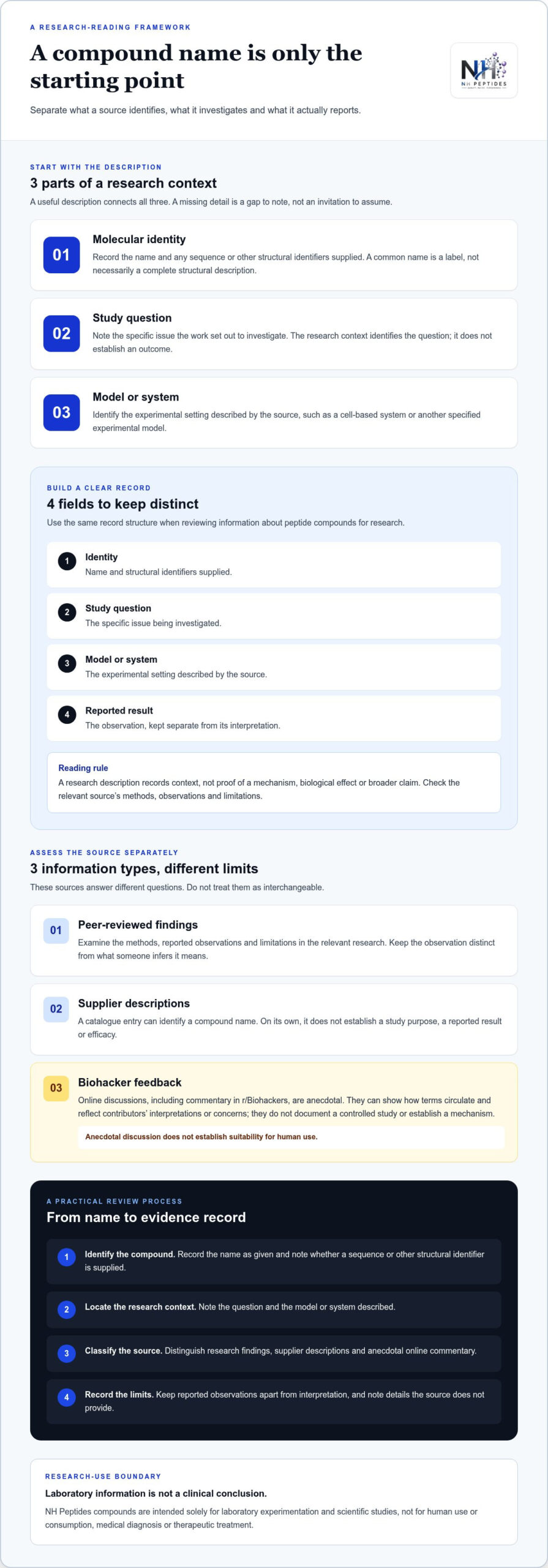
A practical framework for classifying peptide information
Use a consistent record when reviewing peptide information. The aim is to classify what a source says and how far its statements extend, not to guide procurement or experimental procedures. For peptide compounds for research, keep the compound name, research context, source type and limitations in separate fields. This makes assumptions easier to spot before they are repeated as facts.
Classify the source before interpreting a claim
First identify whether the information comes from a research paper, a supplier description or public anecdotal feedback. Each source type has a different purpose. Record the source’s wording before summarising it, then mark any interpretation separately. If a claim goes beyond what the source directly reports, label the extension as unestablished rather than presenting it as a finding.
For example, a supplier description can state how a compound is identified in a catalogue. It cannot, on that basis alone, verify a scientific effect. A paper may report an observation within a specified study, whilst a forum post records an individual’s commentary. Discussions in r/Biohackers are anecdotal material: note the thread context and do not convert its statements into research conclusions or human-use guidance.
Keep compound identity separate from interpretation
Record the compound name exactly as the source presents it. Similar names do not, by themselves, establish that two references concern equivalent molecules. If structural identifiers are provided, preserve them as distinct identity details. Then record the study question and the source’s reported observations in separate fields.
Use primary research sources when assessing scientific claims. A summary or discussion may omit relevant details, so compare interpretations with the original publication where available. Preserve the stated model, methods and limitations. Avoid extending a result beyond the specific context reported.
A four-step framework supports consistent classification:
- 1. Identify the compound. Record the name and any source-provided identifiers. Do not infer identity from a similar label.
- 2. Locate the research context. Note the question being investigated and the model or system described. Keep context distinct from outcome.
- 3. Classify the source. Mark the material as research literature, supplier information or anecdotal commentary. Record the source before paraphrasing its claims.
- 4. Record the limits. Separate direct statements from interpretation. Flag unsupported extrapolations and retain any qualifications stated by the source.
This framework also applies when reviewing Research Peptides as a broader reference category. Catalogue terminology identifies compounds; it does not substitute for evidence about a research question or reported result.
For laboratory research contexts, explore NH Peptides research compounds.
NH Peptides and research-only peptide compounds
NH Peptides is a UK-based supplier of research peptides for laboratory studies, serving independent researchers and laboratory facilities across the United Kingdom. Its catalogue includes named compounds such as Retatrutide, Tesamorlin and GHK-Cu. These names identify catalogue entries only. They do not, by themselves, describe a study question, establish a biological effect or demonstrate a research outcome.
This distinction applies to peptide compounds for research wherever they are listed or discussed. Catalogue terminology can help identify what is being referenced, but scientific interpretation depends on the research context and evidence available. A supplier description should not be read as a substitute for a published finding or as confirmation of a claim made elsewhere.
The scope of research peptide supply
NH Peptides supplies compounds for laboratory experimentation and scientific studies. All peptides are strictly for research use only. They are not for human use or consumption, diagnosis, therapeutic treatment or clinical administration. This boundary is central to interpreting the catalogue: a compound’s presence in a research supply context does not imply a clinical purpose or suitability for use in people.
A catalogue name alone does not establish claims about purity, certification, availability, performance or study results. Those are separate matters from the identity label. For a structured approach to reviewing supplier records, see the research peptide quality documentation guide. Likewise, discussion of a compound in online biohacker forums remains anecdotal commentary, not supplier evidence or confirmation of a research result. Keep forum statements distinct from catalogue information and scientific sources.
Apply the reference framework to catalogue information
When reviewing a catalogue entry, record the name as presented, then keep it separate from any study question, source or reported observation. Similar or familiar names do not establish identical molecular identity. Nor does a listing confirm that a particular mechanism or outcome has been demonstrated. These distinctions support accurate records and prevent descriptive labels from being carried forward as scientific conclusions.
Apply the same approach to Retatrutide, Tesamorlin and GHK-Cu: treat each as a catalogue example, not as a claim about its properties or research findings. If information about a listed compound is compared with a paper or public commentary, note which source makes each statement. Preserve the original context and any stated limitations rather than blending product wording, research evidence and anecdotal discussion into one conclusion.
NH Peptides’ supply scope is laboratory research. The products are not intended for human use or consumption, medical diagnosis or therapeutic treatment. This separation should remain clear whether catalogue information is read alongside scientific literature or online biohacker feedback. Feedback can be considered as commentary, but it does not alter the research-only status or establish efficacy.
For catalogue information within this research-only scope, view NH Peptides research compounds.
Make source classification part of routine review
For future work, keep a short reference record whenever a peptide name appears in a paper, catalogue or online discussion. Note the exact term, the source, the research question and any limitations stated. If a claim is involved, record the source’s wording before writing a summary. This gives colleagues a clear basis for checking how the claim was framed and whether later sources support the same interpretation. It also makes changes in terminology easier to trace.
Consistent records are particularly useful when several information types are reviewed together. Label supplier wording and public biohacker commentary by source, and do not let either stand in for evidence from a study. For peptide compounds for research, this disciplined separation supports precise discussion without extending claims beyond their evidence. When reviewing a forum thread, keep the link and surrounding context with the note so readers can distinguish contributors’ comments from research findings.
NH Peptides provides a research-only selection for laboratory study. To review its catalogue within that defined scope, view NH Peptides research compounds.
A clear source trail is a practical foundation for careful, reproducible interpretation.
Frequently Asked Questions
What are peptide compounds for research?
Peptide compounds for research are molecules examined within a defined laboratory or scientific question. The phrase does not certify a particular effect or use. If a catalogue names a compound but provides no study citation, treat the name as an identity label, not a finding. To assess a related claim, locate its source and check whether it addresses the same compound and research question.
Are research peptides the same as proteins?
Not necessarily. Peptides and proteins are related molecular categories, but scientific sources may use these terms according to conventions specific to their subject. Avoid applying a universal size cut-off unless the reference defines one. In a paper or database entry, retain the author’s terminology and consult the cited structural description if the distinction matters. A label alone cannot settle molecular identity or functional interpretation.
Can a product described as a research peptide be used for human consumption?
No. NH Peptides compounds are strictly not for human use or consumption, diagnosis, treatment or clinical administration. “Research” describes laboratory studies only; it does not indicate safety or efficacy in people. If a webpage or social post presents a research-only compound as suitable for personal use, that statement is outside the supplier’s stated scope and should not be treated as product guidance.
What is the difference between a research finding and biohacker feedback?
A research finding is an observation reported within a defined study; biohacker feedback is public anecdotal commentary. Discussions in r/Biohackers can illustrate how online contributors frame questions or express concerns, but posts do not verify those statements. Read linked threads as commentary, not evidence of efficacy, safety or research outcomes. They are not instructions or recommendations for human use.
Does a peptide compound name prove what it does?
No. A compound name is a label, not proof of a mechanism or effect. A claim that a named peptide produces a particular biological response requires a relevant scientific source, not simply a matching catalogue entry or repeated forum wording. Check that the source concerns the same compound identity and supports the claim made. If that connection is absent, record the claim as unverified.
How should I interpret claims about a peptide compound?
Copy the exact claim and record where it appears. Then locate the original source, identify the compound or identifier discussed, and compare the wording with the source’s methods and conclusions. Mark any added inference separately. For peptide compounds for research, a claim log can help prevent supplier descriptions, published observations and anecdotal feedback from being merged into a stronger statement than the source supports.
Related research resources
For a broader overview of compound information and supporting documentation, read the research reference guide. For the distinction between research context and reported scientific findings, see Peptides for Scientific Research. Browse the NH Peptides research catalogue or review the Quality & Testing information.
