
Scientific Research
How to Store Reconstituted Peptides: A Laboratory Guide

Oct
A single storage temperature cannot be assumed to suit every reconstituted peptide. If you’re determining how to store reconstituted peptides, conflicting temperature and shelf-life claims can make it difficult to identify which guidance applies to a specific prepared sample.
Start with documentation that matches the compound and preparation, then compare it with the approved study protocol. This guide explains how to assess that information, record storage conditions and manage deviations. It also covers what to include on sample labels and in storage-history records, so another researcher can trace the basis for a decision without relying on memory or a general rule.
Online biohacker discussions may describe personal handling practices, but this feedback is anecdotal. It isn’t evidence of peptide stability, a basis for assigning shelf life or guidance for human use. Research peptides supplied by NH Peptides are strictly for laboratory research and are not for human use, consumption, diagnosis or treatment.
Key Takeaways
- For how to store reconstituted peptides, use evidence that applies to the specific compound and prepared sample, not a universal temperature assumption.
- Review product documentation alongside the approved study protocol before assigning storage conditions.
- Assess temperature, light, handling and contamination as distinct factors that may affect sample stability.
- Record compound identity, lot reference, preparation date, solvent and selected storage condition to maintain traceability.
- Treat shelf-life claims and anecdotal handling reports cautiously. Neither replaces relevant stability evidence.
How to store reconstituted peptides: begin with the right documentation
A reconstituted peptide is a laboratory sample prepared by dissolving or suspending a supplied peptide in a specified solvent. Storage requirements apply to that prepared sample, not automatically to every peptide or preparation. To determine how to store reconstituted peptides, begin with evidence that matches the compound, lot and preparation, then compare it with the approved study protocol.
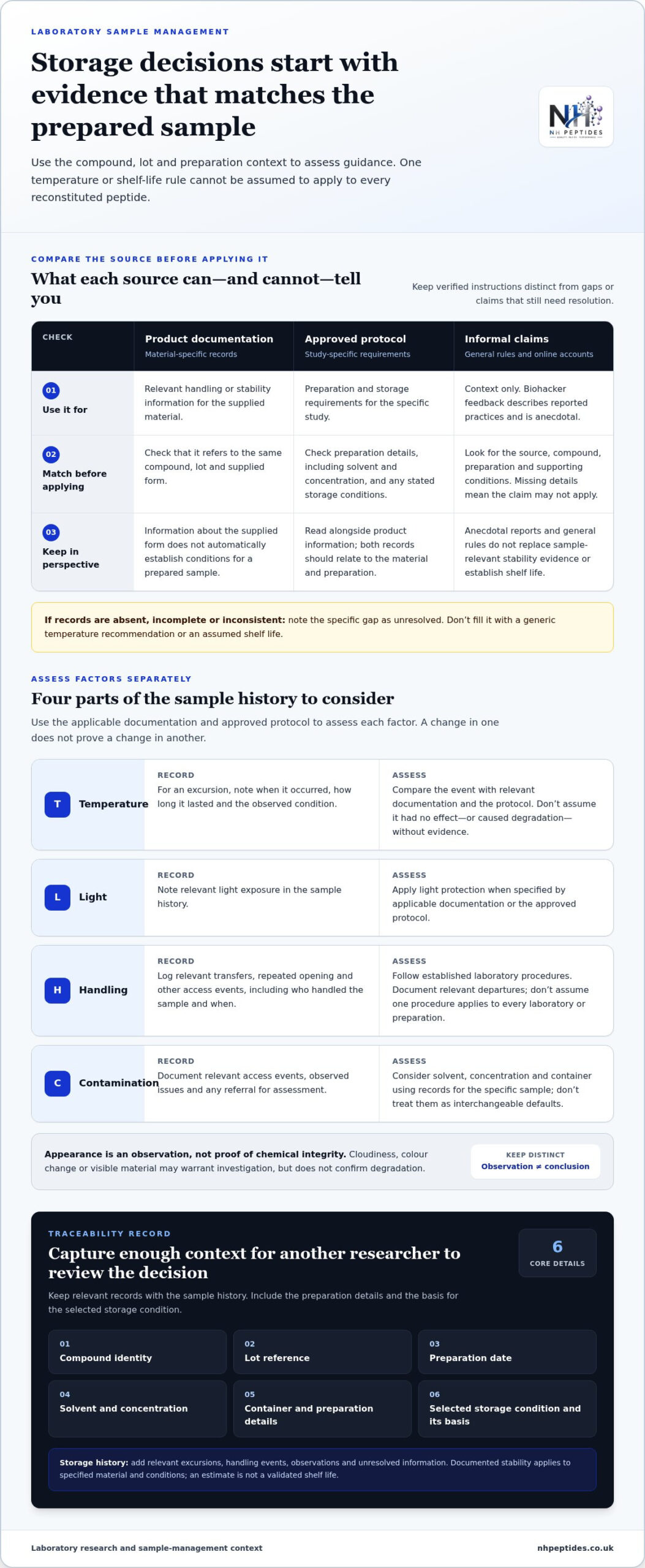
Product documentation may describe the supplied form or provide relevant handling and stability information. The protocol sets out study-specific preparation and storage requirements. Read these records together, checking that they refer to the same material and preparation. General guidance, informal rules of thumb and online accounts cannot replace evidence applicable to the sample. Background on peptide composition and manufacture is available in Peptide synthesis and stability, but this does not establish storage conditions for a particular prepared sample.
Which records should guide storage decisions?
Match the documentation to the exact compound, lot reference and supplied form. A record for a different lot, another peptide or unprepared material may not apply to the reconstituted sample. Review the approved protocol for preparation details and any specified storage requirements, including the solvent and concentration used.
Keep the relevant records with the sample history. When documentation is absent, incomplete or inconsistent with the protocol, record the specific gap or discrepancy as unresolved. Don’t fill it with a generic temperature recommendation or an assumed shelf life. This keeps verified instructions distinct from decisions that still need documented resolution.
Why one storage rule cannot cover every peptide
Peptide identity and preparation context determine which evidence is relevant. A storage statement for one compound cannot automatically be transferred to another. The solvent, concentration and container used for the prepared sample also provide important context. Record these variables and assess them against the applicable product information and protocol, rather than treating different preparations as interchangeable.
Documented stability is evidence tied to specified material and conditions; an estimate is not a validated shelf life. This distinction matters when a claim is repeated without its source, compound, preparation details or supporting conditions. If those elements are missing, don’t treat the claim as a sample-specific instruction.
This guidance concerns laboratory research and sample management only. Research peptides are not for human use, consumption, administration, medical diagnosis or therapeutic treatment. Keep storage decisions within the documented research context, and record unresolved information as an open point rather than converting it into an unsupported handling rule.
What can affect reconstituted peptide stability?
Stability is not a guaranteed property of a prepared sample. It depends on the peptide and the conditions it experiences after preparation. This is why guidance on how to store reconstituted peptides must be interpreted against evidence for the relevant compound and preparation, rather than turned into a general rule.
Temperature exposure, light exposure, handling and contamination are separate considerations. A change in one does not prove that another has occurred, and a sample’s appearance alone cannot establish its chemical integrity. Assess each factor using applicable product information and the study protocol. Don’t assign a numerical effect or shelf life unless supporting evidence applies to the sample and conditions in question.
Temperature, light and handling exposure
Record temperature excursions with the available details, such as when they occurred, how long they lasted and what condition was observed. Compare the event with the protocol and relevant documentation. Don’t assume an excursion had no effect, or that it caused degradation, without evidence.
Apply light protection when specified by applicable documentation or the protocol. Handling events also belong in the sample history, including transfers or repeated opening when relevant. Cloudiness, colour change or visible material may warrant investigation, but these observations do not confirm chemical degradation.
Solvent, container and contamination controls
The solvent, concentration and container are part of the preparation context. Evaluate their suitability for the specific sample using relevant records, rather than treating them as interchangeable defaults. Record the solvent identity and preparation details so a later review can establish what was actually prepared.
Each access to a multi-use container is a handling event to consider. Follow the laboratory’s established procedures for sample access, transfer and contamination control, and document relevant departures from them. No single aseptic procedure should be assumed to apply to every laboratory or preparation. The record should identify who handled the sample, when access occurred and whether an observed issue was referred for assessment.
Public biohacker discussions about peptide handling can illustrate practices people report, but they are anecdotal, not laboratory stability evidence or guidance for human use. For laboratory research context, see research peptides for laboratory studies.
How to assess storage conditions and peptide shelf-life claims
Storage claims are useful only when their scope matches the prepared sample. A temperature or duration quoted without identifying the compound, preparation and supporting conditions cannot establish how to manage that sample. For how to store reconstituted peptides, classify each instruction as documented, protocol-specific or unresolved before applying it.
| Classification | What to check | How to record it |
|---|---|---|
| Documented condition | Does the applicable product information identify the compound, supplied form, preparation context and storage conditions? | Record the source and the conditions it supports. Note any limits on its applicability. |
| Protocol requirement | Does the approved study protocol specify preparation or storage conditions for the sample? | Record the protocol version and relevant instruction. Keep the requirement distinct from product stability evidence. |
| Unknown or unresolved | Is information absent, incomplete, conflicting or unrelated to the prepared sample? | Mark the point unresolved. Don’t replace it with a general refrigerator, freezer or room-temperature assumption. |
How to review a shelf-life statement
Check what a duration claim actually covers. It should be traceable to the relevant compound and preparation, with storage conditions that correspond to the sample under review. A result observed in a defined study is evidence for that study’s material and conditions. It does not automatically establish a general shelf life for other lots, solvents, concentrations or containers.
If the source or supporting conditions aren’t available, label the duration claim unverified. Don’t enter it as an established expiry or handling instruction. A sample’s appearance or an informal report cannot validate a duration claim.
What to do when instructions conflict
Compare applicable product documentation with the approved laboratory protocol. Check whether each instruction refers to the same compound, supplied form and preparation. A mismatch may explain an apparent conflict, but don’t assume that it does. Document the discrepancy, the records reviewed and the point that remains unresolved.
Follow established institutional quality procedures to resolve the issue and record the decision. Don’t select whichever instruction is more convenient or transfer a storage condition or duration from a different peptide. Until the discrepancy has been addressed through the relevant procedure, retain it as a limitation in the sample record.
This assessment separates evidence from assumptions. A stated condition is not automatically applicable simply because it appears in a product sheet, protocol extract or online discussion. Its relevance depends on the material and preparation it describes. Keep the source, scope and decision linked in the record so subsequent handling can be reviewed against the same evidence.
A laboratory workflow for storing reconstituted peptide samples
A consistent workflow links each prepared container to its source documentation, study protocol and storage history. This makes the basis for a storage decision reviewable and helps prevent unsupported conditions or expiry dates from being carried into later records. Apply the sequence to each prepared sample, updating the record whenever its status or handling changes.
- 1. Review the applicable records. Match product documentation to the compound, lot and supplied form. Check the approved study protocol for preparation instructions and storage requirements. Record any unresolved discrepancy before assigning a condition.
- 2. Document the preparation. Enter the compound identity, lot reference, preparation date, solvent and concentration in the laboratory record. Include the study or sample identifier and container reference so the physical sample can be linked to its documentation.
- 3. Assign the documented condition. Record the storage condition specified by applicable documentation and the protocol. Note the source supporting the decision. Don’t substitute a default condition where the relevant records are silent.
- 4. Label and place the sample. Use the laboratory labelling system to identify the sample and connect it to its study record. Confirm that the assigned storage location matches the documented condition, then update the inventory or tracking record.
- 5. Maintain the sample history. Log access events, transfers and known storage excursions in the laboratory’s required format. Record the date, circumstances and action taken, then update the record following any review or change in status.
Label and document each prepared sample
A label should make the sample identifiable without relying on memory or a separate, unlinked note. Use the laboratory’s established format and include the identifiers needed to retrieve its preparation and storage record. Capture the preparation details in the record even when the container label has limited space.
Enter an expiry date only when applicable evidence supports it for the compound and relevant conditions. If there is no such basis, leave the duration unassigned and record that limitation. A convenient date or general estimate is not a substitute for documented evidence.
Monitor storage and document deviations
Use the monitoring process specified for the sample and protocol. If an excursion or handling deviation is known, document the available details and route the event through institutional procedures. Don’t reconstruct missing information as fact.
Assess sample suitability against applicable records and protocol criteria, not appearance alone. A visible change can be recorded and reviewed, but it does not independently establish chemical degradation or confirm integrity. If integrity cannot be established, follow institutional procedures for determining the sample’s status and documenting the decision.
For laboratory studies, select research peptides for your laboratory work and maintain a preparation record that supports traceable handling.
Apply peptide storage guidance within a research-only framework
Storage decisions should follow evidence and protocols applicable to the prepared research sample. A condition or duration taken from a general source may not apply to a different peptide, lot or preparation. Treat the storage record as the link between the material, its preparation, the evidence reviewed and its handling history. This supports an informed assessment of whether the sample remains suitable for its intended laboratory study.
Final review of the storage record
Before relying on a record, check that the compound identity and lot reference match the sample. Confirm that the preparation documentation covers the relevant solvent and container, then compare the selected storage condition with the study protocol and supporting product information. Make the source of each decision clear, rather than presenting an unsupported assumption as an instruction.
Review the sample history as well. Confirm that storage events, access and known deviations have been documented and are available for assessment. Where information is missing or a discrepancy remains, retain it as unresolved and follow the laboratory’s established procedures. Don’t infer sample integrity from appearance alone or add an unsupported shelf-life date.
Keep storage decisions within laboratory research
Public biohacker feedback about peptide handling can be referenced as anecdotal discussion only. It is not laboratory stability evidence, does not establish storage requirements and must not be treated as guidance for human use. Reported practices cannot replace compound-specific documentation, validated study evidence or an approved protocol.
NH Peptides compounds are intended strictly for laboratory research. They are not for human use or consumption, medical diagnosis or therapeutic treatment. Storage guidance in this article concerns research sample management only; it does not support administration or personal use.
For a final record review, verify the identity and lot, confirm that preparation details and selected conditions align with applicable documentation, and ensure the storage history and deviations are available for review. Where the evidence does not support a decision, document that limitation rather than substituting a universal rule. Researchers can review the NH Peptides research compounds in the context of laboratory studies and applicable product documentation.
Make sample records part of the next study
Use each new preparation as an opportunity to strengthen the laboratory’s sample-management process. A consistent record structure makes evidence easier to trace across studies and keeps unresolved storage questions visible, rather than allowing them to become assumed instructions. Review the documentation alongside the protocol whenever a preparation or its handling context changes.
For the next sample, make sure the storage decision can be traced from the applicable evidence through to the current record. Where the basis is incomplete, retain that uncertainty and use established laboratory procedures to determine the next step. This supports deliberate, reviewable decisions without relying on a universal rule.
NH Peptides is a UK-based supplier serving independent researchers and laboratory facilities. Its research compounds are intended strictly for laboratory study, not human use or treatment. Review research peptides for laboratory studies and apply the relevant product documentation within your research workflow.
Frequently Asked Questions
How long can reconstituted peptides be stored?
There is no fixed storage duration that applies to every reconstituted peptide. A duration is supportable only when the evidence covers the compound, preparation and storage conditions in question. Check the relevant product information and study records for scope and limitations. If a claim lacks traceable supporting data, mark it as unverified rather than assigning it as an expiry date or assuming a familiar timeframe applies.
Should reconstituted peptides be refrigerated?
Use refrigeration only when applicable product documentation and the study protocol support that condition. A general recommendation may not apply to a particular compound or preparation. Check that the condition refers to the reconstituted sample, not solely to the supplied material. If records differ, retain the discrepancy for resolution under laboratory procedures rather than selecting a condition by default.
Can reconstituted peptides be frozen?
Consider freezing only where relevant documentation and the approved protocol support it for the prepared sample. If a documented procedure permits freezing, consider whether single-use aliquots are appropriate to avoid repeated freeze-thaw cycles. Record the aliquot identifiers and handling history in the study record. Don’t infer suitability from another peptide’s procedure or from a general online recommendation.
What factors affect reconstituted peptide stability?
Stability can depend on peptide identity and preparation details, including solvent, concentration and container. Temperature and light exposure, handling and potential contamination are also separate considerations. Assess them against the sample’s records. Public biohacker feedback on peptide handling is anecdotal discussion only. It isn’t laboratory stability evidence or guidance for human use.
What information should a reconstituted peptide label include?
Use the laboratory’s labelling system to connect the container to its study record. Include the identifiers required by that system, such as compound identity, lot reference and sample or study code. Ensure the preparation date and storage condition can be traced from the label or linked record. Add an expiry date only where applicable evidence supports it for that preparation and condition.
What should I do if a peptide was stored outside its specified conditions?
Record the excursion promptly, including the known timing, conditions and handling context. Don’t decide that the sample remains suitable, or is unusable, from appearance alone. Compare the event with the applicable protocol and documentation, then follow institutional procedures for review and status decisions. If details such as duration or conditions are unknown, document that uncertainty rather than filling gaps with an estimate.
Can reconstituted research peptides be used for human administration?
No. NH Peptides compounds are intended strictly for laboratory research and are not for human use, consumption, administration, medical diagnosis or therapeutic treatment. Storage guidance in this article concerns research sample management only. It must not be interpreted as instructions for personal use, a clinical procedure or a recommendation to administer a research compound.
Related research and documentation
Storage decisions should follow documentation that applies to the specific compound and prepared sample. For related context, read the research reference guide, review the Quality & Testing information, and see the COA resources. The research catalogue provides product-specific information; it does not replace an applicable protocol or stability evidence.
