
Uncategorized
Research Peptides

Oct
A high purity figure does not, by itself, establish a peptide’s identity or suitability for a particular experiment. Laboratory research peptides are often described using terms that sound conclusive, but each claim needs to be considered against the evidence and the study question.
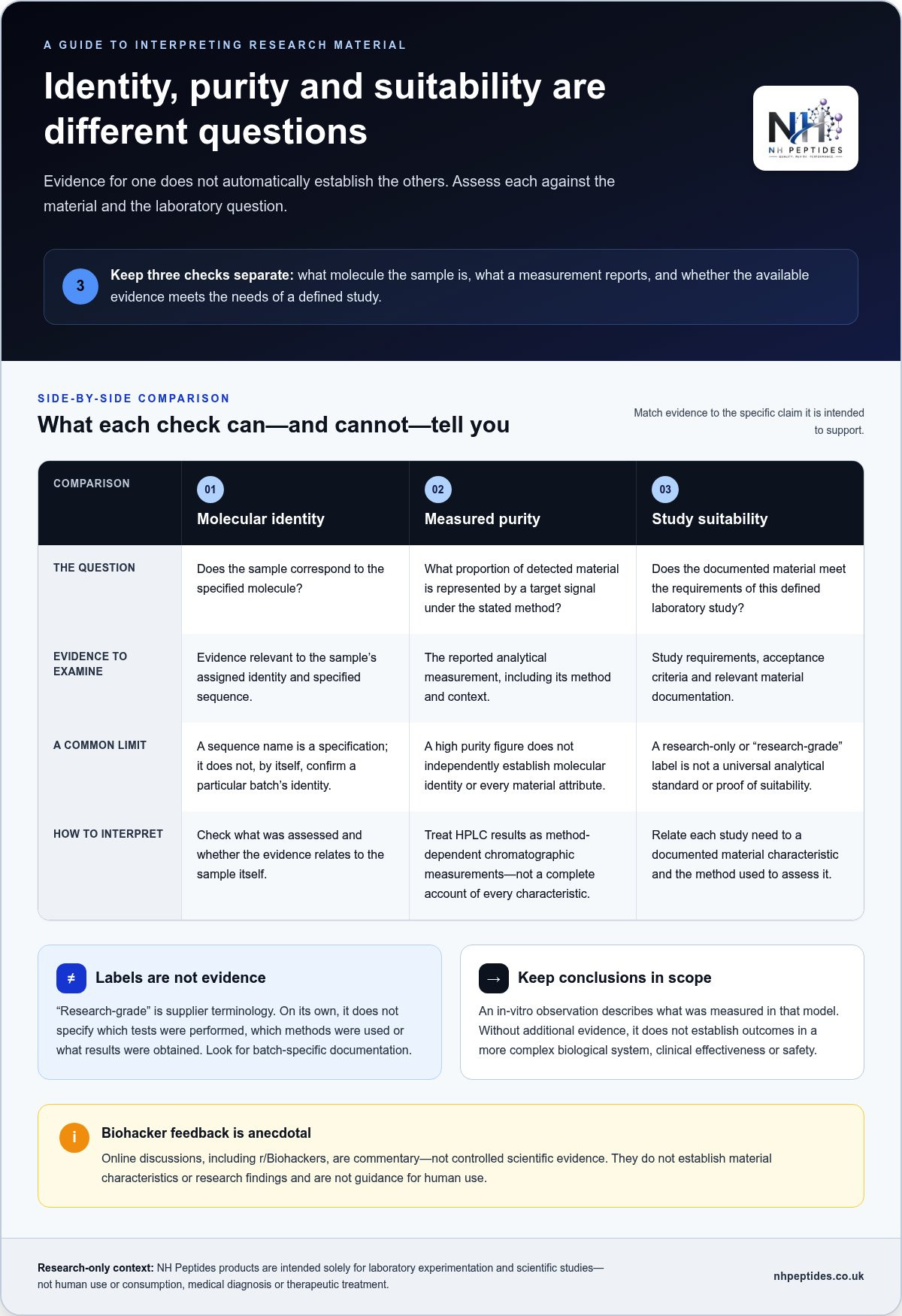
When evaluating a research material, separate molecular identity, measured purity and suitability for the planned study. Evidence for one does not automatically establish the others. Online biohacker feedback, including discussions in r/Biohackers, is anecdotal commentary, not scientific evidence or a basis for human use.
This article explains what research-only terminology can and cannot establish, how to assess evidence in context, and how to identify information relevant to a defined laboratory question. NH Peptides supplies research peptides for laboratory studies only. Its products are not for human use or consumption, medical diagnosis or therapeutic treatment.
Key Takeaways
- Laboratory research peptides are amino-acid chains. The research-only label describes their intended context, not their universal quality or suitability.
- Relate a peptide’s sequence and material attributes to the specific laboratory question before assessing evidence.
- Interpret HPLC results as method-dependent chromatographic measurements, not as a complete account of every material attribute.
- For laboratory research peptides, define study needs, identify the material, review relevant evidence and document the decision.
- NH Peptides’ products are intended solely for laboratory experimentation and scientific studies, not human use, consumption, medical diagnosis or therapeutic treatment.
What laboratory research peptides are, and what the term establishes
Peptides are molecules made from amino acids joined in a specific sequence. Their length and sequence distinguish them from other laboratory compounds, which may have different chemical structures and properties. A peptide’s sequence describes its molecular composition, but does not establish how a material was made, what a particular batch contains or whether it suits a defined experiment.
Definition: “A laboratory research peptide is a peptide presented for use in laboratory investigation. That description identifies its intended context, not its verified identity, purity, quality or suitability for a specific study.”
This distinction is central to interpreting the term. “Laboratory research” describes the stated purpose of a material, not a universal analytical grade. A research-only label is not evidence of safety or efficacy, and it does not establish that a material is approved or suitable for human use. Research context must remain separate from clinical or therapeutic application.
What does research-grade mean for a peptide?
“Research-grade” is supplier terminology, not a universal analytical standard. On its own, it does not specify which tests were performed, what methods were used or what results were obtained. Those details need separate, batch-specific documentation. A purity figure is only one reported measurement. Without its method and context, it cannot establish molecular identity or provide a complete assessment of material quality.
Separate the label from the evidence that supports it. A documented measurement relates to the sample and method described; it does not prove every characteristic a laboratory may require. Interpret results within their stated scope. Claims about a material and evidence for those claims are not interchangeable.
Where laboratory research fits
Laboratory investigation uses defined materials to address research questions under controlled conditions. Requirements depend on the purpose of the work. A study may need evidence about sequence identity, measured composition, batch traceability or another specified attribute. No single label establishes that all relevant requirements have been met. Peptide synthesis describes processes used to create peptide chains, but synthesis information alone does not verify the characteristics of a finished batch.
Retatrutide is one example of a research compound. Naming it does not imply a particular result or application. NH Peptides supplies research peptides, including Retatrutide, solely for laboratory experimentation and scientific studies. Its products are not for human use or consumption, medical diagnosis or therapeutic treatment.
Biohacker discussions, including feedback shared in r/Biohackers, are anecdotal commentary rather than controlled scientific evidence. They do not establish material characteristics or research findings, and should not be interpreted as guidance for human use. For a laboratory decision, use evidence that relates to the material and the defined research question.
How peptide structure and research questions shape laboratory context
A peptide’s amino-acid sequence is a defining feature of its molecular identity. Changing the order or composition of the chain describes a different molecular structure, even when materials share a broad category label. A catalogue term can help classify a material, but cannot independently confirm the identity of a particular sample. That requires evidence relevant to the sample itself.
Identity and purity answer different questions. Identity evidence addresses whether the material corresponds to the specified molecule. A purity measurement estimates the proportion of detected material represented by a target signal under a stated analytical method. Neither result, on its own, establishes every characteristic that may matter to an experiment.
Why sequence and molecular identity matter
Start with the molecular identity required by the research question. Then consider whether the available documentation supports that assignment. A sequence name is a specification, not proof that a supplied batch matches it. Likewise, a high reported purity does not independently establish sequence identity. Interpretation depends on what was measured, which method was used and how the result relates to the stated material.
How experimental context affects research requirements
Material requirements follow from the model and question under study. Before reviewing documentation, define the experimental system, the attribute that could affect interpretation and the acceptance criteria for that attribute. A study focused on molecular recognition may prioritise identity evidence; work sensitive to sample composition may require closer scrutiny of analytical purity and other documented characteristics. These examples show how requirements can vary. They are not experimental protocols.
Useful principle: “Select evidence by matching each study requirement to a documented material characteristic and the method used to assess it.”
This approach also keeps conclusions within the limits of the experimental setting. An in-vitro observation describes what was measured under the conditions of that model. Without additional evidence, it does not establish an outcome in a more complex biological system, clinical effectiveness or safety. Each broader claim requires evidence appropriate to that claim.
Organise an initial review around four checks:
- Model: Specify the experimental system and its relevant limits.
- Question: State what the study is designed to examine.
- Attribute: Identify the material characteristic that could affect interpretation.
- Evidence: Check whether the available measurement addresses that attribute and sample.
Regulatory guidance also has a defined scope. The US Food and Drug Administration’s FDA Guidances for Drugs concerns drug-related guidance. It should not be treated as evidence that a research material is suitable for a particular experiment or as a statement of UK requirements. Keep regulatory context distinct from study-specific analytical evidence.
Researchers assessing research peptides for laboratory studies can follow the same sequence: specify the question, identify the material attribute that matters, then review evidence within its stated scope. This supports a traceable decision without extending the evidence beyond what it shows.
How to distinguish peptide identity, purity and analytical evidence
Analytical documents are most useful when each result is read as an answer to a specific question. A chromatographic purity value does not establish molecular identity, while an identity result does not show every possible impurity or confirm suitability for a study. For laboratory research peptides, the method, sample tested and batch reference define what a report can support. See this guide to research peptide quality documentation for more on how laboratory records and analytical results should be interpreted in context.
Separate the evidence by purpose:
| Evidence area | What it can address | What it does not establish alone |
|---|---|---|
| Identity | Whether analytical findings support assignment to the stated molecule. LC-MS can contribute evidence by comparing measured mass-related data with the expected material. | Overall purity, every impurity, or suitability for a particular study. |
| Chromatographic purity | The relative chromatographic signal attributed to the target under the stated method, such as HPLC. | Definitive identity, unmeasured components, or experimental performance. |
| Batch traceability | Whether a report is linked to an identified batch or sample. | Whether the method answers every study requirement or the result applies to a different batch. |
These are complementary evidence categories, not interchangeable quality labels. A report may cover one or more categories, but its conclusions remain bounded by the sample and procedures described.
Purity results are not identity confirmation
A purity result is a measurement produced using a stated analytical method. In HPLC, compounds are separated and detected under defined conditions. The reported proportion reflects the chromatographic response and calculation used. Results can depend on the method, including its separation conditions and detection. Read a percentage alongside the method and report context, not as a universal measure of quality.
LC-MS is a separate analytical approach that can support identity assessment by providing mass-related information. It does not make a chromatographic purity result redundant, and neither measurement alone establishes how the material will perform in an experiment. Experimental performance requires evidence from the relevant study context.
What batch-linked records can contribute
Traceability helps connect a material to the record used to describe it. Compare the identifier on the material with the batch or sample identifier in the report. Then review the analytical method, test date, reported result and any notes that define the sample or measurement. If the identifiers do not align, the document may not describe the material under consideration.
- Method: Shows how the reported measurement was obtained.
- Batch or sample identifier: Links the result to the material described.
- Date and result context: Helps establish when the measurement was made and what it represents.
Interpret each field against the study’s stated requirements. A well-organised record supports review and traceability, but does not by itself prove that all relevant characteristics have been assessed.
How to assess research peptides against a laboratory study
A defensible material decision begins with the study, not a catalogue label or an isolated analytical figure. For laboratory research peptides, connect each requirement to evidence that addresses it, then record any gaps. This keeps procurement decisions relevant to the intended work and prevents unreported characteristics from being treated as established facts. For a broader research peptide supplier comparison, use the compound and batch-specific documentation as the starting point rather than headline claims or online reputation.
A four-step research-led review
- Define the study need. Record the research question, model and material attributes that could affect interpretation. Set acceptance criteria before reviewing a candidate material, so the criteria are not adjusted to fit the available documentation.
- Identify the material. Compare the stated molecular identity and material or batch identifiers with the records supplied. Note any mismatch or missing identifier. A document that cannot be connected to the material under review provides limited traceability.
- Assess the evidence. For each required attribute, identify the corresponding measurement or record. Check the method, sample and stated result. Record when evidence is absent, unclear or outside the scope of the study requirement. Do not infer characteristics that were not reported.
- Document the decision. Note which criteria are supported, which remain unresolved and the reason for the final assessment. This creates a clear record for later review and helps distinguish a documented finding from an assumption.
The sequence is deliberately study-specific. A result can be relevant to one requirement and insufficient for another. Supplier comparisons and procurement checklists involve additional criteria, while detailed certificate-of-analysis (COA) interpretation is best handled separately from this decision framework.
How to interpret biohacker feedback
Online biohacker discussions, including posts in r/Biohackers, can be referenced as anecdotal community feedback. Testimonials are not laboratory evidence or validated scientific findings. They do not verify a material’s identity, analytical characteristics or performance in a defined study. Treat them as commentary about online discussion, not as a recommendation, research conclusion or basis for human use.
Keep the evidence record focused on sources that directly address the study criteria. If commentary and analytical documentation make different kinds of claims, do not give them equivalent evidential weight. A concise note can state what was reviewed and why a source was excluded from the scientific assessment.
Researchers considering NH Peptides’ research peptides for laboratory studies can use this four-step framework to keep material review tied to a defined research question. Products are intended solely for laboratory experimentation and scientific studies. They are not for human use, consumption, medical diagnosis or therapeutic treatment.
Research-only boundaries and NH Peptides laboratory supply
Research-only wording identifies a stated laboratory context. It does not establish clinical safety, efficacy, regulatory status or suitability for a particular experiment. Those conclusions require evidence appropriate to the claim. A material described for research should not be treated as a medicine or therapeutic alternative.
Keep laboratory research separate from human use
Laboratory research and human use are distinct contexts. Research descriptions do not provide a basis for consumption, administration, dosing or self-experimentation, and this article offers no such guidance. Findings from laboratory work should remain within the limits of the methods and model used. They do not independently establish safety or effectiveness in people.
Regulatory interpretation depends on the relevant product and jurisdiction. For UK-specific questions, consult current official guidance rather than treating a supplier’s research-only wording as a regulatory determination. That wording describes intended context; it does not replace regulatory assessment.
Research peptide supply from NH Peptides
NH Peptides is a UK-based supplier of research peptides, serving independent researchers and laboratory facilities nationally. Its products are intended solely for laboratory experimentation and scientific studies. They are not for human use or consumption, medical diagnosis or therapeutic treatment. Retatrutide is included as a compound supplied for laboratory research, not as a product for clinical or personal use.
These boundaries matter when interpreting product information. A research designation does not establish that a material suits every laboratory question, nor does it support claims beyond documented evidence. Keep intended context, material records and study requirements distinct. Do not assume a specification or result that has not been documented.
For institutional review, retain a clear record of the research purpose and the evidence used to assess a material. Distinguish stated product context from analytical findings, and keep conclusions within the scope of those findings. This supports accountable laboratory decision-making without extending research information into clinical claims.
Review NH Peptides research peptides for laboratory research contexts.
Carry the evidence into your next research decision
Make the next step a documented decision, not an assumption. Before selecting laboratory research peptides for a study, define the question the work must address and the material attributes that could affect interpretation of the results. Keep acceptance criteria clear, and record where available evidence supports them or leaves uncertainty. This creates a useful basis for future review as research requirements develop.
NH Peptides supplies research peptides for laboratory studies, including Retatrutide. Consider product information only in the context of laboratory experimentation and scientific studies. Products are not for human use, consumption, medical diagnosis or therapeutic treatment.
For a research-led review of the available range, review NH Peptides research peptides. A defined question and careful evidence review provide a sound starting point for responsible laboratory work.
Frequently Asked Questions
What are laboratory research peptides?
Laboratory research peptides are peptide materials designated for scientific investigation in a laboratory setting. Their relevance depends on the study question and material specification. For example, a project requiring a defined amino-acid sequence needs evidence addressing that identity; a broad category name is not enough. The research label does not establish a batch’s measured characteristics or predict how it will behave in a particular experimental model.
What does research-grade mean for peptides?
“Research-grade” is a descriptive label, not a complete specification. Interpret it alongside information that applies to the material under review, such as its stated identity, batch reference and analytical records. Online biohacker discussions, including community feedback on r/Biohackers, are anecdotal commentary, not batch documentation or validated scientific findings. They cannot verify a product claim or replace evidence relevant to a laboratory assessment.
Does a high peptide purity result confirm its identity?
No. A high purity result does not, by itself, confirm that the material is the specified peptide. Purity and identity are separate analytical questions. Check whether the report includes evidence relevant to identity, alongside the method and sample behind the purity result. A percentage alone cannot establish how the material will perform in a study or whether it meets that study’s requirements.
How can researchers assess peptide identity?
Researchers can review identity evidence alongside the stated molecular specification and the sample or batch identifier. LC-MS may support identity assessment by providing mass-related data, but its relevance depends on the report’s method and context. Check that the documentation refers to the material being assessed and that the reported evidence addresses the required identity question. Record limitations rather than treating a method name as proof of every characteristic.
Are laboratory research peptides intended for human use?
No. NH Peptides’ products are solely for laboratory experimentation and scientific studies. They are not for human use or consumption, medical diagnosis or therapeutic treatment. A research-only designation does not establish clinical safety, efficacy or regulatory status. Laboratory observations should not be interpreted as advice or evidence for personal use. Keep product information within its stated research context and consult current official guidance where regulatory interpretation is required.
Can one research peptide be suitable for every laboratory study?
No. Suitability is specific to the study design and its material requirements. A material may meet one project’s defined criteria but lack the evidence needed for another model or research question. Before selecting it, specify the experimental system and the attributes that could affect interpretation. Assess available documentation against those criteria rather than assuming that a material suitable for one laboratory purpose will suit all others.
What should a laboratory review before procuring research peptides?
Set out the research purpose and required material attributes first. Then check that the stated identity and batch reference correspond to the records provided, and review the methods and results relevant to each requirement. Note missing information and evidence limits; do not infer unreported characteristics. Procurement records should preserve the basis for the decision. Product use must remain within laboratory experimentation and scientific studies, not human use, diagnosis or treatment.
