
Uncategorized
Retatrutide Supplier UK: A Research-Use Comparison Guide

Oct
A research-use label and a human-use claim are not equivalent. When comparing a Retatrutide supplier UK, keep that boundary clear, especially when supplier pages place laboratory documentation beside clinical findings and online user accounts.
Compare suppliers using consistent criteria: stated research-use boundaries, product identity, batch references and the scope of any testing documents. Keep those details separate from evidence generated in human clinical trials. Published trial findings and informal reports answer different questions, and neither establishes a research product’s safety, efficacy or suitability for human use.
This guide considers Retatrutide’s Phase 3 clinical research separately from biohacker feedback on Reddit. Reddit posts are unverified personal accounts, not controlled evidence or product-specific verification. NH Peptides supplies Retatrutide for research use only. Its products are not for human use or consumption, medical diagnosis or therapeutic treatment. The sections below explain how to assess supplier claims and procurement records without confusing them with clinical findings or anecdotes.
Key Takeaways
- Compare a Retatrutide supplier UK by its research-use boundaries, product identity and procurement records, not consumer-oriented claims.
- Use lot identifiers to connect product information to a specific batch. Assess analytical methods separately from reported results and sample identity.
- Distinguish supplier-provided documents from independent analytical evidence. A document’s presence alone does not establish what it verifies.
- Use a consistent procurement checklist covering research purpose, product identity, available records and intended-use limits.
- Keep clinical findings and biohacker accounts separate from supplier and batch documentation. Neither establishes a research product’s suitability for human use.
Retatrutide supplier UK: separate the research compound from clinical evidence
A supplier comparison looks at research-use supply, product information, records and procurement fit. It cannot establish whether a supplier’s material reproduces findings from a clinical study. Retatrutide is the compound studied in clinical trials; a supplier’s product is a particular material that may be associated with an individual batch. Evidence about the compound does not automatically establish the identity, composition or performance of a supplier’s product.
Supplier pages sometimes place clinical findings alongside product descriptions. Those findings relate to the clinical study and its defined conditions, not to every product sold under the compound name. In a Retatrutide supplier UK assessment, keep research findings, supplier statements and batch-specific documents in separate evidence categories.
Retatrutide is described as a triple agonist acting on GLP-1, GIP and glucagon receptors. The overview of GLP-1 receptor agonists and Retatrutide provides context on the drug class; it does not verify a supplier’s material. NH Peptides supplies Retatrutide for laboratory research only. Its products are not for human use or consumption, medical diagnosis or therapeutic treatment.
What human clinical research can and cannot establish
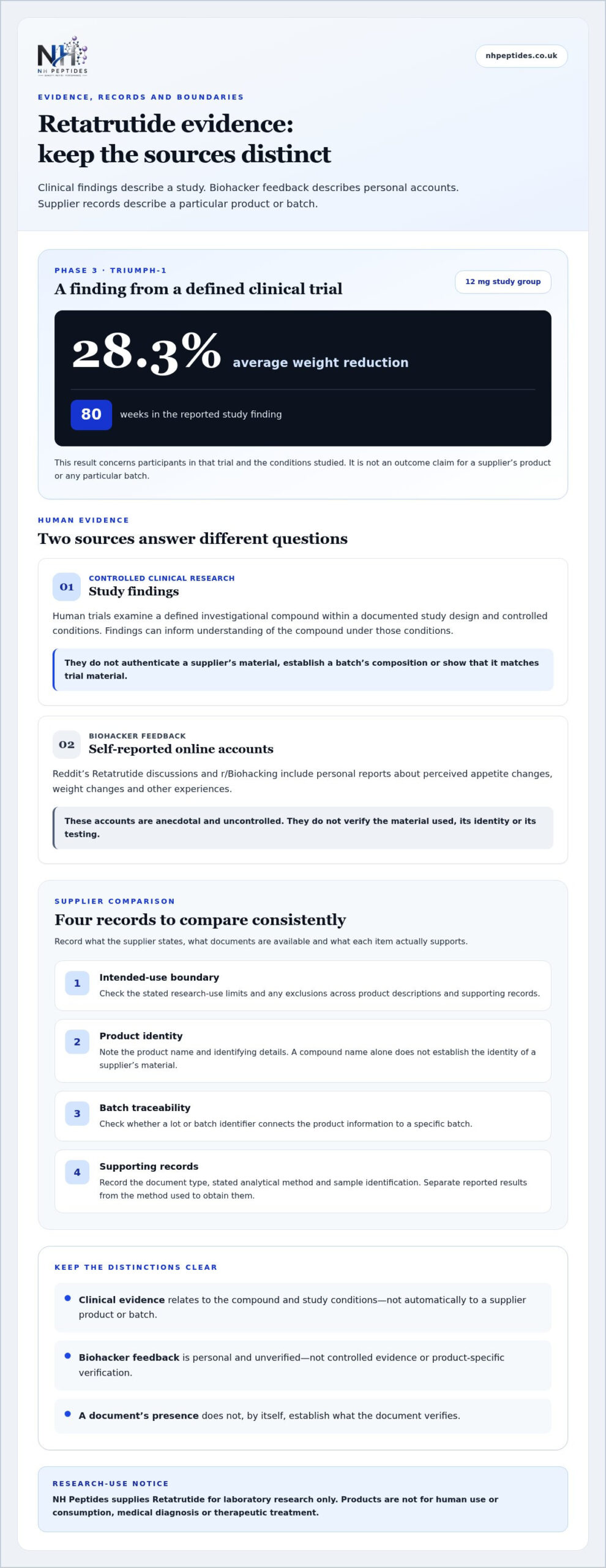
Human trials assess a defined investigational compound within a documented study design and controlled conditions. Results published in the New England Journal of Medicine on 29 September 2026 reported an average weight reduction of 28.3% at 80 weeks in the 12 mg study group of Phase 3 TRIUMPH-1. This finding concerns participants in that trial. It is not an outcome claim for a supplier’s product or a particular batch.
Clinical publications can inform understanding of the compound under the conditions studied. They cannot authenticate a research supplier’s product, establish its batch composition or show that it matches trial material. Procurement records and clinical outcomes address different questions.
How online biohacker feedback differs from research evidence
Communities such as Reddit’s Retatrutide discussions and r/Biohacking include self-reported accounts of perceived appetite changes, weight changes and other experiences. Some UK users describe substantial personal weight loss. These accounts are anecdotal, not controlled clinical data, and they do not establish what material was used or how it was verified.
Online feedback can show what people are discussing, but it cannot verify identity, purity, safety or efficacy. Nor can it validate a supplier’s product or indicate suitability for human use. Keep such accounts separate from published clinical findings and procurement documentation.
Compare Retatrutide suppliers by product information and research-use boundaries
Record what each supplier states, then keep those statements distinct from analytical evidence. Similar product names, customer comments and broad quality language do not prove that two suppliers provide equivalent material. Compare the same categories for each supplier and label details as stated, documented or not provided.
Compare intended-use statements and product descriptions
Check that research-only limits are clear and consistent across product descriptions, ordering information and supporting records. Product descriptions should be distinct from weight-management, treatment or consumer-oriented language. NH Peptides supplies Retatrutide for laboratory research only; its products are not for human use or consumption, diagnosis or treatment.
| Comparison category | Record from supplier information | Interpretation |
|---|---|---|
| Intended use | Stated research-use boundary and any exclusions | Shows how the supplier defines the product’s intended use, not its suitability for other uses. |
| Product identity | Name and identifying details provided for the material | Helps distinguish the product description from Retatrutide as a compound. |
| Batch traceability | Whether a lot or batch identifier is supplied | Indicates whether records can be associated with a specific batch. |
| Supporting records | Document type, stated method and sample identification | Shows what information is presented, not whether every quality attribute has been established. |
Compare documentation claims without treating them as interchangeable
A lot identifier connects records to a particular batch. A certificate presents reported information, while an analytical method describes how a measurement was performed. These serve different purposes. A statement that testing occurred is not the same as reviewing a result tied to a clearly identified sample. Even analytical data do not establish every product attribute or make a material suitable for human use.
Record which documents are available and what each supports. The Retatrutide research compound review checklist offers a structured reference for reviewing product identity and supporting information without conflating supplier claims with verification.
Customer reviews and biohacker posts may describe personal experiences, but they cannot replace batch records or analytical evidence. Treat them as anecdotal, self-reported accounts, separate from supplier documentation. A report about one person’s experience cannot identify the material involved or verify its contents.
Apply the same research-only criteria when reviewing NH Peptides’ Retatrutide research supply as you would to other supplier information.
Assess Retatrutide records: lot identity, analytical methods and evidence limits
In a Retatrutide supplier UK comparison, product records describe a specific batch, while human research and public accounts describe findings or experiences in different contexts. Clinical publications report outcomes observed under defined study conditions. Biohacker accounts may describe perceived changes, but often provide limited information about the material’s identity or provenance. Neither source establishes what a supplier’s batch contains.
Self-reported accounts also vary in how they are recorded. A post may omit context, rely on personal recall or describe an outcome without independent measurement. When reviewing feedback, distinguish what the author says they experienced from what can be verified. Such accounts show topics discussed in biohacker communities; they do not validate product quality or demonstrate a product-specific outcome.
What an HPLC result can indicate
High-performance liquid chromatography (HPLC) separates components in a sample and can support an assessment of relative chromatographic purity. The reported result depends on the method, sample and calculation used. Interpret it in that context, not as a universal measure of quality or evidence about clinical outcomes.
A purity result describes the measured sample under a stated method; it does not, by itself, confirm the sample’s identity. For procurement review, note whether the report identifies the sample and links it to a batch. Do not apply an unstated threshold or extend a result from one batch to another.
When LC-MS identity information is relevant
Liquid chromatography-mass spectrometry (LC-MS) combines separation with mass analysis. Results can contribute evidence about whether a detected component is consistent with an expected molecular mass. Their meaning depends on the sample and analytical context. A method name alone is not enough to assess a result.
Identity evidence does not establish purity, biological activity or a person’s reported experience. Clinical findings and biohacker accounts address different questions. None should be used to fill gaps in product-specific records. The Retatrutide laboratory studies evidence guide provides context for interpreting research findings without treating them as supplier-batch verification.
Keep these fields separate when reviewing records:
- Batch reference: Is the record connected to an identified batch?
- Sample and method: What material was assessed, and how?
- Reported result: What does the finding state, and what remains unresolved?
- Human or anecdotal evidence: Is the source a controlled study or a self-reported account, and what can it support?
This separation makes the evidence easier to interpret. A clinical result, a personal report and an analytical record each have a different context.
Use a research procurement checklist before selecting a UK supplier
Start procurement with the laboratory’s defined research purpose and the Retatrutide product under consideration. Keep the product description separate from human clinical findings and online biohacker accounts. Clinical publications describe outcomes in their stated study settings; community posts describe individuals’ self-reported experiences. Neither establishes the characteristics or outcomes of a supplier’s research product.
A concise sequence for laboratory procurement
Use a consistent record to connect the research purpose with the offered product. Keep procurement criteria separate from experimental or handling instructions.
- Specify the research requirement. Record why Retatrutide is being considered and identify the compound required. Keep this focused on the research project, not personal outcomes discussed online.
- Assess the product description. Note how the supplier identifies the product and describes its research use. Distinguish that description from findings about Retatrutide in human studies.
- Record available product information. Capture batch references and associated records in separate fields. This supports an auditable purchasing record without implying that documentation answers every question about the material.
- State the use boundary. Document that the product is intended for laboratory research only. Keep the restriction visible in procurement records and internal procedures.
Biohacker discussions may include accounts of perceived appetite, weight or other changes. These reports can show which experiences people discuss, but they are self-reported and may not establish what material was involved or how outcomes were assessed. They do not validate a research product or provide a basis for human use. Treat them as a distinct source, not a procurement specification.
Keep clinical and regulatory statements current
Human clinical evidence and online anecdotes have different evidential limits. Check dated trial claims against current primary trial records, and note the date and source used. Do not transfer study outcomes to a supplier’s product or infer that a research compound is appropriate for personal use.
For regulatory wording, consult current authoritative UK sources, including the MHRA where relevant. Supplier descriptions and online accounts are not substitutes for those sources. Keep regulatory statements separate from product selection, and avoid conclusions about diagnosis, treatment or human-use suitability.
The Retatrutide research peptide evidence overview can help distinguish human study findings, online reports and product information. For research procurement, see NH Peptides’ Retatrutide research supply.
NH Peptides Retatrutide supply for laboratory research
NH Peptides is a UK-based supplier of research peptides, including Retatrutide, for researchers and laboratory facilities across the United Kingdom. In a Retatrutide supplier UK comparison, this makes NH Peptides a research supply option for laboratory procurement. It does not describe a particular batch’s analytical characteristics or establish equivalence with material used in clinical studies.
Where NH Peptides fits in a supplier comparison
Assess NH Peptides using the same framework applied to other suppliers. Record the stated product identity and intended research use, then interpret product-specific information within its stated scope. Keep supplier descriptions separate from clinical trial findings and online reports. Do not attribute another supplier’s claims or documents to NH Peptides.
Clinical evidence concerns study material and defined study conditions. Biohacker accounts are self-reported experiences, not procurement records. Neither verifies the identity or characteristics of a supplied batch. A supplier comparison should describe the supply option’s purpose without turning outside evidence into a product claim.
NH Peptides supplies Retatrutide for laboratory research only. It is not for human use or consumption, and it is not intended for medical diagnosis or therapeutic treatment. This boundary applies regardless of how the compound is discussed in clinical publications or online communities. Research supply is not a route to personal use.
Proceed with research-only procurement
For laboratory procurement, use the supplier description to identify the research-use supply route, then align purchasing records with the laboratory’s defined research purpose. Product information, batch-specific records and analytical findings are distinct evidence categories. Do not infer testing, certificates, purity, stock or delivery characteristics from a supplier’s location or product category.
Biohacker discussions may include frequent accounts of perceived experiences, including appetite, weight changes or other effects. These remain anecdotal and self-reported. They cannot establish what material was involved, verify its quality or demonstrate that a research product is suitable for human use. Treat them as public discussion, not a basis for procurement or product assessment.
NH Peptides’ role in this comparison is its stated UK-based supply of Retatrutide for researchers and laboratory facilities. No clinical, diagnostic or therapeutic suitability is implied. The research-only boundary remains central to interpreting the product information.
For laboratory research procurement, view NH Peptides’ Retatrutide research supply. Products are not for human use or consumption.
Make the next procurement review traceable
Use the comparison criteria to create a procurement record that can be reviewed over time. Record the source and date of supplier statements and external evidence. This gives the research team a clear reference when information changes, without treating a revised claim as proof beyond its documented scope.
For each Retatrutide supplier UK assessment, retain the procurement rationale alongside the research purpose. A consistent record supports internal review and keeps research-only boundaries visible as projects and requirements evolve. NH Peptides supplies Retatrutide for laboratory research to UK researchers and laboratory facilities; its products are not for human use or consumption, diagnosis or treatment.
For research-focused procurement information, view Retatrutide for laboratory research. Use the product information to begin your research-only procurement review.
Frequently Asked Questions
Where can UK researchers source Retatrutide for laboratory studies?
NH Peptides supplies Retatrutide as a research peptide to researchers and laboratory facilities across the UK. Use the product information as the starting point, then record how the stated product identity fits the laboratory’s research purpose. The product is strictly for laboratory research, not human use or consumption, medical diagnosis or therapeutic treatment. Clinical publications do not alter this use boundary.
What should a Retatrutide supplier comparison include?
Compare each supplier’s intended-use statement, product identity, lot references and the scope of available analytical records. Record these separately rather than combining them into a general quality judgement. Supplier statements describe the offered product, customer feedback records personal opinions, and clinical publications report study findings. These are not interchangeable forms of evidence. Keep the comparison focused on laboratory procurement, without drawing conclusions about human-use suitability.
Is a supplier’s purity claim enough to assess Retatrutide?
No. A purity figure is one analytical result, and its meaning depends on the method, sample and connection to a specific batch. It does not by itself confirm identity, biological activity, safety or suitability. Avoid applying a universal threshold or attributing an unverified result to NH Peptides. Assess the underlying record and document what the result does and does not establish.
Can online biohacker feedback confirm Retatrutide product quality?
No. Public discussions, including Reddit’s Retatrutide community and r/Biohacking, contain anecdotal, self-reported accounts. Such posts generally cannot establish a research product’s identity, composition, purity or provenance. They are not substitutes for analytical records or clinical evidence. Personal reports should not be presented as product outcomes, proof of efficacy or endorsement of human use.
How can a laboratory distinguish clinical evidence from supplier product information?
Clinical publications describe research conducted under the study conditions they report. Supplier information concerns a particular offered product and may include product descriptions or associated records. Keep these sources separate in procurement documentation, and check the date and primary source for claims about trial status. Neither source establishes the other’s findings. Do not translate clinical results into dosing or treatment advice, or claims that a research peptide is suitable for human use.
What does LC-MS identity confirmation tell a researcher about a peptide?
Mass spectrometry can contribute evidence about molecular identity by measuring mass-related characteristics of a sample. Interpretation depends on the analytical context and the sample assessed. This evidence is distinct from a purity result and does not establish every quality attribute or biological effect. A method name alone is not a complete record.
Can Retatrutide sold for research be used for human consumption?
No. NH Peptides’ Retatrutide is supplied strictly for laboratory research and is not for human use or consumption, medical diagnosis or therapeutic treatment. Do not use research products as medicines or infer human-use suitability from clinical publications, supplier descriptions or online anecdotes. The research-only designation does not provide a basis for personal use. This article does not provide medical advice, dosing guidance or administration instructions.
