
Uncategorized
Retatrutide Research Compound: A Laboratory Review Checklist

Oct
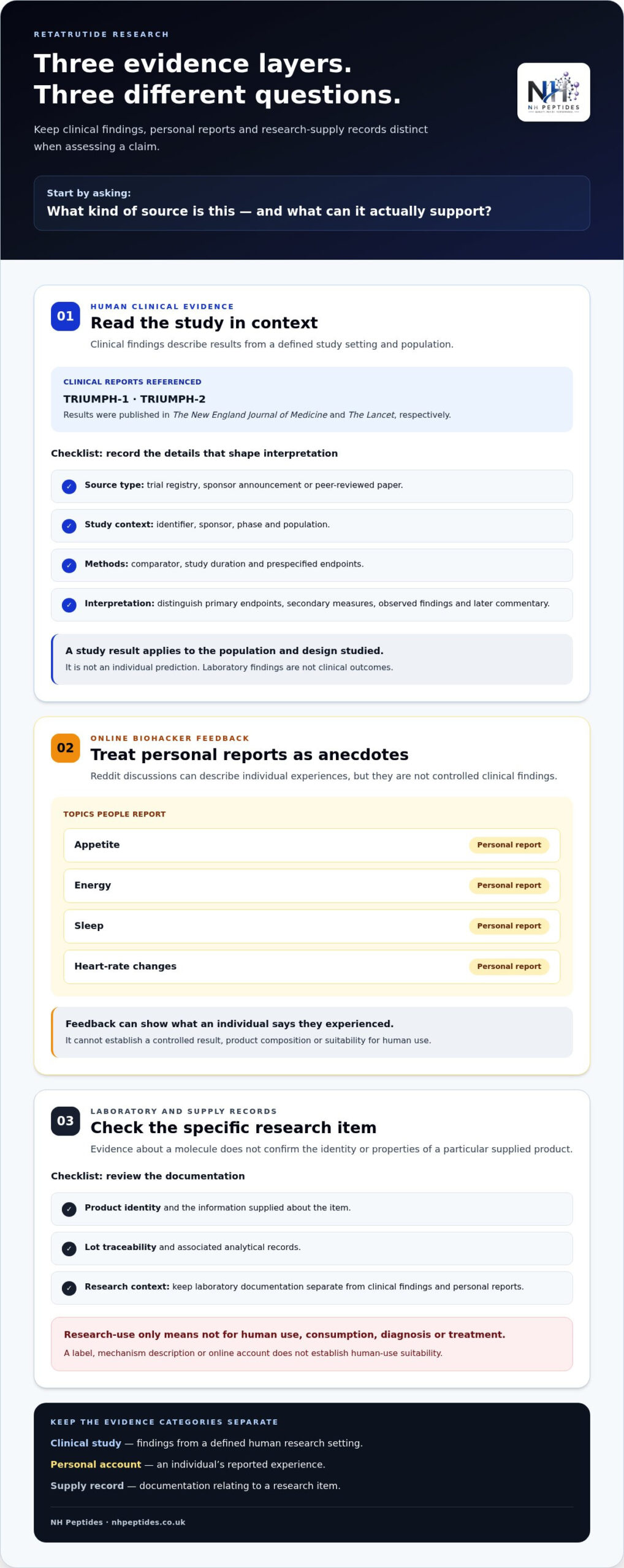
A “research use only” label does not establish clinical evidence, product quality or suitability for human use. The Retatrutide research compound appears in clinical trial reports, supplier descriptions and online anecdotes, but each source answers a different question.
That distinction matters when human trial findings appear alongside personal accounts. Results from the Phase 3 TRIUMPH-1 and TRIUMPH-2 studies, published on 29 September 2026, are clinical evidence. Reports of appetite, energy, sleep or heart-rate changes in Reddit discussions about retatrutide are anecdotal feedback, not controlled findings. Neither type of source replaces laboratory-supply documentation. For a framework for reviewing supporting records, see the research peptide quality documentation guide.
This checklist explains how to assess each evidence layer: study date and context, the limits of online reports, and the records accompanying a research compound. NH Peptides supplies Retatrutide for laboratory research only. It is not for human use, consumption, diagnosis or treatment. Keep clinical results, personal reports and product information clearly separate.
Key Takeaways
- Assess human clinical findings by study population, design, comparator, endpoints and publication date.
- Keep laboratory findings and online biohacker feedback distinct from controlled clinical evidence.
- Use a Retatrutide research compound checklist to review product identity, lot traceability, analytical records and research context.
- Research-use products are not for human use, consumption, diagnosis or treatment.
- NH Peptides supplies Retatrutide and other research peptides for laboratory studies across the UK.
Retatrutide research compound: define the scope before reviewing evidence
Retatrutide, also identified by the research code LY3437943, is a molecule under clinical investigation and described as a triple agonist. The phrase Retatrutide research compound can also describe a product supplied for laboratory research. These contexts are related but distinct: evidence about the molecule does not establish the identity or properties of a particular supplied product.
Clinical research in people evaluates the investigational molecule in defined study settings. Laboratory research examines compounds through non-clinical methods. Neither is interchangeable with personal online reports or supplier descriptions. A product labelled for research use is not for human use, consumption, diagnosis or treatment, regardless of how its mechanism is described.
Before interpreting a claim, separate the information into three records: what the molecule is, what human studies have investigated, and what documentation applies to a particular research-supply item. This helps prevent a mechanism summary from being mistaken for a clinical result, or a clinical result from being treated as confirmation of a product’s composition. The Retatrutide Wikipedia overview can provide general orientation, but study-specific claims require review of the underlying clinical source.
What does the term triple agonist describe?
“Triple agonist” describes activity at three receptor targets: the glucagon-like peptide-1 (GLP-1) receptor, the glucose-dependent insulinotropic polypeptide (GIP) receptor and the glucagon receptor. The term identifies the targets involved. It does not, on its own, establish the magnitude or significance of an effect. Keep this mechanistic description separate from findings measured in a particular study.
What does research compound mean in this context?
Clinical investigation concerns the molecule as studied under a defined research protocol. A research-supply product is a separate item intended for laboratory research. Its label does not establish that it is identical in all respects to material used in a clinical study, or make it suitable for clinical administration. Do not infer human-use suitability from a product description, online account or mechanism summary.
For an initial classification, note the type of source and what it can support:
- Mechanism reference: describes receptor targets and terminology.
- Clinical publication: reports findings from a defined human study.
- Laboratory record: relates to non-clinical compound research or product documentation.
- Personal account: records an individual’s report, not a controlled clinical finding.
This scope check gives each claim an appropriate evidence category. The next step is to assess the clinical study’s design, population, comparator and endpoints.
Clinical research checklist: assess the human evidence in context
Human trial findings are most useful when read alongside the protocol and publication that produced them. Before relying on a reported result, identify its source type, study population, design, comparator, endpoints and date. These details define what the result can support.
Trial findings apply to the population studied and the design used; they are not individual predictions. Keep this distinction clear when comparing human studies with laboratory findings. Preclinical or other laboratory results can inform research questions, but they are not clinical outcomes and should be labelled separately.
Check the source, trial and publication status
Start with the trial identifier and sponsor, then note the study phase and the date of the record or publication. For example, the Retatrutide clinical trial record on ClinicalTrials.gov identifies a Phase 3 study in people with obesity and cardiovascular disease. The registry helps establish the trial’s design and timeline, but it is not a substitute for a published results paper.
Distinguish between a registry, a company announcement and a peer-reviewed publication. A registry describes a study record, which may include design details and updates. A company announcement presents the sponsor’s account of a development or result. A peer-reviewed publication provides a full research report for assessment. TRIUMPH-1 and TRIUMPH-2 results were published in The New England Journal of Medicine and The Lancet, respectively, on 29 September 2026. Check the publications for methods, reported outcomes and limitations rather than relying only on summaries.
Read endpoints and limitations before interpreting results
Build a short record for each human study. Capture the population, comparator, study duration, prespecified endpoints and publication date. Check whether a statement refers to a primary endpoint, a secondary measure or a later interpretation. If the source is a press release, compare its wording with the registry and, where available, the full paper. Differences in emphasis can affect how a result is understood.
Keep observed findings separate from authors’ interpretations and later commentary. A result from one defined group cannot establish what would occur in a different population or under a different design. Avoid turning group averages or proportions into predictions for an individual. This is especially important when online summaries omit the comparator, duration or endpoint that gives a number its meaning.
- Source: registry, sponsor announcement or peer-reviewed paper.
- Study: identifier, sponsor, phase and population.
- Methods: comparator, duration and endpoints.
- Timing: publication date and any later record update.
- Scope: human clinical result or separately labelled laboratory finding.
For a separate laboratory-supply context, NH Peptides provides Retatrutide research compounds for laboratory studies. Product information and clinical publications serve different purposes, so keep each record in its appropriate category.
Biohacker feedback checklist: keep personal reports separate from evidence
Online accounts can show what people choose to report, but they do not have the controls or verification of a clinical study. A Reddit post describing appetite, energy, sleep or heart-rate changes remains anecdotal, however detailed or frequently repeated it may be. For evidence review, classify the source before considering its claims.
The distinctions are practical:
| Source type | What it can describe | Key limitation |
|---|---|---|
| Clinical study | Findings collected under a defined human research protocol. | Applies to the studied population, measures and design. |
| Laboratory study | Results from non-clinical investigation of a compound. | Does not establish a human clinical outcome. |
| Personal online report | An individual’s account of an experience or perceived change. | Is uncontrolled and cannot establish cause, efficacy or safety. |
An individual account cannot establish a clinical outcome. It may be recorded as biohacker feedback, but it must not be presented as proof of efficacy or safety. Online reports describe individuals’ accounts, not NH Peptides products, and are not product-use guidance.
Assess the provenance of an online account
Before citing a post, record the platform, visible publication date, relevant edit history and any author context disclosed in the post. Distinguish firsthand wording from reposts, summaries or promotional claims. A search result is not a verified account: open the original post, confirm it remains publicly accessible, and check that its date and wording support your description.
Public Reddit discussions about retatrutide can help locate dated posts for this limited purpose. A review of Reddit posts from May 2021 to December 2025 identified reports about appetite, energy, sleep and heart rate. These themes describe what people discussed, not controlled findings. Repeated posts may refer to the same account or reproduce similar claims, so repetition is not independent confirmation.
Compare reports without converting them into recommendations
Summarise reported themes neutrally and retain any missing context. Personal accounts may omit relevant background, concurrent factors or the basis for attributing a change to a particular compound. People who post online may also differ from participants in a clinical study. Include these limitations alongside any summary rather than burying them beneath vivid individual stories.
Do not infer dose, administration method or treatment effect from a post, or reproduce such details as instructions. Record only what the author explicitly reports, mark it as anecdotal and keep it separate from clinical endpoints and laboratory observations. A Retatrutide research compound description, a human trial result and an online account each require a different evidence record. None validates the others.
Research compound checklist: review product identity and records
Review the item and its accompanying records as a laboratory procurement exercise. For a Retatrutide research compound, first match the product identity to the intended research context. Then assess whether each available analytical record can be linked to the specific lot. A record is useful only within the scope of what it identifies, measures and documents. It does not establish clinical suitability.
Use this checklist to structure the review:
- Product identity: Compare the stated product name across the product information and associated records.
- Lot traceability: Check whether the lot identifier is consistent wherever it appears.
- Analytical record: Note the stated method, date, sample and lot association.
- Research context: Confirm that the material is being considered for laboratory research, not human clinical use or administration.
Check identity and lot traceability
Identity confirmation and purity measurement answer different questions. An identity result concerns whether the analysed sample is consistent with the identified material under the stated method. A purity measurement concerns the sample composition as assessed by that method. Interpret both only within the scope of the record.
Compare product names and lot identifiers character by character. If an analytical record refers to a different lot, or does not identify the sample’s lot, do not assume it describes the item under review. Record any mismatch as a traceability limitation. A result applies to the stated sample and method, not automatically to other lots or material.
Keep documentation claims within their limits
For every analytical document, capture its issuing source, method, date and connection to the relevant lot. Check what was measured and whether the result is reported for a sample or described more generally. A certificate or test result may support a limited analytical claim; it is not evidence of human suitability, clinical performance or safety.
Do not infer a purity threshold, assay type or testing outcome from a product listing alone. Interpret technical terms in line with the stated method and its scope. The article’s research peptide quality documentation guide provides a further framework for reading quality records. Keep supplier information and laboratory records separate from clinical publications and personal accounts: they address different questions and cannot validate one another.
Maintain the research-only boundary throughout procurement. Research-use wording does not make a compound appropriate for human use, consumption, diagnosis or treatment. NH Peptides supplies research peptides for laboratory studies, including Retatrutide. To review NH Peptides Retatrutide research compounds, keep the assessment within that laboratory-only context.
NH Peptides Retatrutide: apply the checklist within a research-only context
Before considering a research-supply record, keep the evidence categories separate. Human clinical studies report findings within a defined population and study design. Laboratory research concerns non-clinical investigation. Online biohacker feedback records personal accounts, not controlled findings. Supplier records relate to product identity, lot traceability and the analytical information stated for that material. None of these categories can stand in for another.
This distinction sets the limits of interpretation. A clinical result does not verify a supplied research compound; an analytical record does not establish a clinical outcome; and a personal report cannot confirm either. The checklist is complete when each source has been categorised, its date and context recorded, and its claims kept within the evidence it provides.
Summarise the evidence layers before selecting a research compound
For broader context, consult the Retatrutide research-peptide overview and the Retatrutide laboratory-studies article alongside clinical publications and trial records. Use each source for its stated purpose: clinical reports for human-study design and findings, laboratory material for non-clinical research, and dated public posts for anecdotal feedback only. Do not use a supplier description to resolve questions about clinical evidence.
When reviewing biohacker feedback, keep the platform and post date visible in your notes. The accounts describe what individuals chose to report. They are not evidence about NH Peptides products and do not establish efficacy, safety or a recommended course of action. Similarly, laboratory findings should remain labelled as non-clinical, even when the topic overlaps with a human trial.
Keep the next step within laboratory research
NH Peptides supplies research peptides for laboratory studies across the UK, including Retatrutide as a research compound. These products are for laboratory research only, not human use, consumption, diagnosis or therapeutic treatment. Clinical publications, online discussion and analytical records do not change that limitation.
Use the product name and associated records only within the defined research context. A product listing is not a clinical source, and it does not establish clinical outcomes or product performance. Keep documentation review focused on what the records state, without extending those statements to human suitability or administration.
For laboratory research, view the NH Peptides research-peptide range within this research-only context.
Keep future evidence reviews consistent
Use the same source categories whenever new information appears. Record publication and update dates, preserve the study context, and keep personal accounts separate from controlled findings. This makes later comparisons clearer and helps prevent a striking online report or product description from being mistaken for a change in the clinical evidence.
For each Retatrutide research compound record, retain the specific claim it supports and its limitations. Revisit the evidence when underlying study reports or documentation change, rather than relying on undated summaries. A consistent review process gives researchers a clearer basis for deciding which information is relevant to their laboratory work.
NH Peptides supplies research peptides, including Retatrutide, for laboratory studies and serves researchers and laboratory facilities across the United Kingdom. These products are not for human use, consumption, diagnosis or therapeutic treatment. Keep reviews and procurement decisions within that research-only context.
Review NH Peptides’ research peptide range for laboratory research. Keeping each source in its proper place supports a careful, well-documented research process.
Frequently Asked Questions
What does LY3437943 refer to?
LY3437943 is the development code used for Retatrutide in clinical and product information. When citing it, pair the code with the specific source and its publication or update date. Identify whether it appears in a trial registry, journal article or supplier record. The code is a reference term; it does not independently verify a particular product’s identity, analytical status or suitability for an application.
Where can researchers find official updates about Retatrutide trials?
Check the relevant trial registry, dated sponsor announcements and peer-reviewed publications where available. The ClinicalTrials.gov record for a Retatrutide trial provides a registry reference to compare with later updates and published findings. Record the date accessed and the date of each source, since records may differ in scope or timing. These sources provide research information, not evidence that a research compound is suitable for human use.
Why might a clinical-trial press release differ from a journal paper?
A press release is a sponsor communication and may give a concise account of selected findings. A journal paper usually provides more detail on methods, endpoints and limitations, allowing closer assessment of the reported results. Compare publication dates, study populations and outcomes before interpreting differences. A press announcement may precede the full paper. Neither format supports predictions about an individual’s outcome.
Does a certificate of analysis establish that a compound is suitable for human use?
No. A certificate of analysis reports information about specified tests and material; it does not establish clinical suitability, safety or approval. For a Retatrutide research compound, note the test method, date and lot reference, then interpret the record only within its stated scope. NH Peptides products are not for human use, consumption, diagnosis or therapeutic treatment. Analytical documentation does not change that research-only boundary.
How should a researcher cite an online biohacker account?
Identify the platform, post date, disclosed author context and whether the content is firsthand or reposted. Link to the original public post where possible rather than a summary. Reddit discussions about Retatrutide can help locate accounts, but verify the individual post and its date before citing it. Label the account as anecdotal feedback, preserve its context and do not present it as a clinical finding or product-use guidance.
Can findings from one Retatrutide trial be applied to every population?
No. Findings relate to the participants and methods in that particular study. A trial involving a defined population, comparator, duration and set of endpoints may not answer the same question as a study with different criteria. Before summarising a result, check the original registry entry or publication and state the relevant context. Group-level findings describe the study data; they are not advice or predictions for an individual.

Pingback: Retatrutide Supplier UK: A Research-Use Comparison Guide