
Uncategorized
Research Peptide Supplier Comparison: A UK Laboratory Buying Guide

Oct
The most visible supplier claim is not necessarily the most useful evidence. A research peptide supplier comparison should begin with the compound required and the information available for that specific product and batch, not headline purity statements or online reputation.
Supplier claims can be difficult to compare consistently, and product records vary in detail. Biohacker discussions, including Reddit feedback on peptide suppliers, may describe perceived consistency or purchasing experiences. Such commentary is anecdotal; it cannot establish identity, purity, safety or efficacy, and does not determine suitability for laboratory research.
This guide sets out a repeatable comparison framework for UK laboratory buyers. It separates product fit and traceable documentation from supplier statements and anecdotal feedback, with research-use boundaries kept explicit. NH Peptides is included as one supplier option, alongside criteria applicable across the market.
The comparison focuses on the records that can support a procurement decision, the limits of online commentary, and the distinctions between product information and verifiable evidence. The aim is to help identify a supplier whose research compounds align with a defined laboratory requirement.
Key Takeaways
- Use a research peptide supplier comparison to match a specified research requirement with relevant product information and records.
- Assess each supplier against the same criteria, including compound naming, documentation, traceability and procurement clarity.
- Record unavailable information as a gap rather than inferring product or batch details from supplier claims.
- Keep published human research distinct from anecdotal biohacker commentary when considering research context.
- Use the comparison to assess documented fit for procurement; it cannot establish a compound’s safety or efficacy.
Why research peptide supplier comparisons need more than headline claims
A research peptide supplier comparison should begin with the compound required and the research question it is intended to inform. Product descriptions and prominent claims can help identify what a supplier says it offers, but they cannot stand in for the wider context in which a compound is discussed. NH Peptides’ compounds are designated solely for laboratory research, not human use, consumption, diagnosis or treatment.
Published human research and informal biohacker discussion attract attention because they concern people, but they serve different purposes. Peer-reviewed studies report findings within defined research settings. They can help readers understand what questions have been investigated, while offering no basis to assume a supplier’s research product is the material used in a study or is suitable for personal use.
Set the research requirement before comparing suppliers
Write down the compound name and the non-clinical research context before reviewing supplier descriptions. Specify what product information is relevant to the planned work, then compare listings against those needs. Keep questions raised by human research literature in a separate note from procurement requirements. This prevents interest in a topic or reported outcome from being mistaken for evidence that a particular supplier’s product fits the research question.
Distinguish research evidence from online discussion
Published human research can describe study populations, methods and reported outcomes. Read it as literature context, not as a recommendation or a bridge between a study and a commercial product. The material described in a publication cannot be presumed equivalent to a supplier’s compound. General information on peptide synthesis methods can explain production approaches, but does not establish the characteristics of an individual supplier product.
Biohacker feedback is anecdotal commentary. Threads such as Reddit discussions about peptide suppliers and biohacker peptide discussions may contain accounts of ordering experiences, perceived consistency or reported effects. These posts can indicate what users are discussing, not whether a product has a particular identity, quality, safety or efficacy. Treat the accounts as informal commentary, not controlled human research or evidence of suitability for human use.
Keep the distinctions visible when assessing a supplier: product information describes the offering; scientific publications provide research context; and online posts record personal accounts. None should be used to make an unsupported claim about another category. This separation allows human-focused discussion to inform background reading without displacing the defined laboratory requirement.
Compare research peptide suppliers by product fit and supporting records
A useful comparison starts with the compound named in the research requirement, then considers how the supplier presents that product and what supporting information accompanies it. Human research and online biohacker discussion may explain why a compound attracts interest, but neither establishes that a supplier’s product matches a study material or an individual’s account. Keep literature context, anecdotal commentary and product records in separate fields.
A lot-matched certificate of analysis (COA) is a document that links reported analytical results to the identified product lot under review. It supports assessment only within the tests and sample information it states. A research peptide supplier comparison should not treat the presence of a COA as proof of every product attribute.
Assess compound identity and lot traceability
Compare the compound name in the supplier’s product information with the name used in the research requirement. Retatrutide, for example, is among NH Peptides’ listed research compounds. Its appearance in a supplier range does not establish that a product is equivalent to material described in published human research. Keep the product listing and any relevant lot record distinct, and note precisely what each source states.
Human research literature should be reviewed for its own context, including the compound named and the study question. Do not transfer outcomes reported in a publication to a supplier’s product. Online biohacker accounts may refer to the same compound name, but that similarity does not identify the product or connect a personal account to a particular lot.
- Compound naming: Record the supplier’s stated name and compare it with the research requirement and literature terminology.
- Product information: Capture stated details relevant to the requested compound; mark absent fields as unavailable.
- Documentation: Note what each record actually reports, rather than assuming it answers questions raised by a study or online post.
- Traceability: Record whether the product and any analytical record are explicitly linked to the same lot.
- Procurement clarity: Separate information about purchasing from scientific findings and anecdotal reports.
Interpret purity and analytical records within scope
A purity figure is one kind of product information. Interpret it alongside the test, sample and limitations stated in the relevant record. Do not infer identity from purity or attribute an analytical method that is not named in the record. This keeps a product claim from being confused with findings in human research, where study results apply to the materials and conditions reported by the authors.
Biohacker commentary deserves separate attention as anecdotal discussion. Biohacker discussions about peptide suppliers and peptide supplier reviews may describe ordering experiences or perceived consistency. They do not verify identity, purity, safety or efficacy, and cannot show that a product is suitable for human use. For broader documentation context, Research Peptide Quality Documentation: A Laboratory Reference addresses product records. NH Peptides compounds are solely for laboratory research, not human use or treatment.
Use a consistent framework to compare supplier claims and research context
A comparison framework should capture more than supplier-facing product details. Human research publications and biohacker discussions may shape how a compound is understood, but each has a different role. Record literature context separately from product information, and do not use reported human outcomes to infer the attributes of a supplier’s research compound.
Apply a repeatable supplier comparison scorecard
Use the same fields for each supplier, then add distinct fields for published research and informal feedback. For publications, record the citation and the study context relevant to the research question. For online discussion, note the source and the type of account, such as a reported purchasing experience or a perceived product difference. Keep these entries descriptive, not evaluative.
- Define the need. Specify the compound and non-clinical research objective. Identify which published human research is relevant background, without treating it as a product specification.
- Review product information. Record the supplier’s description separately from how the compound is named or discussed in publications and biohacker forums.
- Inspect records. Assess product documentation against the laboratory’s requirements. Keep this evidence distinct from publication findings and user accounts.
- Assess procurement clarity. Record the stated purchasing information, then note any unresolved comparison fields without assigning unsupported scores or rankings.
This layout helps prevent a highly discussed compound from receiving a stronger procurement assessment simply because it appears frequently in literature or online conversation. The same standard applies to every supplier and product under review.
Interpret published human research without overclaiming
For each relevant publication, note what was investigated, the population or setting described, and the outcomes reported. Check that the compound and material are described in terms that are relevant to the laboratory’s question. A publication can inform scientific context; it cannot confirm that a supplier’s product is identical to the material used in that research or establish a purchasing outcome.
Biohacker accounts are not publications or controlled observations. Biohacker supplier discussions and peptide purchasing feedback may include claims about perceived effects, consistency or ordering experiences. Record such commentary as anecdotal, and avoid treating repeated accounts as confirmation of a product claim. They cannot verify a specific product lot or establish safety or efficacy.
Use both human literature and informal feedback only as separate context for research planning. Neither supports human use, administration or treatment with a supplier’s product. Product procurement remains grounded in the defined laboratory requirement and the relevant supplier information, while unresolved points remain explicitly unresolved.
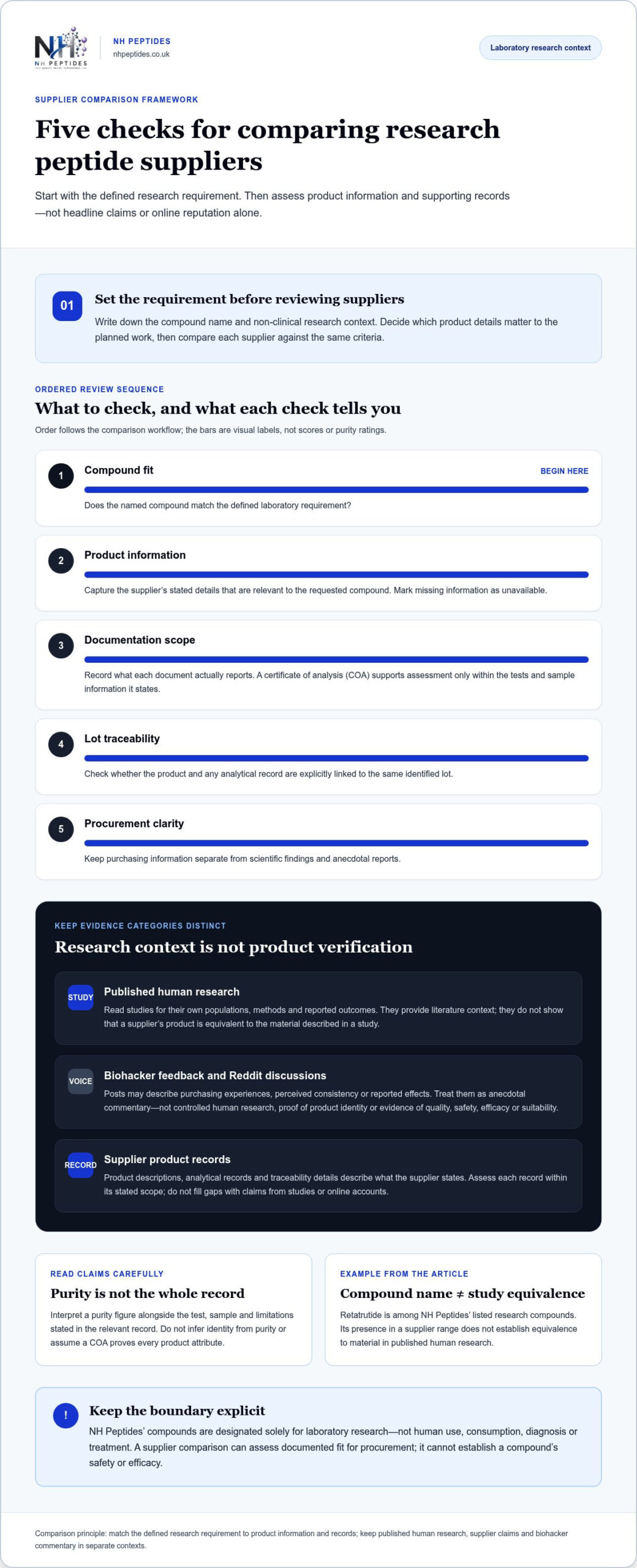
Apply the comparison criteria to a laboratory peptide purchasing decision
A scorecard is useful when it reflects the laboratory’s actual documentation requirements, not when it rewards suppliers for publishing the largest number of files. Suppliers may present different types of information. Apply the same criteria and evidence threshold to each, while recording unavailable fields neutrally. This keeps the assessment consistent without assuming every supplier publishes identical records.
Compare a listed compound against the defined requirement
Retatrutide provides a practical example of how to apply the fields. It is a listed research compound from NH Peptides. Begin by comparing the stated compound name with the requirement recorded for the study. Then review the product information and any records provided for that specific product and lot. Do not assume that documents for another compound, or general supplier statements, apply to it.
Before making a procurement decision, note whether the information available addresses each criterion set by the laboratory. A record that does not identify a lot cannot be treated as lot-specific evidence. An absent field should be marked unavailable, not interpreted as either a positive or negative result. The comparison establishes what information has been documented against the requirement; it does not establish details that the source does not provide.
For broader laboratory research context, the article Research Peptides can be considered alongside the scorecard. Keep that general context separate from product-specific procurement records.
Keep purchasing decisions within laboratory scope
Base the decision on fit with the defined research requirement, the relevance and clarity of product records, and the purchasing information provided. Do not give extra weight to therapeutic claims, popularity or online anecdotes. Published human research may inform general literature context, but it does not show that a supplier’s product is equivalent to material described in a study.
Biohacker commentary can be recorded as anecdotal feedback about reported purchasing experiences or perceived consistency. Discussions on biohacker peptide supplier feedback and peptide supplier reviews are not product records or scientific evidence. They cannot verify a product lot, identity, purity, safety or efficacy. Keep this material separate from the procurement assessment, and exclude human-use suitability, administration, dosing and treatment outcomes from the comparison.
NH Peptides compounds are for laboratory research only, not for human use, consumption, diagnosis or treatment. To assess listed compounds against a defined research requirement, review NH Peptides research compounds.
Choose a research peptide supplier using documented criteria
A defensible purchasing decision follows a short sequence: confirm product fit, examine relevant records, assess procurement clarity, then document the basis for the decision. A research peptide supplier comparison can show how the information provided aligns with a laboratory’s defined requirements. It cannot establish unreported product attributes, clinical suitability, safety or efficacy.
Document the basis for the supplier decision
Record the criteria applied to each supplier and the source reviewed for each finding. Keep product information, supplier assertions and product-specific analytical documentation in distinct entries. Note missing or ambiguous details in the laboratory’s procurement record, alongside any decision about whether those gaps affect the defined requirement.
Published research citations belong in a separate literature section. They describe research reported in a publication, not the identity or properties of a supplier’s product. Likewise, informal online discussion should not be merged with analytical records. Biohacker feedback can offer anecdotal accounts of reported purchasing experiences or perceived consistency, but it is not scientific or product-specific verification. For example, biohacker supplier discussions should be logged, if relevant, as commentary only.
Use a final decision record that states what was established and what remains unresolved. This supports a traceable procurement rationale without converting incomplete information into a positive or negative product claim.
Review NH Peptides within the same comparison framework
NH Peptides is a UK-based supplier serving independent researchers and laboratory facilities nationwide. Its listed compounds, including Retatrutide, are research products only. They are not for human use, consumption, diagnosis or treatment. Apply the same product-fit and documentation criteria used for other suppliers, and base any conclusion on the information relevant to the specific product and lot under review.
The comparison can establish whether the available product information and records address the laboratory’s stated procurement criteria. It cannot prove that a research compound will produce a particular result, establish equivalence to material used in published human research, or support human administration or treatment. Popularity and testimonials do not extend what the documentation establishes.
For a final review, confirm that the compound name aligns with the research requirement, that relevant records support the details being relied upon, and that procurement information is sufficiently clear for the laboratory’s process. Preserve any evidence gaps in the decision record rather than resolving them through inference. This keeps the conclusion limited to what was actually reviewed.
View NH Peptides research peptides and assess the listed research compounds against your defined laboratory criteria.
Make the next procurement decision evidence-led
Use the comparison record as a working reference for future procurement. Note which criteria were decisive, where evidence was incomplete and what documentation the research requirement depends on. This makes the next research peptide supplier comparison more consistent without turning a supplier statement or online account into proof.
Biohacker commentary can remain a separate contextual source. Online biohacker feedback is anecdotal and does not establish product identity, quality, safety or efficacy. Keep it distinct from supplier records and published research.
NH Peptides is a UK-based supplier serving independent researchers and laboratory facilities nationwide. Its research compound range includes Retatrutide, and products are designated solely for laboratory research, not human use or treatment. Review the relevant product information against your laboratory’s defined requirements.
Review NH Peptides research compounds and continue your assessment using documented criteria. A clear record supports a more disciplined procurement decision.
Frequently Asked Questions
Can a certificate of analysis prove that a research peptide is suitable for a study?
No. A certificate of analysis can document specified results for the sample or batch it identifies, but it cannot decide whether those results meet a particular study’s requirements. Suitability depends on the laboratory’s protocol and acceptance criteria. For example, if a protocol requires a particular identity check, a document that reports only a purity result may not address that requirement.
Does a high purity result confirm peptide identity?
No. Purity and identity are separate analytical questions. A high reported purity value alone doesn’t establish that the material is the named peptide. Check which measurement the record describes and whether it reports identity evidence separately. If identity is a required criterion but the record doesn’t address it, note the gap rather than treating the purity figure as a substitute.
How should laboratories compare peptide supplier documentation?
Use a shared record for every supplier and capture the document title, issue date or identifier, compound name, lot reference, stated test and result. In a research peptide supplier comparison, also record whether each item is a supplier statement or a result documented in a specific record. This format helps procurement staff retrieve the evidence later and identify records that need review when requirements change.
Can biohacker feedback verify a research peptide supplier?
No. Biohacker feedback is anecdotal commentary, not independent verification of a supplier’s product or a specific lot. Online biohacker discussions may describe individual purchasing experiences or perceptions, but they don’t establish identity, purity, safety or efficacy. Consider such posts separately from scientific publications and procurement records, and don’t use personal accounts to infer suitability for human use.
Is a research peptide supplier’s product equivalent to material used in a clinical study?
Not on the basis of a shared compound name alone. A publication describes the material and study conditions reported by its authors; a supplier product is a separate item unless its own records establish relevant characteristics. Do not infer that the two materials are interchangeable or equivalent. Published clinical findings provide literature context, not confirmation of a supplier product’s identity, provenance or performance.
What should a laboratory do when supplier records don’t answer a comparison criterion?
Mark the criterion as unresolved and record exactly what is absent, such as a missing lot reference or an unreported test. Then assess whether that information is required by the study protocol or the laboratory’s procurement process. If it is essential, defer a decision that depends on it until the requirement can be addressed. Keep the gap visible in the procurement record rather than estimating or assuming an answer.
