
Uncategorized
Troubleshooting Peptide Solubility Issues: A Research-Focused Guide

Oct
A peptide that dissolves clearly has not, on appearance alone, been shown to have the expected identity or quality. When troubleshooting peptide solubility issues, start by recording exactly what you observe and the conditions in which you observe it. That makes it easier to distinguish a visible change from a verified explanation.
Researchers may look to published human studies and informal biohacker feedback for context. Human studies report findings within a defined research setting, while community feedback is anecdotal. Neither establishes the identity, purity, solubility or suitability of a particular research compound. Keep those sources separate from laboratory observations and analytical evidence.
This guide offers a non-prescriptive way to review solubility observations. It covers the material and experimental details to record, how to compare evidence, and common interpretation mistakes. It is about research compounds and evidence-aware assessment, not instructions for human use.
Key Takeaways
- Distinguish incomplete dissolution, visible particles, turbidity, precipitation and colour change in your records.
- Compare material characteristics with solvent composition, pH, ionic strength and temperature before suggesting a cause.
- Use a documented sequence for troubleshooting peptide solubility issues, separating observations from explanations.
- Assess supplier records, published methods and analytical results according to what each can establish.
- Interpret published human research separately from anecdotal biohacker feedback; neither replaces compound-specific evidence.
Peptide solubility issues: define the observation before diagnosing it
Solubility describes how much of a compound dissolves in a specified solvent system under defined conditions. It is not a fixed visual property that can be judged without context. Record the material and the conditions alongside the observation. Peptides differ in sequence and structure; a general overview of peptide structure provides background, but cannot predict the behaviour of a specific sample.
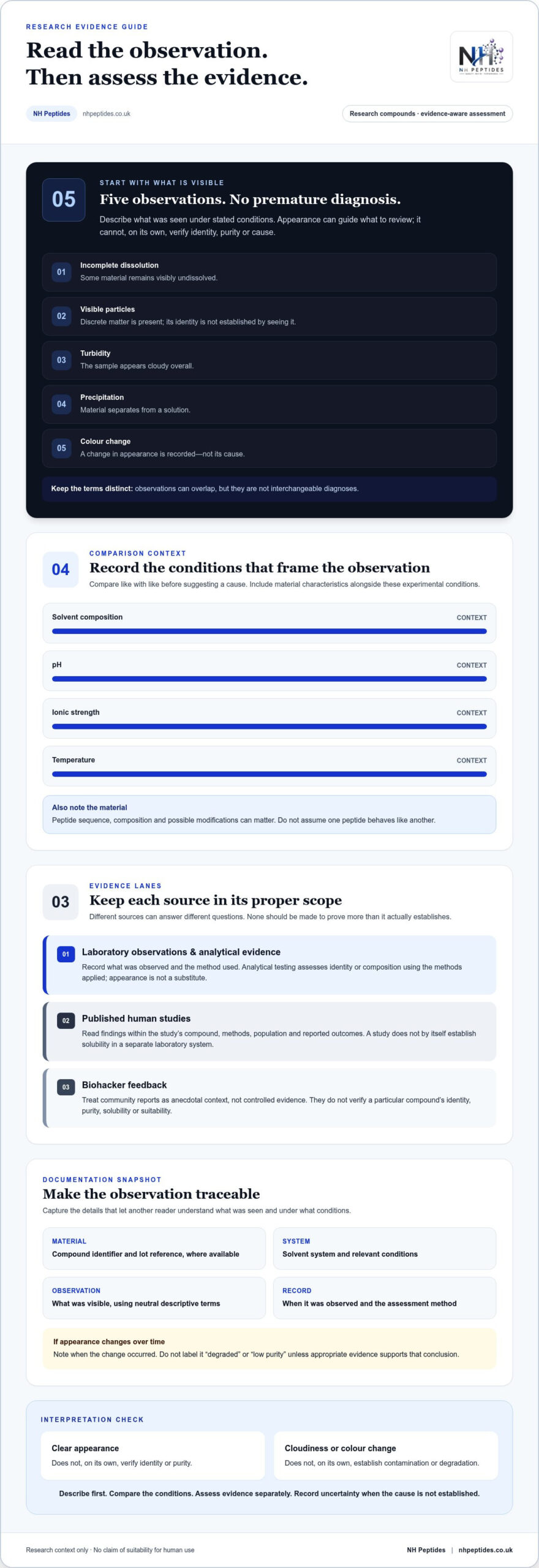
Use precise, neutral terms. Incomplete dissolution means some material remains visibly undissolved. Visible particles describes discrete matter without identifying it. Turbidity means the sample appears cloudy overall. Precipitation describes material separating from a solution. Colour change records a change in appearance, not its cause. These observations can overlap, but they are not interchangeable diagnoses.
Appearance describes what was seen under stated conditions; analytical testing assesses identity or composition using the methods applied. A clear sample does not verify identity or purity. Cloudiness or colour change alone does not establish contamination or degradation. Use appearance to guide what records to review, not as a substitute for evidence about the material.
Record the observation without interpreting it prematurely
Describe what is directly visible, using terms such as clear, cloudy, particulate or precipitated. Record the compound identifier and lot reference where available, the solvent system, and when the observation was made. Include relevant conditions and the method used to assess the sample. If an observation changes over time, note when that change occurred rather than labelling it “degraded” or “low purity”. Use those conclusions only when appropriate evidence supports them. This keeps the observation traceable and leaves its explanation open to review.
Separate laboratory evidence from human research context
Published human research reports findings from a defined study. It does not, by itself, validate a product-preparation protocol or establish solubility. Read a study for the compound, methods and outcomes it actually covers, and keep its findings separate from laboratory observations. Public biohacker feedback may be noted as anecdotal context, but it is not controlled evidence and does not verify identity, purity, solubility or suitability.
For research peptides, document what was seen, then assess material records and relevant analytical evidence separately. Our research peptide quality documentation guide explains how to review the supporting records. During troubleshooting peptide solubility issues, neither a favourable appearance nor an informal report confirms product quality. If the evidence does not establish a cause, record that uncertainty rather than presenting a possible explanation as fact.
Why research peptides may show different solubility behaviour
Peptide structure can affect interactions with a solvent, but it cannot establish how a particular material will behave in a specific system. Amino-acid composition, charge distribution and hydrophobicity are possible factors. Sequence differences mean that observations should not be generalised from one compound to another. Solvent composition, pH, ionic strength and temperature also help define the context for interpreting reported behaviour.
Peptide properties that can influence observed behaviour
Amino-acid composition affects the interactions a peptide may have with its surroundings. Sequence differences or modifications may therefore matter when comparing compounds. Aggregation is one possible explanation for persistent visible material, but appearance alone cannot diagnose it. A specific solubility profile needs compound-specific evidence, not an assumption based on a related peptide.
Published human research can show what was investigated and how findings were reported in a defined study. Read it for the compound and outcomes actually examined, rather than using it to infer solubility in a separate laboratory system. Informal biohacker feedback is anecdotal context, not controlled research or evidence of identity, quality, solubility or suitability. Neither source establishes that research compounds are intended for human use.
Experimental context and literature interpretation
For laboratory comparisons, record solvent composition, pH, ionic strength and temperature where available. These details help establish whether two observations or methods are meaningfully comparable. They are not a formulation or preparation recommendation. A human study may provide context for a research question, but its findings cannot establish behaviour under laboratory conditions that the study did not assess.
Interpret human-study publications within their methods, population and reported outcomes. Avoid extending findings beyond that scope. Biohacker commentary may highlight questions people discuss, but often lacks the detail needed for a scientific comparison. Keep it separate from published evidence. Neither anecdotal reports nor human-study outcomes replace a laboratory assessment of the specific compound and conditions.
When troubleshooting peptide solubility issues, treat peptide properties and experimental conditions as variables to document and evaluate, not as a basis for unsupported predictions. This keeps human-research context, informal feedback and laboratory evidence distinct.
Compare likely causes before changing the experimental interpretation
Human-study findings and informal reports can prompt different questions about a peptide, but neither directly explains a laboratory observation. Read published findings within the study context; treat biohacker feedback as anecdotal commentary, not controlled evidence. Then compare the laboratory record with evidence relevant to the material and conditions in question. The examples below show what to review and where interpretation should stop.
Observation: Particles or persistent visible material.
Variable class: Material characteristics.
Evidence to review: Compound identifier, lot reference, available material records and relevant analytical results.
Interpretation limit: The appearance does not identify the material or establish a cause.
Observation: Incomplete dissolution or cloudiness.
Variable class: Solvent context.
Evidence to review: The documented solvent system and the conditions reported in any study being compared.
Interpretation limit: A finding under different conditions cannot explain this observation on its own.
Observation: A difference between reports or observations.
Variable class: Environmental conditions.
Evidence to review: Whether the pH, ionic strength, temperature and methods are comparable.
Interpretation limit: Different conditions limit comparison; they do not prove a cause.
Observation: Conflicting descriptions across sources.
Variable class: Measurement and reporting limitations.
Evidence to review: Whether each source is a human study, supplier record, analytical result or informal account, and what it actually assessed.
Interpretation limit: Different evidence types are not equivalent and cannot be combined into a verified conclusion.
Material-related observations versus condition-related observations
Human-study reports and biohacker accounts may describe findings or personal impressions, but they do not resolve a lot-specific laboratory question. Before comparing either source with a laboratory record, check whether the material and conditions are identified. Missing or conflicting identifiers indicate a traceability gap, not proof of compromised material. Do not present community claims as analytical findings.
What analytical records can and cannot establish
Analytical results may support conclusions about the specific sample and property assessed. LC-MS, for example, may contribute to identity assessment when appropriately interpreted, but does not independently establish solubility in every system. Published human research and anecdotal feedback have different limits; neither substitutes for evidence about the particular laboratory conditions. During troubleshooting peptide solubility issues, keep each source within its evidential scope.
Troubleshoot peptide solubility issues with a documented review sequence
A consistent review sequence helps separate direct observations from explanations proposed afterwards. It also makes the reasoning easier to trace when reviewing laboratory records or published methods. This is a documentation framework, not a preparation protocol. Experimental decisions should follow validated study methods and relevant institutional laboratory procedures.
A practical review sequence for laboratory records
- Describe the observation. Record the visible state using neutral wording, such as cloudy or particulate, and note when it was observed. Keep possible causes out of the description.
- Identify the material. Record the compound identifier and lot reference where available. If an identifier is absent or inconsistent, flag the traceability limitation instead of inferring a material defect.
- Capture the method context. Refer to the experimental record, including the stated solvent system and conditions. Do not fill gaps with assumptions or details from a different method.
- Compare with records. Review available compound documentation and relevant published methods. Check whether the material and conditions are comparable before using a report to interpret the observation.
- Assess the evidence and report uncertainty. Separate what was directly observed from explanations that remain untested. State which variables are unresolved and what the evidence can and cannot establish.
Repeatability depends on recorded conditions and comparable evidence. Without both, a difference between observations cannot reliably be attributed to a specific variable.
When evidence remains inconclusive
Available observations may not distinguish between plausible causes. Visible material, for example, may not show whether the explanation relates to material characteristics, experimental conditions or the limits of observation. Report that uncertainty directly. Do not treat a plausible explanation as a confirmed finding without supporting evidence.
Where an experimental decision is required, use validated study methods and appropriate institutional scientific oversight. Human-study publications provide context for their reported findings, not instructions for laboratory handling. Informal biohacker feedback is anecdotal and does not prove a material’s identity, quality or suitability. Neither source resolves an experimental question without evidence relevant to the specific material and conditions.
Keep the scope explicit: research peptides supplied for laboratory studies are not for human use or consumption, and are not intended for diagnosis or therapeutic treatment. This review sequence supports careful interpretation; it does not establish how a product will perform in every system.
For research-focused procurement, review research peptide offerings alongside the records relevant to the intended laboratory study.
Use research documentation to assess peptide solubility claims
Documentation supports traceability by helping establish which material, records and experimental context a claim concerns. It does not guarantee that a peptide will behave identically across different solvent systems or laboratory conditions. When troubleshooting peptide solubility issues, assess each source according to what it can establish rather than treating all statements as equivalent evidence.
Assess claims against the evidence type
Published research reports findings from a defined study, using its stated material, methods and conditions. Human-study findings may provide scientific context, but do not establish a laboratory preparation protocol or show how a separate sample will behave.
Supplier documentation can support traceability when it identifies the material and provides records relevant to the supplied compound. Read each record within its stated scope. A description or accompanying record does not, by itself, prove solubility under every experimental condition.
Analytical results address the question examined by the stated method. Their value depends on the sample, method and interpretation. Do not extend a result to claims about conditions it did not assess.
Biohacker feedback is anecdotal and uncontrolled. Public accounts may describe individual experiences, but do not verify product identity, purity, solubility or suitability. Treat them as informal commentary, not a substitute for primary research or analytical evidence. They must not be interpreted as indicating that research peptides are intended for human use.
Do not repeat claims about purity, solubility or performance as established facts unless the evidence directly supports them. A human study, supplier description, laboratory method and online account each have different evidential limits. Clear attribution preserves those distinctions.
Keep procurement and research context distinct
For general context, the Research Peptides guide can be read alongside the methods and records relevant to a laboratory study. Quality-documentation references can help when assessing traceability and the scope of analytical evidence. A record may link material to its documentation, but cannot establish behaviour in an experimental system it did not examine.
When citing published human research, interpret it within its study design and stated outcomes. When discussing biohacker feedback, label it as anecdotal and keep it separate from controlled research. Neither source establishes a product-preparation method or supports claims about a specific research compound without appropriate evidence.
NH Peptides supplies research compounds for laboratory studies, including Retatrutide. Explore research peptides for laboratory studies as part of documentation-aware research procurement.
Carry evidence-led review into your next study
Use each solubility observation to strengthen the research record. A consistent description, clear material references and relevant experimental context make later comparisons more useful, even when the cause remains unresolved. This keeps troubleshooting peptide solubility issues focused on evidence rather than assumptions based on appearance.
Published human research and anecdotal biohacker feedback can provide context, but neither establishes how a specific research compound will behave in a laboratory system. Keep each source within scope, and base experimental decisions on validated methods and appropriate institutional oversight.
NH Peptides is a UK-based supplier of research compounds for laboratory studies. Its offerings include research peptides and Retatrutide, strictly not for human use or consumption, and not for diagnosis or treatment. View research peptides for laboratory studies.
Clear records make the next review more defensible. Continue with a documented, evidence-aware approach.
Frequently Asked Questions
Can peptide solubility vary between compounds with different amino-acid sequences?
Yes. Different sequences can interact differently with a solvent, so observations for one compound should not automatically be applied to another. Related compounds may also differ in sequence modifications or other material characteristics relevant to a study. For a meaningful comparison, use records that identify the compound and the conditions assessed. A prediction based on sequence alone is not a substitute for compound-specific evidence.
Does a cloudy appearance prove that a peptide has degraded?
No. Cloudiness is a visual observation, not a chemical finding. It does not identify what caused the appearance or establish whether the peptide has changed. Record whether the cloudiness was present initially or developed during the observed period, then review relevant records and analytical evidence. A claim of degradation requires evidence that supports it; appearance alone is insufficient.
Can LC-MS results confirm whether a peptide is soluble in a particular solvent system?
Not by themselves. LC-MS may support identity assessment, but an identity result does not show how much material is dissolved in a particular solvent system. That question requires an appropriately validated method designed to assess the relevant sample and conditions. Interpret results within the method’s stated scope, including what the analysis measured.
What information should a laboratory record when documenting a solubility observation?
Alongside material and condition details, note who made the observation and how it was assessed. If an image or instrument reading was captured, record its file or result identifier and the method used. A later reviewer should be able to distinguish an unaided visual description from an instrument-derived measurement. If an entry is amended, preserve the original and make the change and reason traceable.
Can published human research establish solubility under different laboratory conditions?
No. Human research reports findings from its own study design and does not establish solubility under laboratory conditions that were not assessed. A study may describe a compound in a particular research context, but it cannot automatically validate behaviour in a different solvent system, analytical method or experimental setting. Use such publications for relevant research context, not as a substitute for evidence addressing the laboratory question.
Are biohacker reports reliable evidence of peptide solubility?
No. Public biohacker reports are anecdotal accounts, not controlled assessments of a sample’s solubility. They may omit the material identity, experimental conditions and method needed to interpret an observation. Treat them as informal commentary, not as a way to verify identity, purity or suitability. They also do not establish that research peptides are intended for human use or provide instructions for such use.
Does a certificate of analysis report solubility as well as identity or purity?
Not necessarily. A certificate of analysis reports the tests and results within its stated scope; do not assume solubility was assessed unless it is explicitly included. Review the material or lot identifier, named test, result and any stated method details. A certificate may support interpretation of the tests reported, but does not establish behaviour in every experimental system.
