
Scientific Research
Troubleshooting Inconsistent Peptide HPLC Results: A Practical Diagnostic Workflow

Oct
What if the cause of inconsistent peptide HPLC results is not the column, but a change made during sample preparation or system setup? Shifts in retention time, peak area or peak shape can have several causes. Troubleshooting becomes slower when multiple variables are changed at once. A controlled sequence helps distinguish sample variation from method or instrument variation.
This practical workflow for troubleshooting inconsistent peptide HPLC results starts with sample and preparation records, then covers mobile-phase handling, column condition and instrument performance. For each symptom, it suggests checks that help isolate one variable at a time. Record observations, adjustments and resulting chromatograms so that conclusions remain traceable. HPLC findings describe the sample under the stated method conditions. They do not, by themselves, confirm molecular identity or establish anything about human use.
Key Takeaways
- Define the change first: retention time, peak area, peak shape, resolution or signal. Compare like with like.
- Review sample identity, preparation records, diluent and handling before changing chromatographic conditions.
- Use the observed symptom to prioritise checks of the mobile phase, column and instrument. Test one variable at a time.
- Preserve the original method, chromatograms and sequence records to support traceable troubleshooting.
- Interpret chromatographic consistency within its analytical limits. It does not alone establish peptide identity or biological effect.
Start peptide HPLC troubleshooting by defining the inconsistent result
Start with the chromatographic observation, not a suspected cause. Record whether retention time, peak area, peak shape, resolution or signal presence changed. Describe the direction: earlier or later elution, higher or lower area, a broader or narrower peak, or loss of the expected signal. This gives troubleshooting a clear starting point and prevents an observation from being mistaken for its explanation.
Retention drift is a change in when a peak elutes; peak-area variation is a change in its integrated detector response. Either can occur without the other. Peak shape describes an individual peak’s profile, while resolution describes the separation between neighbouring peaks. The High-performance liquid chromatography (HPLC) overview explains how separation and detection produce a chromatogram.
Classify the result before changing the method
Compare replicate injections with the established method and its applicable system suitability criteria. Record whether the deviation occurs once or recurs, and whether it affects one analyte, several peaks or the whole chromatogram. A single irregular injection is different from a progressive shift across a sequence. Keep the observed symptom separate from any suspected cause.
Published human-study literature can provide context about how an analytical method was used in a particular study. Compare reported method conditions only when relevant to the method under investigation. A published result does not establish why a separate chromatogram changed or provide evidence about supplied research materials. Biohacker commentary is also anecdotal context, not sample-specific analytical evidence.
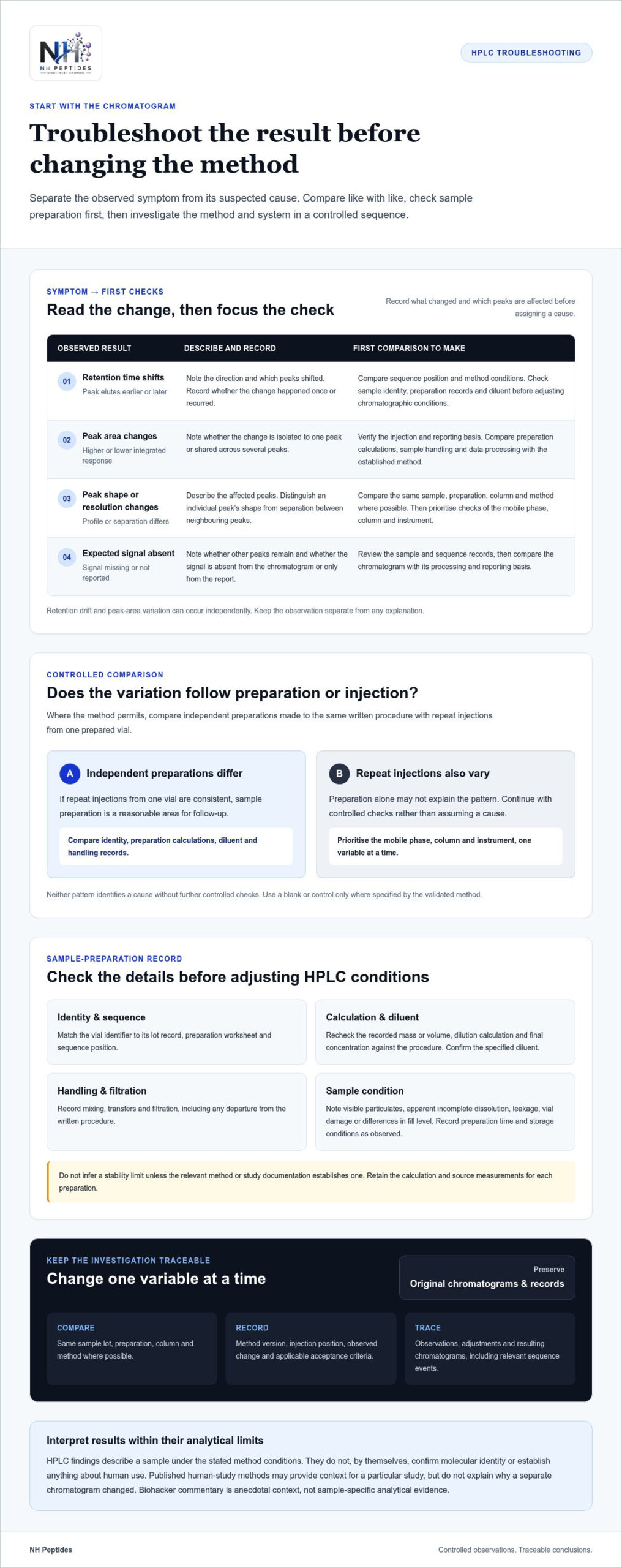
Use a symptom-to-check record to keep the assessment focused:
- Retention time shifts: record the direction and affected peaks; compare sequence position and method conditions.
- Peak area changes: note whether the change is isolated or shared; verify the injection and reporting basis.
- Peak shape or resolution changes: describe the affected peaks before assigning a cause.
- Expected signal is absent: note whether other peaks remain and whether the signal is absent from the chromatogram or only the report.
Establish a reliable comparison baseline
Where possible, compare the same sample lot, preparation record, column and method. Confirm that chromatograms use the same processing and reporting basis, including the integration approach required by the procedure. A numerical difference is difficult to interpret if the sequence, sample handling or data processing also changed.
Review sequence order and instrument logs for changes before the first affected injection. Record relevant timestamps, distinguishing documented events from possible explanations. A useful baseline identifies the sample and preparation, method version, column, injection position, observed change and applicable acceptance criteria. Preserve the original chromatograms and records before intervening. This makes later comparisons more reliable and keeps observations distinct from conclusions drawn from human-study literature or biohacker accounts.
Check peptide sample preparation before adjusting HPLC conditions
Review sample preparation before changing chromatographic conditions. A retention shift or area difference may reflect a mismatch in sample identity, preparation calculation, diluent, handling or timing rather than a change in the HPLC system. First compare the sample record with the approved procedure and analytical sequence. Keep the established method unchanged during this check.
Review preparation records and sample condition
Match each vial identifier to its lot record, preparation worksheet and sequence position. Recheck the recorded mass or volume, dilution calculation and final concentration against the procedure. Confirm that the specified diluent was used and that preparation steps were completed in the recorded order. A transcription error or vial-position mismatch can make sound chromatographic data appear inconsistent with the intended sample.
Inspect the prepared sample and vial. Record visible particulates, apparent incomplete dissolution, leakage, damage or differences in fill level. Note mixing, transfer and filtration steps, including any departure from the written procedure. Record preparation time and storage conditions as observed. Do not infer a stability limit unless the relevant method or study documentation establishes one.
Test sample-related causes systematically
Where the method permits, compare independent preparations made according to the same written procedure with repeat injections from one prepared vial. If independent preparations differ while repeat injections from one vial are consistent, preparation is a reasonable area for follow-up. If repeat injections also vary, preparation alone may not explain the pattern. Neither result identifies a cause without further controlled checks.
Use a blank or control only where specified by the validated method. Review its result alongside the sample chromatograms and record whether the relevant signal is present. Do not substitute a different blank or control without documenting the change, as that alters the comparison.
- Diluent: record the specified and actual diluent, including any documented deviation.
- Concentration: retain the calculation and source measurements for each preparation.
- Filtration: record whether filtration was performed and the procedure used.
- Vial and handling: note vial type, transfers, mixing and visible sample condition.
Change one preparation variable at a time, and only within the approved procedure or a controlled investigation. For example, if filtration differs between records, compare preparations under otherwise matched conditions before investigating another factor. Preserve chromatograms, integration reports and preparation records for each comparison. This helps distinguish sample-related variation from later instrument or chromatographic checks.
For research programmes using peptide materials, consistent lot identification and preparation records support traceable analytical work. NH Peptides supplies research peptides for scientific studies. These materials are for research use only, not human use.
Distinguish mobile-phase, column, and instrument causes
After reviewing sample preparation, compare the chromatography setup with the established method. Mobile-phase composition or handling, column condition and instrument performance can produce overlapping symptoms. Treat each as a possibility to investigate, not a diagnosis. Record the evidence for and against each possibility before making a controlled change.
Identify mobile-phase and column differences
Check solvent and additive identities, preparation sequence, recorded composition, storage and batch details against the method. Note any deviation rather than assuming a fresh preparation is equivalent to the previous one. Confirm the installed column’s identity and documented use history. Review the prescribed equilibration and recorded temperature control before attributing a retention shift to sample composition. Do not alter method conditions outside the approved procedure.
Use the chromatogram’s pattern to prioritise checks while keeping observations separate from explanations:
- Retention changes across several peaks: compare mobile-phase records, equilibration, temperature records and sequence timing.
- Pressure trend differs from the established run: inspect the column history and flow path for documented changes or maintenance events.
- One peak changes shape or separation: compare column identity and history, then review the relevant method and instrument records.
- Signal is absent across samples: review injection events, detector settings and system logs before assigning a sample-specific cause.
These are prompts for prioritising checks, not proof of a cause. A pressure difference, for example, is an observation to investigate, not confirmation that the column is responsible. Retain the original chromatograms and logs so the basis for each follow-up check remains clear.
Use peak behaviour to narrow instrument checks
Describe broadening, tailing, fronting, splitting and absent peaks as separate observations. Check whether the pattern is confined to one sample or recurs across the sequence. If it persists across different samples, review the injection sequence and instrument status, then inspect accessible tubing and connections for visible leaks or disturbance. Compare detector settings and maintenance records with the established configuration.
Peak shape can help prioritise checks, but it does not prove a cause. A split peak should prompt a documented review of the sample, column and flow path, not an immediate column replacement. Broadening alone cannot distinguish a sample-related effect from a system-related change. Use the symptom to select the next test, then change one variable at a time and assess the chromatogram using the same reporting basis.
For research involving peptide materials, method records and material documentation serve different purposes and should be assessed independently. NH Peptides supplies research peptides for laboratory studies. This describes research materials, not HPLC testing or a guarantee of analytical results.
Apply a controlled workflow to isolate the cause
A defensible investigation starts by preserving the original conditions. Retain the method version, chromatograms, sequence table, sample preparation records and instrument status before intervening. Include the time of the first affected injection and any relevant log entries. This gives you a reference point for judging whether a controlled change altered the symptom, rather than relying on recollection after several adjustments.
Order checks around the observed pattern. Start with records and sample checks, then assess mobile-phase preparation and handling. Review column identity, history and equilibration, followed by temperature records and instrument components where indicated. This is a practical sequence, not a universal fault hierarchy. If the pattern clearly points to a particular check, document why you prioritised it.
Run controlled comparisons in a fixed order
For each test, retain the original reference condition and change only one variable. Keep the sample, sequence position, processing settings and other method conditions consistent where possible. Compare the resulting chromatogram with the original for the same peak attribute and direction of change. If investigating a mobile-phase record, for example, do not also replace the column in that comparison. Several simultaneous changes may improve the result, but they prevent you from identifying which change mattered.
Repeat the relevant comparison according to the applicable method or investigation plan. Assess whether the original observation has resolved, persists or changed form. One improved injection is not enough to establish repeatability. Record departures from the planned sequence and any conditions that could limit interpretation. Changes to an approved method or system should follow the laboratory’s applicable procedures.
Record evidence without overstating conclusions
Document each intervention with its rationale, date, operator, conditions, chromatographic outcome and repeatability. Separate direct observations from interpretation. “Retention time returned to the reference range after mobile-phase replacement” describes an observation. “The previous mobile phase caused the shift” is a root-cause conclusion that requires supporting evidence. If the cause remains uncertain, say so and identify what evidence is still needed.
- Observed: peak area decreased in the affected sequence.
- Checked: preparation record and injection sequence reviewed.
- Changed: one variable under documented conditions.
- Compared: repeat chromatogram assessed against the same reference.
- Conclusion: outcome and unresolved uncertainty recorded separately.
Keep analytical troubleshooting records distinct from published human-study literature and anecdotal biohacker feedback. Neither type of context identifies the cause of a chromatographic change in a tested sample. For product context, NH Peptides supplies research peptides for laboratory studies. View the research peptide range; supplied peptides are not for human use.
Interpret peptide HPLC results within their analytical limits
A reproducible chromatogram shows that the method produced a consistent response under the recorded conditions. It does not, by itself, establish every property of the sample. Retention time and peak area are method-dependent observations. Interpretation relies on appropriate controls, documented processing and the method’s stated purpose. Keep that distinction in mind when assessing results and deciding what further evidence an analytical conclusion requires.
Separate chromatographic performance from identity claims
HPLC separates detected components under defined conditions. A peak at an expected retention time is not independent confirmation of identity. Similarly, a purity percentage based on chromatographic peak areas describes the relative response of detected components under that method. It does not establish the amount of peptide in the material, detect every possible non-UV-absorbing component, or demonstrate biological activity or safety.
Where identity confirmation is required, an orthogonal technique such as mass spectrometry may be included in the analytical plan. The appropriate evidence depends on the question being tested and the validated procedures in use. Do not extend a single chromatogram, or a purity value without its method and reporting context, into claims the analysis does not support.
Keep literature and anecdotal context clearly labelled
Published human-study literature describes the materials, methods and findings of the relevant study. It can provide context for an analytical method only when the method is directly comparable. It is not evidence about a separate research material or its documented results, and it is not an instruction for use. Keep literature references distinct from sample-specific analytical records.
Biohacker discussions about peptides are anecdotal commentary. Posts may include reports about certificates of analysis, documentation and perceived quality, but they are not verified HPLC data, identity confirmation or evidence of product suitability. Treat each post as an individual account, not a validated finding or a claim about supplied research materials. Such feedback does not establish intended use; supplied peptides are not for human use.
Review research peptide information
For a defensible conclusion, state what the chromatogram demonstrates, what remains uncertain and whether the study plan requires additional analysis. Tie the method result to the tested sample and conditions. NH Peptides supplies research peptides for scientific studies. The results of this workflow are not an analysis of supplied products or a guarantee of a particular analytical outcome. Supplied peptides are not for human use, consumption, diagnosis or treatment.
- Define the observed chromatographic change.
- Check sample records before changing HPLC conditions.
- Compare mobile-phase, column and instrument evidence systematically.
- Change one variable at a time and record the outcome.
- Keep analytical findings separate from identity, biological-effect and anecdotal claims.
Review research peptides for laboratory studies.
Carry the findings into the next analytical run
Use the investigation to strengthen the decision record for the next run. Define in advance which chromatographic observations require review, what reference condition you will use and what evidence is needed before assigning a root cause. This makes troubleshooting inconsistent peptide HPLC results a repeatable quality practice rather than a sequence of undocumented adjustments.
Keep conclusions proportionate to the data. A consistent chromatogram supports confidence in method performance under the conditions tested; it does not establish every property of a research material. Published human-study findings and anecdotal biohacker commentary are separate forms of context, not substitutes for sample-specific analytical evidence. Research peptides supplied by NH Peptides are for scientific studies only, not for human use, consumption, diagnosis or treatment.
For the next stage of laboratory research, review the relevant product information against your study requirements and documentation needs.
Review research peptides for laboratory studies. Apply the same measured approach to each new result to keep analytical decisions clear and defensible.
Frequently Asked Questions
Why does peptide retention time change between HPLC runs?
Retention time can shift when effective separation conditions differ between runs. Compare mobile-phase composition, column temperature, flow conditions and equilibration history with the method record. Check whether the same column and method version were used. A shift across several peaks may point to a broader system or method difference, while a change limited to one peak may reflect selectivity or sample-related factors. Treat these patterns as clues, not diagnoses.
Can inconsistent peak area occur when retention time is stable?
Yes. Peak area can vary even when retention time is reproducible. Review the injection record, sample concentration and preparation calculations, then check whether detector settings and integration parameters were consistent. Changed integration boundaries, for example, can alter reported area without changing elution time. Compare raw chromatograms with the processing method, not only the final result table. Interpret area changes against the controls and reporting basis defined for the method.
What causes a peptide HPLC peak to split or tail?
A split or tailing peak can arise from sample handling, injection conditions, column condition or interactions within the flow path. Check whether the feature recurs in repeat injections and whether other peaks show similar behaviour. Inspect the original chromatogram and review integration separately. Peak appearance can guide the next check, but it cannot establish a mechanism on its own. Record the observation before selecting a controlled follow-up test.
How can I tell whether carryover is affecting peptide HPLC results?
Where the method permits, examine a blank or control injection after a sample that produced a substantial peak. Compare any signal with the preceding sample’s retention time and appearance, and review the sequence order. A matching signal supports further carryover investigation but does not locate its source. Check injector and wash records, then assess the result against the laboratory’s established criteria.
Does a consistent HPLC purity result confirm peptide identity?
No. A consistent HPLC result indicates repeatable chromatographic behaviour under the method conditions; it does not independently confirm molecular identity. HPLC and mass spectrometry provide different analytical information, so identity assessment may require an orthogonal technique specified by the study plan. A purity value also depends on the method’s detection and reporting basis. It is not evidence of biological activity, safety or suitability for human use.
Should I change several HPLC parameters at once to fix inconsistent results?
No. Changing multiple parameters together obscures which change affected the result. Preserve the original settings, select a check related to the observed symptom and adjust one variable at a time within the approved procedure. Compare the outcome with the same reference condition. If several changes are unavoidable, record each one and its timing so the chromatographic data can be interpreted accurately.
Can biohacker feedback explain inconsistent peptide HPLC results?
No. Community discussions about peptides and certificates of analysis are anecdotal commentary, not analytical records. Posts may describe concerns about documentation or perceived quality, but they cannot identify why a specific chromatogram changed or verify a sample’s properties. Treat each account as unverified, separate it from HPLC results and assess claims against suitable analytical documentation. Research peptides supplied for scientific studies are not for human use, consumption, diagnosis or treatment.
Related NH Peptides research resources
For further background on research compounds and product documentation, see the research reference guide. You can also review the Quality & Testing information and COA resources. For catalogue context, visit the research catalogue. These resources describe supplier information and do not replace a validated analytical method or product-specific evidence.
