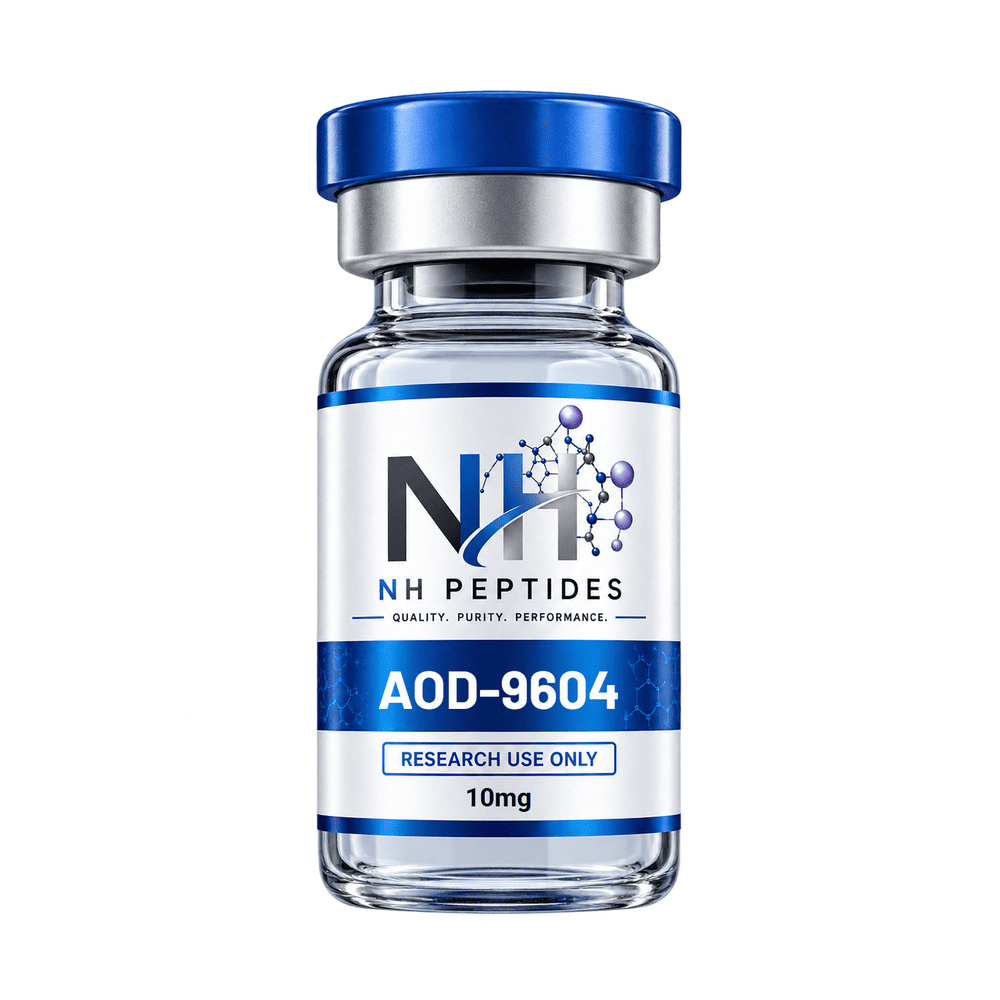
AOD-9604 10mg
£35.00
Synthetic peptide corresponding to a C terminal region of human growth hormone, supplied lyophilised as a reference standard for laboratory research.
- Short hGH sequence fragment, not the intact hormone
- Lot matched certificate of analysis with every order
- Research use only. Not for human or veterinary use
10 in stock
- Research use only Not for human or veterinary use
- Certificate per lot Published against the lot number
- Independently tested RP-HPLC with LC-MS identity
- Restricted sale 18+ qualified researchers only
Certificates of analysis
Every lot is analysed by RP-HPLC with LC-MS identity confirmation. Select a lot to view its full report.
What is AOD-9604?
AOD-9604 is a synthetic peptide corresponding to a short region of the human growth hormone sequence, supplied as lyophilised powder for laboratory research.
AOD-9604 is a fragment, not growth hormone
Human growth hormone is a 191 residue protein. AOD-9604 corresponds to a short C terminal region of that sequence and is a small fraction of its length. It is not human growth hormone, it is not supplied as human growth hormone, and NH Peptides does not supply human growth hormone.
The distinction matters analytically as well as descriptively: a short synthetic fragment and a full length recombinant protein differ by an order of magnitude in molecular weight and are characterised by entirely different methods.
Specification figures for AOD-9604
The sequence, molecular formula and molecular weight for the lot supplied are stated on its certificate of analysis. Published figures for research compounds are not always consistent between sources, so this page defers to the certificate rather than restating a value that may not match the material in the vial.
Analysis and certification
Each lot of AOD-9604 is analysed by an independent laboratory using RP-HPLC with LC-MS identity confirmation before it is released for sale. The certificate of analysis is published against the lot number rather than the product page, so the document you read is the document for the vial you receive.
Research use only
NH Peptides supplies AOD-9604 as an analytical reference standard for laboratory research. It is not supplied for any use in humans or animals, and no information on this page describes or implies any such use.
Purity specification for AOD-9604
Lots are released against a ≥99% purity specification, determined by RP-HPLC peak area. The figure for the lot you receive is stated on its certificate of analysis and may differ from the specification.
A specification is a release threshold, not a description of every lot. Where a measured figure and the specification differ, the certificate is the record that applies to your material. Analytical figures relate to the lot they are published against and carry no implication of suitability for any purpose beyond laboratory research.
| Compound | AOD-9604 |
|---|---|
| Also known as | hGH fragment 176–191 |
| Class | Synthetic peptide, growth hormone sequence fragment |
| Sequence | Stated on the certificate of analysis |
| Amino acids | Stated on the certificate of analysis |
| CAS number | Stated on the certificate of analysis |
| Molecular formula | Stated on the certificate of analysis |
| Molecular weight | Stated on the certificate of analysis |
| Appearance | White to off white lyophilised powder |
| Purity specification | ≥99% |
| Identity method | LC-MS |
| Purity method | RP-HPLC |
| Solubility | Soluble in sterile water and aqueous buffers for analytical preparation |
| Labelled quantity | 10mg |
How AOD-9604 is tested
Two separate analyses are carried out on every lot before it is released, and both appear on the certificate.
RP-HPLC, for purity
Reversed phase high performance liquid chromatography separates the material by hydrophobicity. The main peak is integrated against the total peak area to give the purity figure. This is what the ≥99% specification refers to, and it is a measure of how much of the material is the intended compound rather than related substances, residual reagents or truncated sequences.
LC-MS, for identity
Liquid chromatography coupled to mass spectrometry confirms that the material eluting in the main peak has the expected mass. Purity alone does not establish identity: a lot can be 99% pure and still be the wrong compound. The two analyses answer different questions and both are needed.
What arrives with the order
- The vial, labelled with compound, labelled quantity and lot number
- A dispatch note listing the lot numbers supplied
- A storage and handling sheet
- The certificate of analysis for the lot, published against the lot number
If any of these is missing, or if the lot number on the vial does not match the certificate, contact us before using the material.
Storing AOD-9604
Lyophilised material is shipped under cold chain and should be returned to freezer storage on arrival. Store the sealed vial dry at −20°C or below, protected from light and moisture.
Preparing AOD-9604 stock solutions
Prepare stock solutions in sterile water or an appropriate aqueous buffer for analytical work, at a concentration suited to your assay. Confirm solubility against the certificate of analysis before preparing stocks.
Peptide solutions are less stable than lyophilised powder. Prepare close to the point of use, hold at 2–8°C for short periods only, and avoid repeated freeze and thaw cycles.
Handling and disposal
Assess the hazards of this material before handling and use appropriate controls and protective equipment. It has not been characterised toxicologically and should be treated as potentially hazardous.
Dispose of unused material, vials and packaging lawfully and in line with your institution's waste procedures. Anyone handling the material must be trained and competent to do so.
On receipt
Check the parcel before putting the material away. Three things are worth two minutes:
- Packaging integrity. Confirm the vial is intact, the seal is unbroken and the insulated packaging has not failed in transit.
- Lot number. Check the number on the vial label against the certificate of analysis and against the dispatch note. All three should agree.
- Return to storage. Move the material into its stated storage conditions promptly rather than leaving it at ambient temperature.
If anything does not match, or the packaging has clearly failed, contact us before using the material. Problems visible on arrival should be reported within 7 days so a carrier claim remains possible.
Record keeping
Record the lot number in your notes at the point of first use, alongside the date the vial was opened and the concentration of any stock solution prepared. Certificates are published against the lot number rather than the product, so the lot number is the only reliable link between your results and the analytical data for the material that produced them.
What purity specification does this material meet?
Lots are released against a ≥99% specification, verified by RP-HPLC with LC-MS identity confirmation. The figure for the lot you receive is stated on its certificate of analysis.
How do I match my vial to its certificate?
By lot number. The vial label carries the compound, the labelled quantity and the lot number, and the certificate is published against that same lot number.
Is this human growth hormone?
No. It is a short synthetic peptide corresponding to a region of the hGH sequence, not the 191 residue protein. NH Peptides does not supply human growth hormone.
How is the fragment distinguished from the full protein?
By molecular weight. A short synthetic fragment and a full length recombinant protein differ by an order of magnitude in mass, which LC-MS identity testing confirms directly. The figure for the lot supplied is on its certificate of analysis.
Who is eligible to order?
Sale is restricted to persons aged 18 or over who are qualified researchers, or who purchase on behalf of a research institution, laboratory or business. This website is not an offer to supply to the general public. Full details are in our research use only policy.
Are prices shown with VAT?
Prices are shown in pounds sterling. Any VAT that applies is calculated and displayed at checkout, together with the delivery charge, before you confirm payment.
What happens if the lot changes between orders?
Each lot has its own certificate of analysis. If you reorder and a new lot is in stock, you receive that lot’s certificate. Record the lot number for each order separately.
Do you provide dosing or protocol guidance?
No. We do not provide dosing information, administration guidance or protocol design, by any channel, and we cannot answer questions of that kind. Material is supplied for laboratory research only.
How is it shipped?
Under cold chain in temperature stable, plainly labelled packaging on a tracked UK service. Compound names do not appear on the outer packaging.
Looking for something else?
Tell us the compound and quantity you are looking for and we will confirm availability and lead time. Research use only.
Contact Us