Fantastic product spot on excellent customer service fast delivery, highly recommended ⭐️⭐️⭐️⭐️⭐️
Abbey
Verified customer

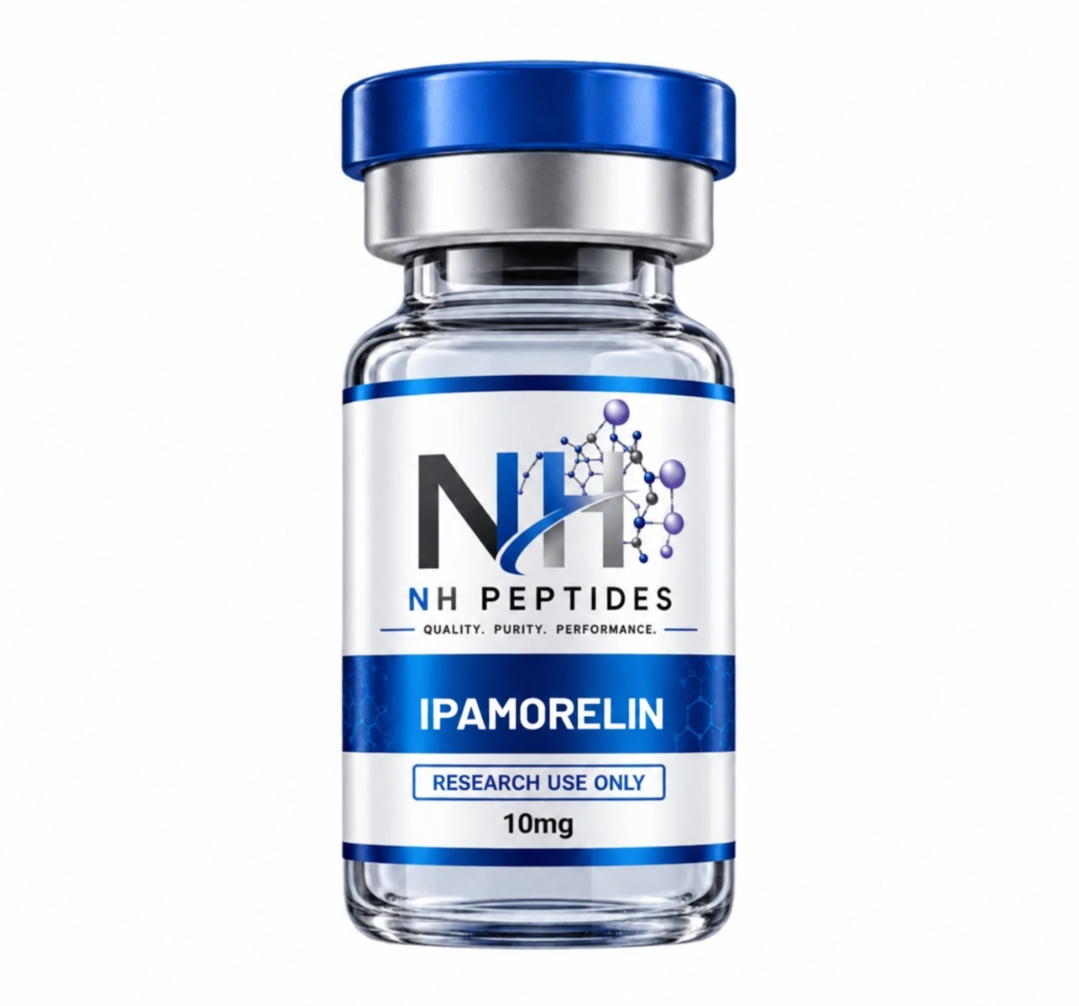
£22.50
Synthetic pentapeptide growth hormone secretagogue, supplied as lyophilised reference material for laboratory research.
8 in stock
Every lot is analysed by RP-HPLC with LC-MS identity confirmation. Select a lot to view its full report.
Ipamorelin is a synthetic peptide that acts as a selective growth hormone secretagogue, supplied in research settings as a lyophilised powder. It is studied for its interaction with the ghrelin receptor (GHS-R1a) and its effects on growth hormone release pathways.
Ipamorelin is a pentapeptide comprising five amino acid residues. Its sequence distinguishes it from other synthetic growth hormone secretagogues and provides the basis for its identification as a separate research compound.
The amino acid sequence, molecular formula and molecular weight for the supplied lot are stated on its certificate of analysis. Published figures can vary between sources and product forms, so the certificate of analysis is the primary reference for the specific material supplied.
Ipamorelin is not authorised as a medicine by the UK Medicines and Healthcare products Regulatory Agency (MHRA). Its regulatory status may vary by jurisdiction, and research-use supply should not be interpreted as authorisation for medical use. NH Peptides supplies this product solely as laboratory research material, not for human or veterinary use.
Each lot of Ipamorelin should be supported by appropriate analytical documentation. Where independent laboratory testing using reverse-phase high-performance liquid chromatography (RP-HPLC) and liquid chromatography–mass spectrometry (LC-MS) has been performed, the results should be recorded on the corresponding certificate of analysis. Certificates should be linked to the relevant lot number so that the documentation can be matched to the material supplied.
NH Peptides supplies Ipamorelin solely as a research reference material for laboratory investigation. It is not supplied for administration to humans or animals, and the information on this page does not describe or imply suitability for such use.
The purity specification for Ipamorelin should be stated in accordance with the supplier’s documented release criteria. Where a lot is specified at ≥99% purity by RP-HPLC peak area, this should be supported by the relevant analytical documentation. The measured result for the supplied lot should be taken from its certificate of analysis.
A purity specification represents a stated release threshold and is not a guarantee that every lot has the same measured result. Where a measured value and the specification differ, the lot-specific certificate of analysis is the reference record for that material. Analytical results relate to the tested lot and do not imply suitability for any purpose beyond the stated laboratory research context.
| Choose size | 10mg |
|---|
| Compound | Ipamorelin |
|---|---|
| Class | Synthetic peptide, growth hormone secretagogue |
| Amino acids | 5 |
| Sequence | Stated on the certificate of analysis |
| CAS number | Stated on the certificate of analysis |
| Molecular formula | Stated on the certificate of analysis |
| Molecular weight | Stated on the certificate of analysis |
| Appearance | White to off-white lyophilised powder |
| Purity specification | ≥99%, where supported by the applicable specification |
| Identity method | LC-MS, where documented |
| Purity method | RP-HPLC, where documented |
| Solubility | Refer to the applicable product and batch documentation |
| Labelled quantity | Per variation, stated on the vial label |
Where the testing has been performed, the certificate of analysis should document the analytical methods used for each lot before release.
Reversed-phase high-performance liquid chromatography (RP-HPLC) separates components of a sample according to their interactions with the chromatographic stationary phase and mobile phase. The relative area of the principal peak can be used to report chromatographic purity by peak-area percentage.
A stated ≥99% specification represents a defined acceptance threshold when supported by the applicable release criteria. Peak-area purity is an analytical measurement and does not, by itself, establish absolute chemical purity or confirm the identity of the compound.
Liquid chromatography coupled with mass spectrometry (LC-MS) can support compound identification by separating sample components and measuring their mass-to-charge ratios. Results can be compared with the expected characteristics of Ipamorelin to support identity confirmation.
Purity and identity are separate analytical questions. A high chromatographic purity result alone does not establish that a sample is Ipamorelin; appropriate identity testing provides complementary evidence. The methods and results applicable to each lot should be recorded in its certificate of analysis.
If documentation is missing or the lot number on the vial does not match the certificate of analysis, contact NH Peptides for clarification before the material is used. The supplied documentation should be checked against the actual product and batch.
Store Ipamorelin in accordance with the storage conditions specified by the manufacturer and the applicable certificate of analysis. Keep the vial sealed and protect the material from moisture and light. If refrigerated or frozen storage is specified, follow the documented temperature requirements and any applicable shipping instructions.
For laboratory analytical work, preparation of Ipamorelin stock solutions should follow the validated procedure for the intended analytical method and the material's supporting documentation. Confirm the appropriate solvent, compatibility and concentration requirements before preparing a solution.
Peptide solutions may have different stability characteristics from lyophilised material. Solution stability depends on factors including solvent composition, temperature, concentration and storage duration. Use documented stability information where available, and avoid repeated freeze–thaw cycles where these may affect sample integrity.
Assess the hazards associated with Ipamorelin before handling and apply appropriate laboratory controls and protective equipment in accordance with your institution's risk assessment. Where toxicological information is incomplete, treat the material cautiously and avoid unnecessary exposure.
Dispose of unused material, vials and packaging in accordance with applicable waste regulations and your institution's procedures. Personnel handling the material should be appropriately trained and competent.
Check the parcel and product documentation before placing the material into storage. Three checks are particularly important:
If any information does not match, or the packaging appears damaged, contact NH Peptides before using the material. Report visible delivery or packaging problems within 7 days of receipt so they can be assessed in line with the applicable delivery and claims procedures.
For laboratory traceability, record the Ipamorelin lot number alongside the date the material is received and, where relevant, the date the vial is opened. If analytical stock solutions are prepared, record the preparation details in accordance with your laboratory's procedures.
Certificates of analysis should be matched to the relevant lot rather than treated as generic documentation for every product unit. Keeping the lot number with your analytical records helps maintain traceability between the material tested and the associated analytical documentation.
The one selected at checkout. It is printed on the vial label and stated on the certificate of analysis.
Prices are shown in pounds sterling. Any VAT that applies is calculated and displayed at checkout, together with the delivery charge, before you confirm payment.
No. We do not provide dosing information, administration guidance or protocol design, by any channel, and we cannot answer questions of that kind. Material is supplied for laboratory research only.
Under cold chain in temperature stable, plainly labelled packaging on a tracked UK service. Compound names do not appear on the outer packaging.
Tell us the compound and quantity you are looking for and we will confirm availability and lead time. Research use only.
Contact Us
Why NH Peptides



Orders leave our Midlands despatch centre in temperature stable, plainly labelled packaging on a tracked UK service.
Researcher Reviews
Feedback from laboratories and independent researchers across the UK on ordering, packaging, delivery and the documentation supplied with each batch. Every review comes from a real customer and is checked by our team before it is published.

Stay informed
Be first to know when a sold out lot returns and when new reference material is added to the catalogue.
We use your address for restock notices only. Unsubscribe in one click. See our privacy policy.

Choose which cookies you allow. You can change your choice at any time using the cookie settings button in the bottom left of the page.
Required for the site to function. They enable basic navigation, security, your basket, checkout, and account login. The site cannot operate without these.
Enable enhanced functionality and personalisation, such as remembering your preferences or live chat widgets.
Help us understand how visitors use the site by collecting and reporting information anonymously. Includes Google Analytics.
Used to track visitors across websites and measure advertising. Includes Google Ads, Meta Pixel, and similar services. These are never set without your consent.