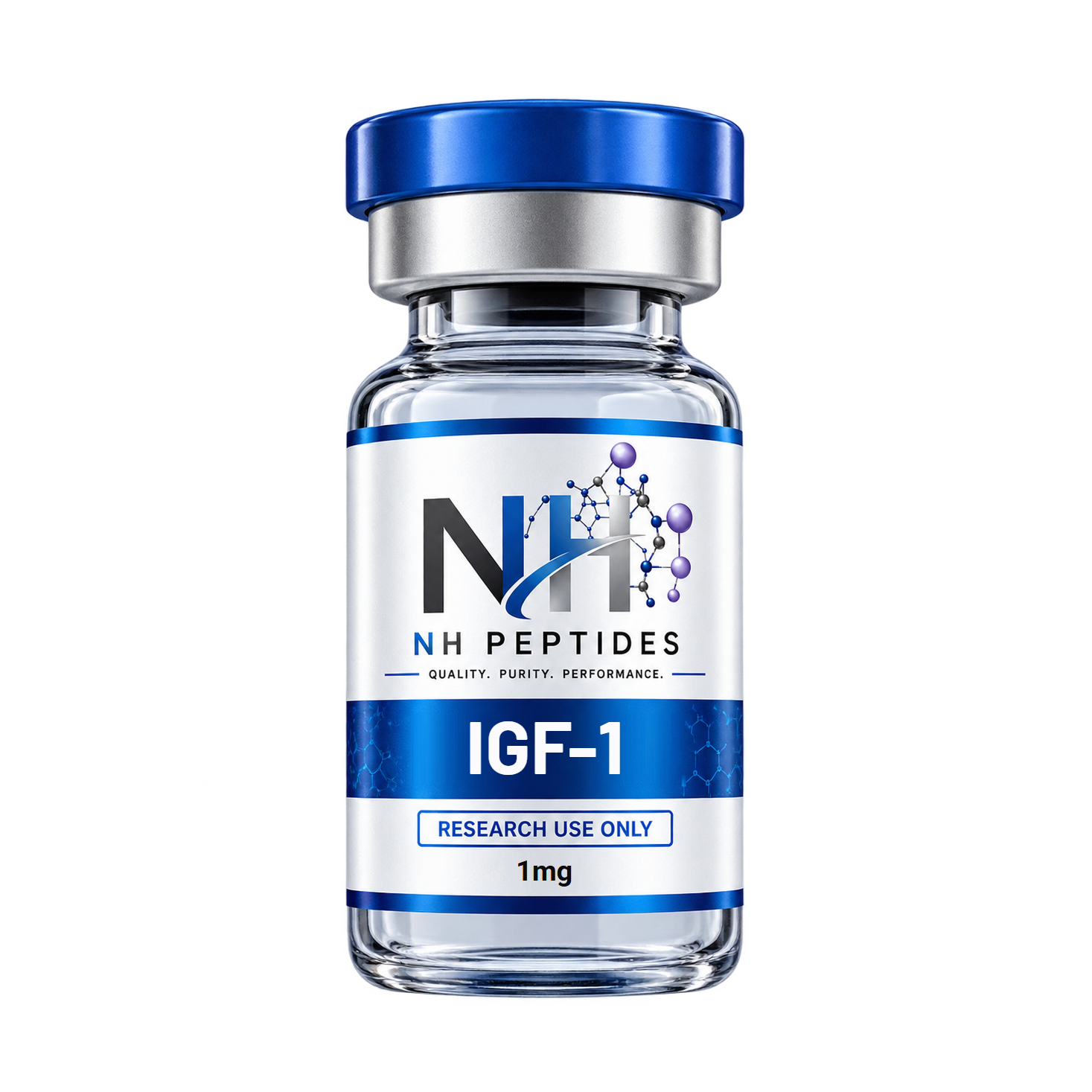
IGF-1 LR3 1mg
£42.50
Recombinant analogue of human insulin-like growth factor 1, supplied as lyophilised powder and used as a reference standard and cell culture supplement in laboratory research.
- 83 residue analogue, expressed recombinantly
- Lot matched certificate of analysis with every order
- Research use only. Not for human or veterinary use
10 in stock
- Research use only Not for human or veterinary use
- Certificate per lot Published against the lot number
- Independently tested RP-HPLC with LC-MS identity
- Restricted sale 18+ qualified researchers only
What is IGF-1 LR3?
IGF-1 LR3, also written Long R3 IGF-1, is a recombinant analogue of human insulin-like growth factor 1. It is supplied as a lyophilised powder for laboratory research and is used both as an analytical reference material and as a supplement in cell culture media.
How the analogue differs from IGF-1
Human IGF-1 is a single chain of 70 amino acid residues. The LR3 analogue carries two modifications and is 83 residues in total. The R3 refers to a single residue substitution, arginine in place of glutamic acid at position 3. The Long refers to a 13 residue extension added at the N terminus. The two changes together reduce the affinity of the molecule for the insulin-like growth factor binding proteins present in serum, which is the property that makes the analogue useful in culture systems where binding protein interference is unwanted. The sequence and the modifications for the material supplied are stated on the certificate of analysis for the lot.
A recombinant protein, not a synthetic peptide
Most of the reference materials in this catalogue are synthetic peptides of fewer than fifty residues, assembled by solid phase synthesis. IGF-1 LR3 is not. It is a recombinant protein, expressed in a host organism and purified from that expression system, and it carries three disulfide bonds that must be correctly formed for the molecule to be what the label states. This matters when reading the certificate. Chromatographic purity describes the proportion of the material that elutes as a single species. For a protein of this size it does not by itself establish correct folding, nor the absence of aggregates or of host cell protein carried through from expression. Read the full certificate rather than a single headline figure, and confirm that the analyses reported are the ones your work requires.
Solubility and handling
IGF-1 LR3 is poorly soluble at neutral pH and is normally reconstituted in dilute acid rather than water or a neutral buffer, then diluted into the working medium. Preparation guidance for the material supplied is on the certificate of analysis and in the storage and handling tab of this listing.
Specification figures
The sequence, molecular weight, expression system, purity, labelled quantity and the analyses performed for the lot supplied are stated on its certificate of analysis. Published figures for research compounds are not always consistent between sources, so this page defers to the certificate rather than restating a value that may not match the material in the vial.
Analysis and certification
Each lot is analysed by an independent laboratory before it is released for sale, and the certificate of analysis is published against the lot number rather than the product page. The document you read is the document for the vial you receive. The methods applied to this lot, and the figures they returned, are stated on that certificate.
Research use only
NH Peptides supplies IGF-1 LR3 as a reference material and cell culture reagent for laboratory research. It is not supplied for any use in humans or animals, and no information on this page describes or implies any such use. Nothing in this listing is a medicinal product, a food, a cosmetic or a cosmetic ingredient.
| Choose Size | 70mg, 80mg |
|---|
| Product | IGF-1 LR3, Long R3 insulin-like growth factor 1 |
|---|---|
| Class | Recombinant protein, analogue of human IGF-1 |
| Length | 83 amino acid residues |
| Modifications | Arginine substituted for glutamic acid at position 3, plus a 13 residue N-terminal extension |
| Disulfide bonds | Three |
| Labelled quantity | 1mg |
| Sequence | Stated on the certificate of analysis |
| Molecular weight | Stated on the certificate of analysis |
| Expression system | Stated on the certificate of analysis |
| Appearance | White lyophilised powder |
| Purity | Stated on the certificate of analysis |
| Analyses performed | Stated on the certificate of analysis |
Reading the certificate for a recombinant protein
The analyses that apply to a recombinant protein are not the same as those that apply to a short synthetic peptide, and this listing states what the certificate reports rather than assuming a fixed method set. Chromatographic purity describes how much of the material elutes as a single species. It does not on its own establish correct disulfide folding, nor the absence of aggregates or of host cell protein carried through from the expression system. Where your work depends on any of those, confirm that the certificate reports them before ordering.
Why no purity figure is printed on this page
Analytical figures relate to the lot they are published against. A figure printed on a product page describes a lot you may not receive. The certificate published against your lot number is the record that applies to your material, and it carries no implication of suitability for any purpose beyond laboratory research.
Storing the lyophilised protein
Lyophilised material is shipped under cold chain and should be returned to freezer storage on arrival. Store the sealed vial dry at −20°C or below, protected from light and moisture. Allow the vial to reach room temperature before breaking the seal, so that moisture does not condense onto the cake. Recombinant proteins are less tolerant of handling stress than short synthetic peptides. Keep the lyophilised material dry, and return it to the freezer promptly after use.
Reconstitution
IGF-1 LR3 is poorly soluble at neutral pH. It is normally reconstituted in dilute acid, commonly 10mM hydrochloric acid or dilute acetic acid, rather than in water or a neutral buffer, and then diluted into the working medium. Confirm the reconstitution guidance on the certificate of analysis for your lot before preparing stocks, since it takes precedence over any general guidance here. Introduce solvent slowly against the vial wall rather than directly onto the cake, and allow the material to dissolve without agitation. Do not vortex. Vigorous agitation promotes aggregation and denaturation in proteins of this size.
Working solutions
Prepare working dilutions immediately before use. At low concentrations protein adsorbs onto glass and plastic surfaces, which reduces the concentration actually delivered, and a carrier protein is commonly added to dilute solutions for that reason. Confirm carrier compatibility with your assay before adding one. Avoid repeated freeze and thaw cycles. Aliquot the reconstituted stock into single use volumes at the point of preparation rather than returning a working stock to the freezer more than once.
General handling
Handle as an uncharacterised research chemical using standard laboratory precautions. Wear appropriate personal protective equipment, avoid the generation of dust when handling the lyophilised cake, and dispose of the material and its containers in accordance with the rules that apply at your institution and under the law of your jurisdiction. This material is supplied for laboratory research only. It is not for human or veterinary use.
What does LR3 mean?
It describes the two modifications the analogue carries relative to human IGF-1. The R3 is a single residue substitution, arginine in place of glutamic acid at position 3. The Long is a 13 residue extension at the N terminus. Human IGF-1 is 70 residues, the LR3 analogue is 83.
Is this the same molecule as IGF-1?
No. It is an analogue of human IGF-1, not the native sequence. The two differ by the substitution and the N-terminal extension described above. The sequence supplied is stated on the certificate of analysis for the lot.
Why is no purity figure shown on this page?
Because analytical figures relate to the lot they are published against, and a figure printed on a product page describes a lot you may not receive. The certificate published against your lot number is the record that applies to your material.
How should it be reconstituted?
In dilute acid rather than water or a neutral buffer, since the protein is poorly soluble at neutral pH, then diluted into the working medium. Confirm the guidance on the certificate of analysis for your lot before preparing stocks, and see the storage and handling tab.
Why does the certificate look different from your peptide certificates?
Because this is a recombinant protein rather than a short synthetic peptide, and different analyses apply. Chromatographic purity does not on its own establish correct disulfide folding or the absence of aggregates and host cell protein. If your work depends on any of those, confirm the certificate reports them before ordering.
Can I use it as a cell culture supplement?
It is supplied as a reference material and cell culture reagent for laboratory research. Whether it suits a given culture system is a question for your own qualification work, and nothing on this page states or implies suitability for any particular application.
How do I match my vial to its certificate?
By lot number. The vial label carries the product, the labelled quantity and the lot number, and the certificate is published against that same lot number.
How is it shipped?
In temperature stable, plainly labelled packaging on a tracked UK service. Compound names do not appear on the outer packaging.
Who is eligible to order?
Sale is restricted to persons aged 18 or over who are qualified researchers, or who purchase on behalf of a research institution, laboratory or business. This website is not an offer to supply to the general public. Full details are in our research use only policy.
Are prices shown with VAT?
Prices are shown in pounds sterling. Any VAT that applies is calculated and displayed at checkout before you place the order.
Looking for something else?
Tell us the compound and quantity you are looking for and we will confirm availability and lead time. Research use only.
Contact Us