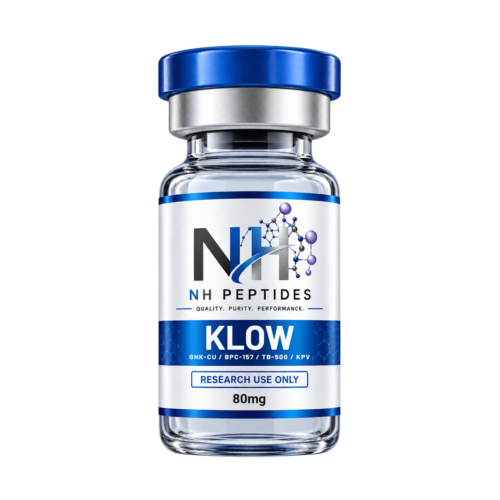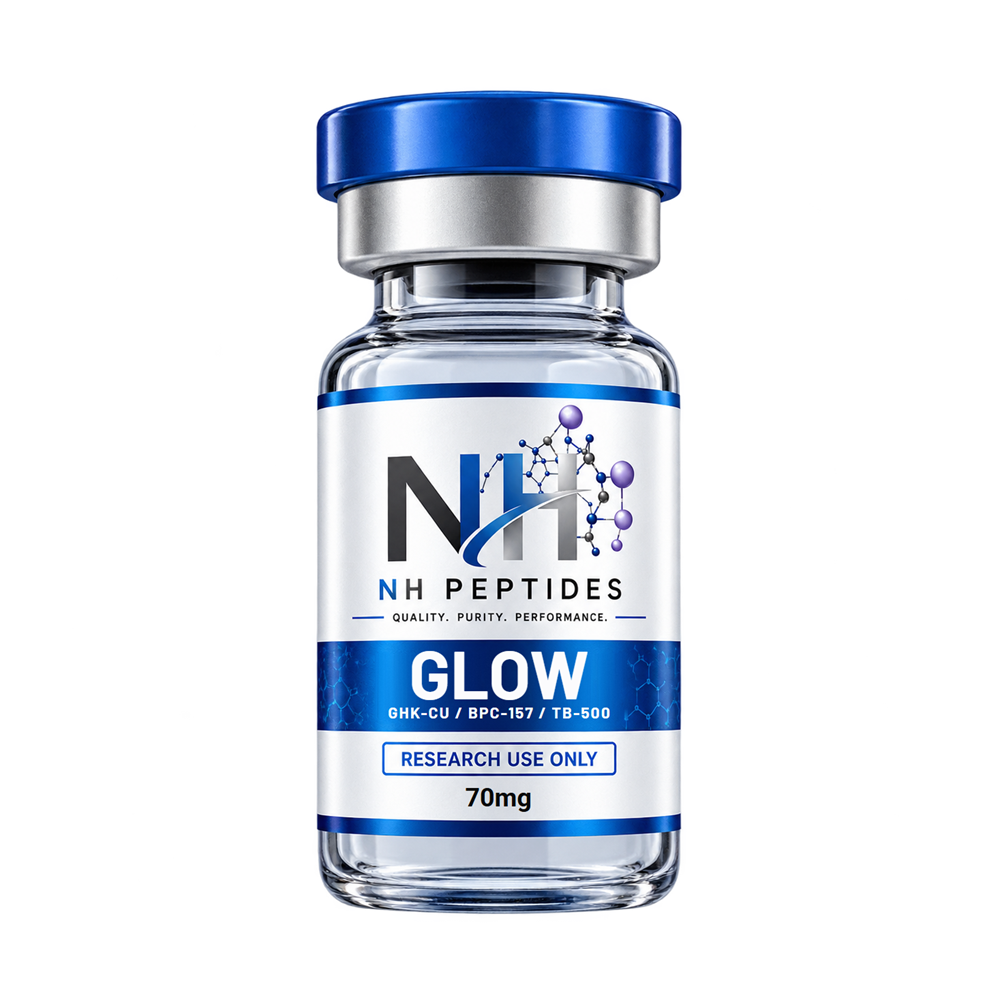
GLOW – 70mg
£50.00
Three component peptide mixture, co-lyophilised in a single vial and supplied as a reference standard for laboratory research.
- GHK-Cu, BPC-157 and TB-500 at a fixed stated ratio
- Lot matched certificate of analysis with every order
- Research use only. Not for human or veterinary use
11 in stock
- Research use only Not for human or veterinary use
- Certificate per lot Published against the lot number
- Independently tested RP-HPLC with LC-MS identity
- Restricted sale 18+ qualified researchers only
Certificates of analysis
Every lot is analysed by RP-HPLC with LC-MS identity confirmation. Select a lot to view its full report.
What is the GLOW or the GHK-Cu / BPC-157 / TB-500 Blend?
This is a three component mixture supplied as lyophilised powder for laboratory research. The three peptides are synthesised separately and then co-lyophilised into a single vial at a fixed stated ratio.
Components
GHK-Cu is a coordination complex formed between the tripeptide glycyl-L-histidyl-L-lysine and a copper ion. BPC-157 is a synthetic pentadecapeptide, a fifteen residue sequence corresponding to a partial fragment of a protein described in gastric juice. TB-500 corresponds to the acetylated actin binding region of thymosin beta-4.
The designation TB-500 is applied inconsistently across the supply chain. Some suppliers use it for the acetylated fragment and others for the full length protein. The certificate of analysis for the lot confirms which species is present by LC-MS.
The copper complex
GHK-Cu is a metal complex rather than a free peptide, and it behaves accordingly. The blue tint that appears once the material is taken into solution comes from the copper and is the most direct visual indication that the complex is intact. Loss of that colour indicates the complex has been disturbed, usually by pH extremes, vigorous agitation or a competing chelating agent in the buffer.
Because a metal is present, the certificate of analysis for this product carries an elemental analysis in addition to the peptide analyses.
Why a co-lyophilised mixture
A mixture prepared from one cake enters solution in a single step rather than being combined from three separately weighed and diluted stocks. For comparative work that includes a mixture condition alongside single compound conditions, this removes one source of preparation variance between the arms.
The ratio is fixed at the point of manufacture and cannot be varied after supply. Where a design requires the three concentrations to vary independently, the single compound listings are the correct format instead.
Specification figures for the blend
The component quantities, sequences, molecular formulae and molecular weights for the labelled quantity and lot supplied are stated on its certificate of analysis. The two labelled quantities in this listing do not carry the same component split, so the certificate for the specific variation you order is the record that applies. Published figures for research compounds are not always consistent between sources, so this page defers to the certificate rather than restating a value that may not match the material in the vial.
Working with a multi component reference
Purity and identity are established per component rather than for the mixture as a whole, so a single figure does not describe this material. Read each component line on the certificate separately. Net peptide content per component is also stated there, and it is the figure to work from when calculating concentrations rather than the total labelled quantity.
Analysis and certification
Each lot of the blend is analysed by an independent laboratory using RP-HPLC with LC-MS identity confirmation before it is released for sale. Both analyses are carried out per component, and an elemental analysis is carried out for the copper complex. The certificate of analysis is published against the lot number rather than the product page, so the document you read is the document for the vial you receive.
Research use only
NH Peptides supplies this blend as an analytical reference material for laboratory research. It is not supplied for any use in humans or animals, and no information on this page describes or implies any such use. Nothing in this listing is a cosmetic or a cosmetic ingredient.
| Choose Size | 70mg, 80mg |
|---|
| Product | GHK-Cu / BPC-157 / TB-500 Blend |
|---|---|
| Class | Co-lyophilised three component peptide mixture |
| Components | GHK-Cu, BPC-157 and TB-500 |
| Component quantities | Per variation, stated on the certificate of analysis |
| Sequences | Stated on the certificate of analysis |
| CAS numbers | Stated on the certificate of analysis |
| Molecular formulae | Stated on the certificate of analysis |
| Molecular weights | Stated on the certificate of analysis |
| Appearance | White to off white lyophilised powder, blue in solution |
| Purity specification | ≥99% per peptide component |
| Identity method | LC-MS, per component |
| Purity method | RP-HPLC, per component |
| Elemental analysis | Carried out for the copper complex, stated on the certificate of analysis |
| Labelled quantity | Per variation, stated on the vial label |
How the blend is tested
Every lot is analysed before release and the results appear on the certificate. Identity is confirmed by LC-MS against the expected mass for each sequence. Purity is determined by RP-HPLC peak area. An elemental analysis is carried out in addition, because one component is a metal complex rather than a free peptide.
The peptide analyses are reported per component. A multi component reference does not have a single purity figure, so the certificate carries one line per component rather than one figure for the vial.
Purity specification for the blend
Lots are released against a ≥99% purity specification applied to each peptide component individually, determined by RP-HPLC peak area. The figures for the lot you receive are stated on its certificate of analysis and may differ from the specification.
A specification is a release threshold, not a description of every lot. Where a measured figure and the specification differ, the certificate is the record that applies to your material. Analytical figures relate to the lot they are published against and carry no implication of suitability for any purpose beyond laboratory research.
Storing the blend
Lyophilised material is shipped under cold chain and should be returned to freezer storage on arrival. Store the sealed vial dry at −20°C or below, protected from light and moisture.
Allow the vial to reach room temperature before breaking the seal, so that moisture does not condense onto the cake.
Preparing stock solutions
Prepare stock solutions in sterile water or an appropriate aqueous buffer for analytical work, at a concentration suited to your assay. Confirm solubility against the certificate of analysis before preparing stocks.
Introduce solvent slowly against the vial wall rather than directly onto the cake, and allow the material to dissolve without agitation. Do not vortex. Copper complexes are sensitive to vigorous agitation and to extremes of pH, and will dissociate if the buffer contains a competing chelating agent. Confirm buffer compatibility before preparing stocks if the copper complex needs to stay intact for your assay.
The blue colour that appears on reconstitution comes from the copper and indicates the complex is intact. Loss of colour indicates it has been disturbed.
Because the vial holds three components, concentrations should be calculated from the per component net peptide content on the certificate rather than from the total labelled quantity. All three components enter solution together and cannot be separated after reconstitution.
Peptide solutions are less stable than lyophilised powder. Prepare close to the point of use, hold at 2–8°C for short periods only, and avoid repeated freeze and thaw cycles. Adsorption to plastic surfaces can reduce effective concentration in dilute working solutions, so use low binding consumables where the assay is sensitive to this.
Handling and disposal
Assess the hazards of this material before handling and use appropriate controls and protective equipment. It has not been characterised toxicologically and should be treated as potentially hazardous. Note that one component contains a metal and should be assessed on that basis as well as as a peptide.
Record the lot number from the vial label in your own inventory alongside the certificate of analysis, storage temperature and disposal route, so that your records remain auditable after the order closes.
Dispose of unused material, vials and packaging lawfully and in line with your institution’s waste procedures. Do not dispose to drain.
Do the 70mg and 80mg vials contain the same component split?
No. The two labelled quantities do not carry the same split between the three components. The certificate of analysis for the variation you order states the component quantities for that vial, and it is the record to work from.
Why does the solution turn blue?
The colour comes from the copper in the GHK-Cu complex and indicates that the complex is intact. Loss of colour indicates it has been disturbed, usually by pH extremes, vigorous agitation or a competing chelating agent in the buffer.
Which molecule is supplied as TB-500?
The certificate of analysis for the lot confirms the species present by LC-MS. The designation is used inconsistently across the supply chain, sometimes for the acetylated actin binding fragment of thymosin beta-4 and sometimes for the full length protein, so the certificate rather than the product name is the record to work from.
Can the ratio between the components be changed?
No. The ratio is fixed at the point of co-lyophilisation and cannot be varied after supply. If your design requires the three concentrations to vary independently, the single compound listings are the correct format.
Why is there no single purity figure for this product?
Because purity and identity are established per component rather than for the mixture as a whole. The certificate carries one line per peptide component, and each is assessed against the specification separately. An elemental analysis is reported in addition, because one component is a metal complex.
What purity specification does this material meet?
Lots are released against a ≥99% specification applied to each peptide component individually. The figures for the lot you receive are stated on its certificate of analysis.
How do I match my vial to its certificate?
By lot number. The vial label carries the product, the labelled quantity and the lot number, and the certificate is published against that same lot number.
How is it shipped?
In temperature stable, plainly labelled packaging on a tracked UK service. Compound names do not appear on the outer packaging.
Who is eligible to order?
Sale is restricted to persons aged 18 or over who are qualified researchers, or who purchase on behalf of a research institution, laboratory or business. This website is not an offer to supply to the general public. Full details are in our research use only policy.
Are prices shown with VAT?
Prices are shown in pounds sterling. Any VAT that applies is calculated and displayed at checkout, together with the delivery charge, before you confirm payment. The total shown at checkout is the total you pay.
Looking for something else?
Tell us the compound and quantity you are looking for and we will confirm availability and lead time. Research use only.
Contact Us